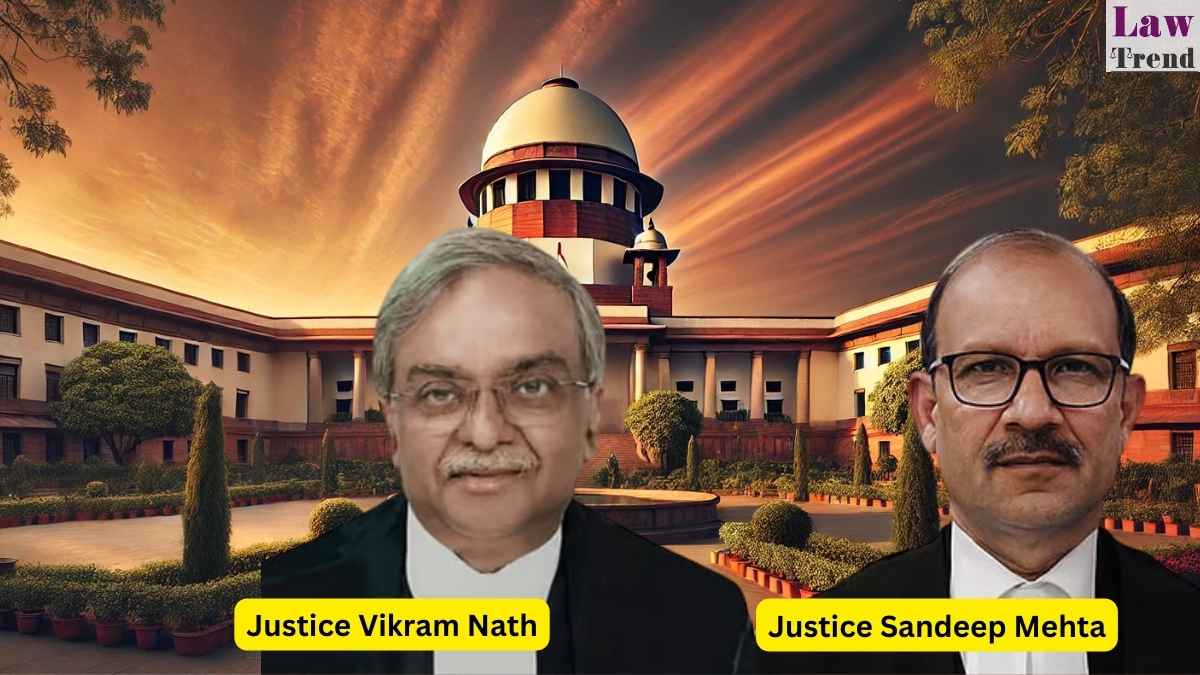
In a significant ruling clarifying the statutory boundaries of insolvency protection, a Supreme Court bench comprising Justice Vikram Nath and Justice Sandeep Mehta held that a moratorium declared under Section 14 of the Insolvency and Bankruptcy Code, 2016 (IBC) operates exclusively against the corporate debtor and does not extend protection to co-respondents such as promoters, directors, associated companies, or landowners. Setting aside an order of the National Consumer Disputes Redressal Commission (NCDRC) that had adjourned a homebuyer complaint sine die against all parties, the apex court directed the Commission to proceed with the hearing of the complaint against non-debtor co-respondents in accordance with law.
Background of the Case
The matter originated from a residential project named ‘Mantri Manyata Energia’, developed by Respondent No. 1, Mantri Technology Constellations Private Limited (now known as Buoyant Technology Constellations Private Limited). The appellants, who are homebuyers, entered into construction agreements and agreements for sale in 2016 for an undivided share in the project land, with possession promised on or before December 31, 2018.
Despite paying substantial sale consideration, the homebuyers were not handed over possession within the stipulated timeframe. Aggrieved by the delay, the appellants and other homebuyers instituted Consumer Case No. 13 of 2023 before the NCDRC, alleging deficiency in service and unfair trade practices against seven respondents:
- Respondent No. 1: The developer company (Corporate Debtor).
- Respondent No. 2: Mantri Developers Pvt. Ltd., an associated company.
- Respondent Nos. 3 to 5: Promoters and directors of Respondent Nos. 1 and 2.
- Respondent Nos. 6 & 7: Landowners of the project land.
During the pendency of the consumer complaint, the National Company Law Tribunal (NCLT), Bengaluru Bench, admitted an application under Section 9 of the IBC against Respondent No. 1 on August 23, 2024, initiating the Corporate Insolvency Resolution Process (CIRP) and imposing a moratorium under Section 14 of the IBC.
Following this, the homebuyers filed applications (I.A. No. 14200 of 2024 and I.A. No. 15656 of 2024) before the NCDRC, praying that the consumer complaint proceed against Respondent Nos. 2 to 7 notwithstanding the moratorium operating against Respondent No. 1. On January 20, 2025, the NCDRC rejected the applications, holding that the liability of Respondent Nos. 2 to 7 could not be independently examined at that stage as the alleged deficiency pertained to Respondent No. 1 with whom the agreements were signed, and adjourned the consumer complaint sine die. The homebuyers challenged this decision before the Supreme Court.
Contentions and Arguments
Counsel for the homebuyers urged the Supreme Court to allow the consumer complaint and grant the relief claimed therein. Conversely, senior counsel appearing for the various respondents raised objections including lack of privity of contract, maintainability of the consumer complaint, and the absence of any independent obligations under the executed agreements.
Supreme Court’s Analysis and Precedents
Analyzing Section 14 of the IBC, the Supreme Court stressed that the purpose of a moratorium is limited and statutory in nature. The Court observed:
“The object of this moratorium is to preserve the assets of the corporate debtor during the insolvency resolution proceedings and to facilitate an orderly resolution.”
The Court emphasized that adjudicating authorities cannot expand the statutory scope of Section 14:
“The scope of the moratorium is statutory. It is not open either to the adjudicating authority or the Court to enlarge its ambit beyond what the statute contemplates. A plain reading of the provision makes it clear that the moratorium operates against the corporate debtor alone. No other category, whether it be any subsidiary company, any managers/ directors, personal guarantors etc. can be added to it unless specifically provided.”
To support its conclusion, the bench referred to precedent cases explicitly discussed in the judgment:
- P. Mohanraj v. Shah Brothers Ispat Pvt. Ltd. (2021): The Supreme Court had held that Section 14 applied only to the corporate debtor and that natural persons remain liable under law.
- Ansal Crown Heights Flat Buyers Association v. Ansal Crown Infrabuild Pvt. Ltd. (2024): The apex court held that a moratorium against a corporate debtor does not protect its promoters and directors, and proceedings against them can continue.
- Saranga Anilkumar Aggarwal v. Bhavesh Dhirajlal Sheth & Ors. (2025): The Court reaffirmed that “the protective sweep of a moratorium must remain in the four walls as carved out by the statute. It ought not be expanded in a manner that stultifies remedies envisaged under the Consumer Protection Act, unless expressly provided.” The bench added that “The object of the Code is to facilitate the resolution process and not to eclipse the statutory remedies.”
Faulting the reasoning of the NCDRC, the apex court noted that while the Commission claimed liability was yet to be determined, it prematurely concluded that deficiency was attributable only to Respondent No. 1:
“In doing so, the Commission effectively answered the very question which was yet to be adjudicated.”
The Court further clarified:
“The question that fell for consideration while deciding the interlocutory applications was not whether Respondent Nos.2 to 7 were liable. The question was whether, in the absence of any moratorium operating in their favour, the consumer complaint could proceed against them.”
“In the absence of any such statutory bar, the Commission was required to adjudicate the complaint against the said respondents and determine, upon consideration of the rival pleadings and objections, whether any liability could ultimately be fastened upon them. It was not open to the Commission to foreclose that inquiry at the interlocutory stage.”
Court Decision
The Supreme Court declined the homebuyers’ request to decide the main consumer complaint on merits directly, holding that preliminary objections such as maintainability and privity of contract must first be decided by the NCDRC.
Partly allowing the civil appeals, the Supreme Court set aside the rejection of I.A. No. 15656 of 2024 and I.A. No. 14200 of 2024 and allowed both applications. The apex court directed the NCDRC to resume and hear Consumer Complaint No. 13 of 2023 against Respondent Nos. 2 to 7 in accordance with law, while clarifying that proceedings against Respondent No. 1 will remain governed by the Section 14 IBC moratorium.
Case Details
Case Title: Tejas J. Shah & Amisha T. Shah & Ors. v. Mantri Technology Constellations Pvt. Ltd.
Case No.: Civil Appeal Nos. 4289-4290 of 2025
Bench: Justice Vikram Nath and Justice Sandeep Mehta
Date: July 27, 2026