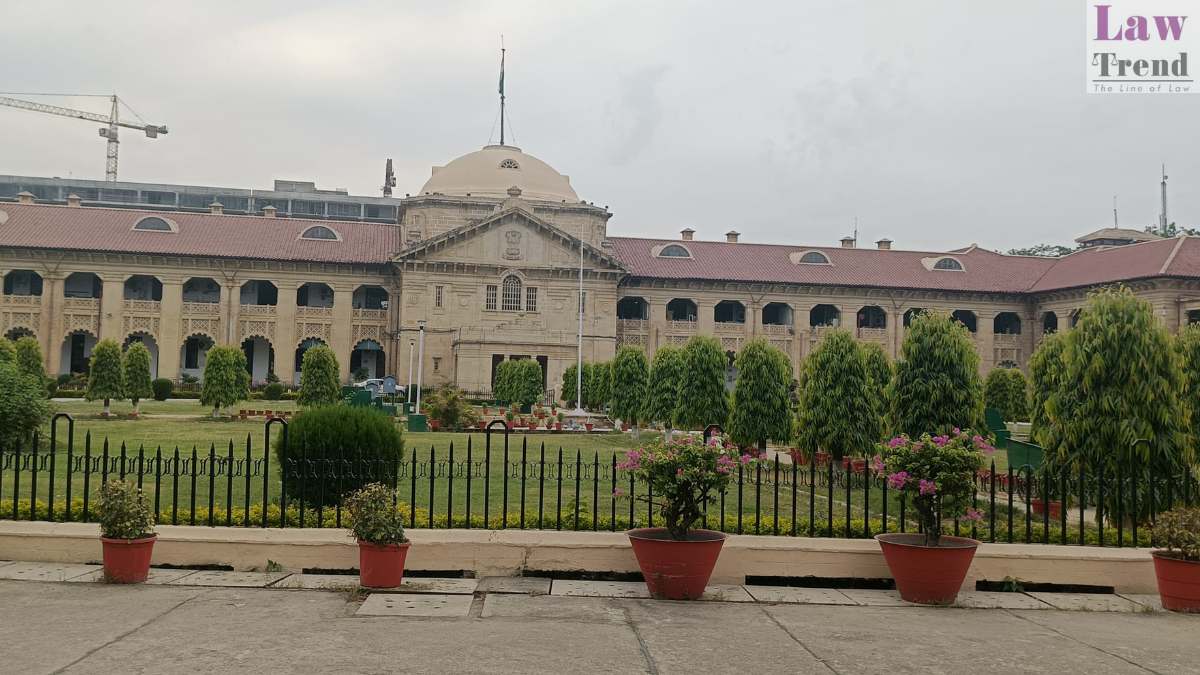
The Allahabad High Court has ruled that the absence of a distinct charge under Section 302 of the Indian Penal Code (IPC) simpliciter does not invalidate a conviction if the accused had clear notice of the specific overt act alleged against them and suffered no prejudice during trial. A Division Bench comprising Justice Siddharth and Justice Vinai Kumar Dwivedi laid down this principle while dismissing a criminal appeal arising out of a 1988 land dispute violence in Mirzapur. The Court upheld the conviction and life imprisonment of an appellant for murder, along with the conviction of three other surviving appellants for attempt to murder and rioting.
Background of the Case
The case stems from an incident that took place on October 24, 1988, at around 7:30 A.M. in Village Chitawanpur, District Mirzapur. According to the written report lodged by informant Fakruddin (PW-1), his maternal grandfather Jasim Khan (PW-3) and Akilu (PW-2) were ploughing plot No. 1387 using a tractor. Accused Babu Khan arrived at the spot and objected to the ploughing. Following an altercation, Babu Khan ran to his house, threatening to return with a gun.
Shortly thereafter, Babu Khan returned with 17 other individuals, armed with guns, country-made pistols (kattas), and spears (ballams). Upon Babu Khan’s instigation, the group opened fire on Jasim Khan, Akilu, Rahimuddin, Karimuddin, Hakimuddin, and Hasnain. Akilu hid behind the tractor and escaped unhurt, while others sustained firearm injuries.
Hearing the commotion, Badruddin, Sharif Khan, Ashraf alias Guddu, and informant Fakruddin rushed to the spot. The assailants challenged them and fired another volley of gunshots, injuring all four. Badruddin succumbed to his gunshot wounds while being transported to the hospital on a tractor.
An First Information Report (FIR) was registered at Police Station Kotwali Dehat as Case Crime No. 283 of 1988 against 18 named accused under Sections 147, 148, 149, 302, and 307 IPC. Following the investigation, a charge sheet was submitted, and the case was committed to the Court of Session.
By a judgment dated September 24, 1993, the IInd Additional Sessions Judge, Mirzapur (Sessions Trial No. 329 of 1989) acquitted eight accused of all charges. The Trial Court acquitted seven accused—Babu Khan, Jafru Khan, Nazaru Khan, Malik Khan, Sayeed Khan, Rustam Khan, and Irshad Khan—of the charge under Section 302 read with Section 149 IPC, but convicted them under Sections 147, 148, and 307 read with Section 149 IPC, sentencing them to four years of rigorous imprisonment. Accused Hashim Khan was held guilty under Section 302 IPC simpliciter and sentenced to life imprisonment, in addition to convictions under Sections 147, 148, 307, and 149 IPC.
All eight convicted persons filed an appeal before the High Court in 1993. During the pendency of the appeal, four appellants—Babu Khan, Sayeed Khan, Jafru Khan, and Nazaru Khan—passed away, and the appeal abated as to them. The appeal proceeded solely on behalf of the four surviving appellants: Malik Khan, Irshad Khan, Rustam Khan, and Hashim Khan.
Arguments of the Parties
Counsel for the surviving appellants argued that Hashim Khan was convicted under Section 302 IPC simpliciter even though no specific charge under Section 302 IPC had been framed against him, as charges were framed only under Section 302 read with Section 149 IPC. Relying on the Supreme Court ruling in Suraj Pal v. State of U.P. (AIR 1955 SC 419), counsel argued that the absence of a specific charge vitiated the conviction and caused serious prejudice.
The appellants further submitted that eight co-accused had been acquitted on the exact same set of evidence provided by PW-1, PW-2, and PW-3. Citing Javed Shaukat Ali Qureshi v. State of Gujarat ((2023) 9 SCC 164), counsel argued that on the principle of parity, the surviving appellants were also entitled to acquittal. Additionally, it was argued that the Trial Court erroneously relied on unproved statements of injured witnesses recorded under Section 164 CrPC, which were not put to the accused during their examination under Section 313 CrPC, citing Sharad Birdhi Chand Sarda v. State of Maharashtra ((1984) 4 SCC 116).
Conversely, learned AGA for the State and counsel for the informant argued that the prosecution case rested on direct eyewitness testimony from PW-1, PW-2, and injured witness PW-3. They submitted that the Trial Court relied on the oral evidence of examined witnesses, and the reference to Section 164 CrPC statements was made only because the defense itself cross-examined the witnesses on those statements. They argued that non-framing of a separate charge under Section 302 IPC simpliciter does not invalidate a conviction when no prejudice is caused, and that acquittal of some co-accused does not automatically bar the conviction of others if specific overt acts are established.
Court’s Analysis and Observations
The High Court systematically examined the legal issues raised by the appellants.
1. On Conviction Under Section 302 IPC Without a Specific Simpliciter Charge
Regarding the non-framing of an independent charge under Section 302 IPC against Hashim Khan, the High Court analyzed the ruling of a five-Judge Constitution Bench of the Supreme Court in Willie (William) Slaney v. State of Madhya Pradesh ((1955) 2 SCC 340). The High Court noted that procedural errors or omissions in framing charges do not automatically vitiate a trial unless substantial prejudice or a failure of justice is demonstrated.
Highlighting the governing principle from Willie Slaney, the Court observed that:
“If an accused gets full and fair trial in accord with natural justice and well established principles, if he is tried by a competent court, if he is told and clearly understands the nature of the offence for which he is being tried, if the case against him is fully and fairly explained to him and he is afforded a full and fair opportunity of defending himself, then, provided there is substantial compliance with the outward forms of the law, mere mistakes in procedure, mere inconsequential errors and omissions in the trial are regarded as venal by the CrPC and the trial is not vitiated unless the accused can show substantial prejudice.”
Applying this principle, the High Court found that Hashim Khan was fully aware throughout the trial that he was specifically accused of carrying a gun and firing the shot that killed Badruddin. Post-mortem reports confirmed that Badruddin suffered multiple fatal gunshot wounds puncturing his lung, heart, and liver. The Court concluded that no prejudice or failure of justice occurred, affirming that a conviction under Section 302 IPC simpliciter is legally permissible even if the formal charge was framed under Section 302 read with Section 149 IPC.
2. On Parity and Acquittal of Co-Accused
Addressing the argument that the appellants should be acquitted because eight co-accused were acquitted on the same evidence, the High Court referred to three-Judge Bench decisions of the Supreme Court in Gurcharan Singh v. State of Punjab ((1955) 2 SCC 424) and Nisar Ali v. State of U.P. ((1957) 1 SCC 350).
The Court reiterated that the maxim falsus in uno, falsus in omnibus is not a mandatory rule of evidence in India, but merely a rule of caution. The High Court held:
“the part and portion of evidence of the prosecution witnesses that is found trustworthy and reliable shall be read into evidence. In light of such reliable and trustworthy prosecution evidence, accused persons can be legally held guilty and convicted.”
The Court held that the Trial Court had carefully differentiated between the non-participating accused and the active participants who committed overt acts by firing weapons, thereby correctly convicting the appellants while acquitting others.
3. On Section 164 CrPC Statements and Section 313 CrPC Examination
The Court referred to Maqsoodan v. State of U.P. (AIR 1983 SC 126) to clarify that statements recorded by a Magistrate under Section 164 CrPC for an injured person who subsequently survives cannot be treated as dying declarations under Section 32 of the Evidence Act. However, such statements can be used under Sections 155 and 157 of the Evidence Act for corroboration and contradiction. Since the defense itself cross-examined PW-3 regarding his Section 164 statement, the Trial Court was justified in considering those responses.
Regarding the examination under Section 313 CrPC, the High Court cited Wasim Khan v. State of U.P. (AIR 1956 SC 400) and Bhoor Singh v. State of Punjab ((1974) 4 SCC 754), noting that minor omissions do not invalidate a trial unless actual prejudice is established. The Court found that Question No. 18 of the Section 313 examination substantially covered the incriminating circumstances.
4. On Direct Evidence versus Circumstantial Evidence
The High Court distinguished the decision in Sharad Birdhi Chand Sarda v. State of Maharashtra ((1984) 4 SCC 116), noting that Sharad Birdhi Chand Sarda pertained to circumstantial evidence, whereas the present case rested on direct eyewitness testimony from PW-1, PW-2, and injured witness PW-3. The Court added that the prosecution is not obligated to examine every injured person, provided the evidence produced is reliable and sufficient to establish guilt beyond reasonable doubt.
Decision of the Court
The High Court held that the prosecution had successfully proved its case beyond a reasonable doubt through consistent eyewitness testimonies and supporting medical evidence. Finding no perversity or illegality in the Trial Court’s judgment, the High Court affirmed the judgment and order of conviction and sentence dated September 24, 1993, passed by the IInd Additional Sessions Judge, Mirzapur in Sessions Trial No. 329 of 1989.
The appeal filed by surviving appellants Malik Khan, Irshad Khan, Rustam Khan, and Hashim Khan was dismissed. Their bail bonds were cancelled, and sureties discharged. The surviving appellants were directed to surrender before the Chief Judicial Magistrate, Mirzapur, within one month to serve out their remaining sentences. The Court ordered that if they fail to surrender within the stipulated period, the Chief Judicial Magistrate, Mirzapur, shall issue non-bailable warrants to secure their arrest.
Case Details:
Case Title: Babu Khan and 7 others v. State of U.P.
Case No.: Criminal Appeal No. 1696 of 1993
Bench: Justice Siddharth, Justice Vinai Kumar Dwivedi
Date: July 24, 2026