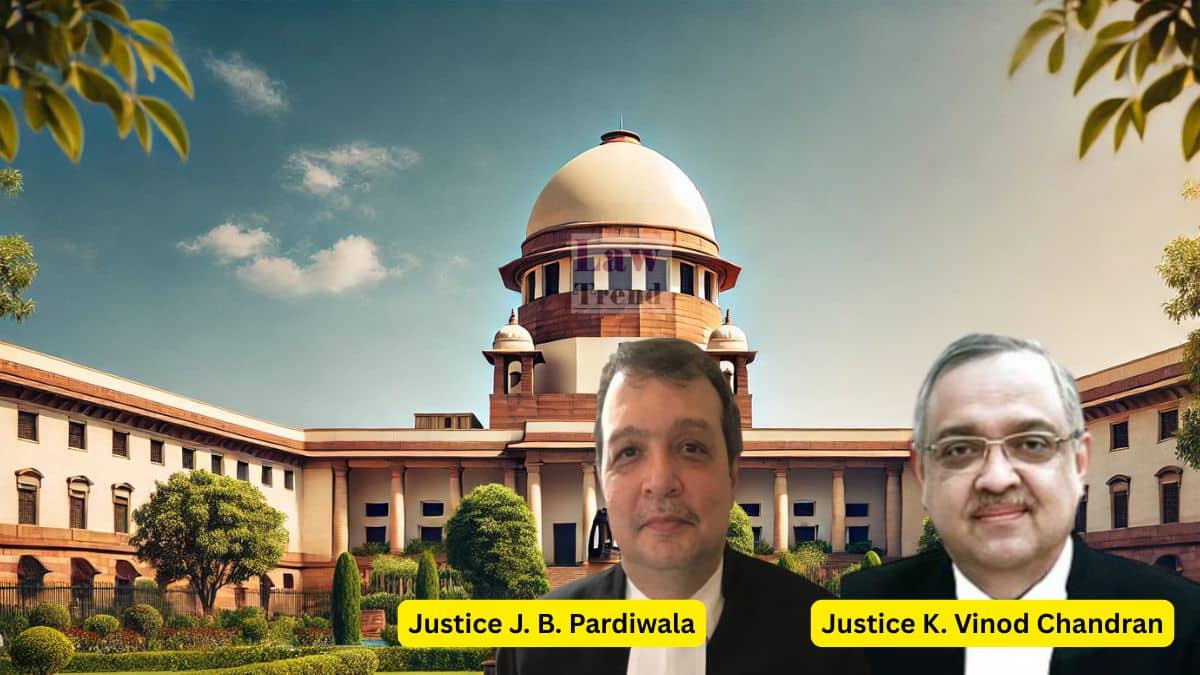
The Supreme Court of India has set aside the murder conviction of two appellants, ruling that serious discrepancies in eyewitness testimonies, medical contradictions, and grave investigative lapses created a reasonable hypothesis of innocence. A Bench comprising Justice J. B. Pardiwala and Justice K. Vinod Chandran allowed the criminal appeal against the judgment of the High Court, which had affirmed the Trial Court’s order convicting the appellants under Section 302 read with Section 34 of the Indian Penal Code, 1860, and Section 27 of the Arms Act, 1959.
Background of the Case
According to the prosecution, a dispute regarding the blockage of a drainage resulted in waterlogging in front of the deceased’s house, triggering a quarrel between two families. On the fateful day, while the deceased was bathing his buffalo, five accused persons allegedly arrived at his house. Following an exhortation by one of the accused, appellant A2 allegedly shot the deceased in the left side of the chest, causing instantaneous death. Appellant A1 was accused of firing at women and children, while the remaining accused allegedly assaulted other family members with lathis.
The First Information Statement (FIS) was lodged by the deceased’s son (PW10). Out of the five persons put on trial, the Trial Court acquitted three and convicted two (A1 and A2). The High Court affirmed the conviction and sentence, leading the two convicts to assail the verdict before the Supreme Court.
Rival Contentions and Evidence on Record
The prosecution based its case primarily on direct eyewitness evidence furnished by the close relatives of the deceased—his sons (PW2, PW3, PW10), daughter (PW5), and daughter-in-law (PW6)—along with a villager from a nearby village (PW8). The prosecution examined twelve witnesses in total to establish that homicide by gunshot had taken place pursuant to the drainage dispute.
In contrast, the defence examined three witnesses. One of the defence witnesses (DW1) deposed that on the night of the incident, while traveling to his sister’s house, he heard shouts and gunshots, flashed his torch, and saw a man lying prostrate surrounded by armed individuals chanting slogans of “Inqilab Zindabad,” before fleeing when threatened. The defence highlighted that the area had Naxal activity and contended that the prosecution’s version was manufactured, citing the unnatural conduct of the family in carrying the body to the police station instead of a hospital.
Analysis of the Court
Examining the evidence, the Supreme Court identified several irreconcilable contradictions between the eyewitness accounts, the medical evidence, and the police investigation:
- Contradictions in Eyewitness Testimony: The Bench noted that the FIS did not mention the presence of PW5, PW6, or PW8. In cross-examination, major portions of the testimonies of PW5 and PW6 were confronted as omissions from their statements under Section 161 of the Code of Criminal Procedure (CrPC). Furthermore, although PW8 claimed to have accompanied PW2, PW2 did not corroborate this fact.
- Medical Evidence vs. Prosecution Narrative: While eyewitnesses claimed that the deceased died instantaneously on the spot, the autopsy doctor (PW11) testified that a person sustaining such a gunshot injury could have survived for 3 to 6 hours. Furthermore, PW6 claimed she could feel her father-in-law’s pulse when he was taken from the spot. The Bench found it highly unnatural that the relatives took the victim to the police station instead of rushing him to a hospital for medical treatment. Additionally, the alleged injuries sustained by PW5, PW6, and PW6’s child were either inconsistent with the medical testimony of PW7 or unsupported by hospital records.
- Flaws in Police Investigation: The Investigating Officer (PW12) admitted that no map of the scene of occurrence was prepared, no reconnaissance was carried out, and no telltale signs or bloodstained earth were recovered due to heavy rains. The clothes of the relatives, claimed to be soaked in blood, were neither seized nor medically examined.
- Unrecovered Weapons and Firearm Claims: The weapons of assault remained unrecovered, and no licence was produced on record to establish that A1 possessed a licensed weapon. Commenting on the eyewitnesses’ claim that A1 was carrying a licensed firearm, the Court observed: “On the mere sight of a weapon, it cannot be identified as one licensed. We pertinently observe that, this smacks of premeditation to frame the accused, who is known to have a licensed weapon. But unfortunately, the I.O did nothing to produce the license and prove at least that the accused had access to such a weapon.”
- Scrutiny of Related Witnesses: Addressing the weight to be given to related witnesses, the Court held: “Related witnesses merely for their relationship with the deceased cannot be called interested witnesses. But when, from the circumstances, as in the present case, where there is found a ring of falsity in their testimonies, a closer scrutiny is warranted.”
Citing the landmark decision in Sharad Birdhichand Sarda v. State of Maharashtra (1984) 4 SCC 116, the Bench noted that while the principle governing the hypothesis of innocence is traditionally applied in circumstantial evidence cases, it holds relevance where direct testimony fails to inspire confidence: “Due to the discrepancies and the inconsistencies, we are unable to place faith on the oral testimony of eyewitnesses. In that circumstance, the reasonable doubt regarding a hypothesis of innocence assumes relevance.”
Decision of the Court
Holding that the circumstances did not point solely to the guilt of the accused, the Supreme Court extended the benefit of doubt to both appellants.
The Court allowed the appeal, set aside the conviction and sentence, and directed that the appellants be released forthwith from custody if not required in any other case, with their bail bonds standing cancelled if on bail.
Case Title: Ashok Upadhyay and Anr. v. The State of Bihar
Case No.: Criminal Appeal No. 1223 of 2022
Bench: Justice J. B. Pardiwala and Justice K. Vinod Chandran
Date: September 08, 2026