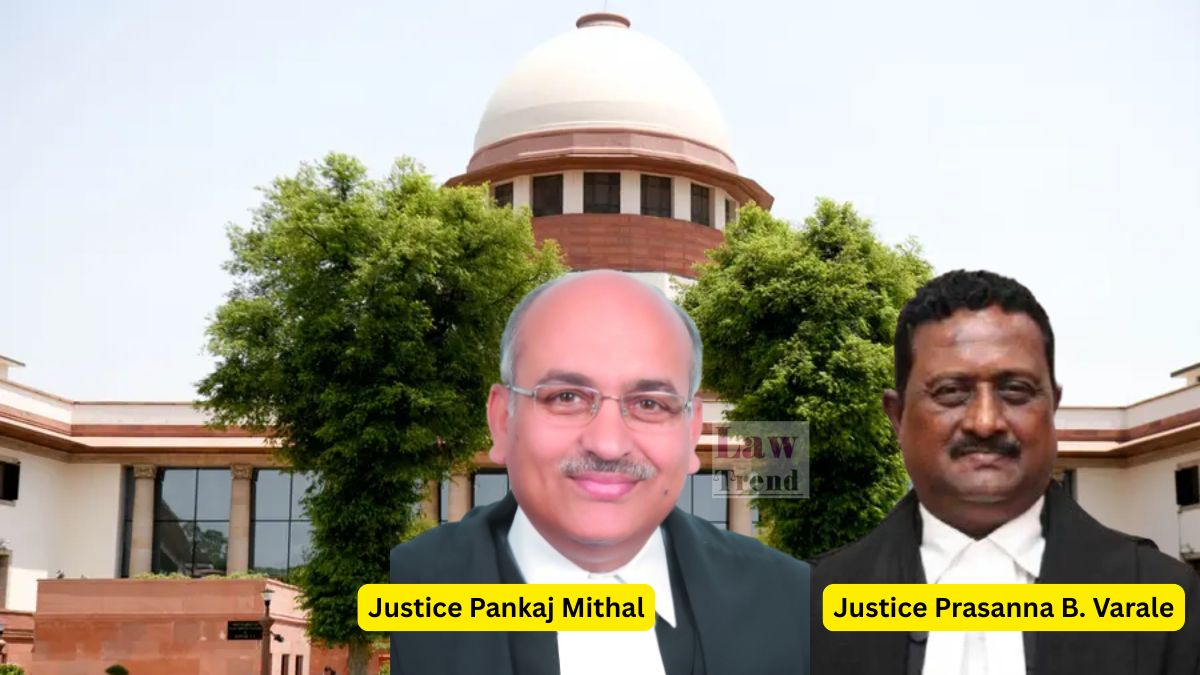
The Supreme Court of India has ruled that the recovery of incriminating evidence under Section 27 of the Indian Evidence Act, 1872, is not vitiated merely because independent panch (seizure) witnesses turn hostile. A Division Bench comprising Justice Pankaj Mithal and Justice Prasanna B. Varale held that the testimony of an investigating officer, if found convincing and reliable, is sufficient to establish such recoveries.
The Court made these observations while dismissing a criminal appeal filed by Upendra Khare (spelled as “Uperndra Khare” in court records), thereby upholding his conviction and sentence of life imprisonment on four counts under Section 302 of the Indian Penal Code, 1860 (IPC), read with Section 149 IPC, for his involvement in the brutal murder of four members of a family in Satna, Madhya Pradesh.
Background of the Case
The case dates back to July 2002. On July 20, 2002, around 6:05 AM, an informant named Anupam Shukla reported to the PS City Kotwali, Satna, that his cousin brother, Rajesh Shukla, had been unreachable since meeting him on July 18, 2002. Upon visiting Rajesh Shukla’s house that morning, the informant found the back door open. Inside, he discovered the dead bodies of Rajesh Shukla, his wife Madhu Shukla, his son Prabhanshu Shukla, and his sister Vinita Shukla, all bearing severe injuries.
Following this discovery, First Information Report (FIR) Case No. 515/2002 was registered under Section 302 IPC. Subsequently, offences under Sections 382 (theft after preparation made for causing death) and 404 (dishonest misappropriation of property possessed by deceased person) of the IPC were added after family members reported that jewellery worn by the deceased and stored in the almirah had been stolen.
The investigation revealed that a neighbour, Devendra Singh, had harboured feelings for Vinita Shukla and used to tease her. Devendra was frequently seen in the company of the appellant, Upendra Khare. The prosecution’s case was that on July 18, 2002, Devendra Singh, Upendra Khare, Gyanchand alias Chunni, Neeraj Kumar, and Babua alias Abhishek Singh entered Rajesh Shukla’s house armed with a country-made pistol, cartridges, and a gupti (swordstick). The accused persons administered Calmpose (diazepam) injections to render the victims unconscious before killing them.
The appellant, Upendra Khare, was arrested on September 21, 2002. At his instance, the police recovered used syringes, empty phials of Calmpose injection, a cotton rope, and the clothes he wore during the commission of the offence. Stolen jewellery was recovered at the instance of Devendra Singh.
Following the trial, the First Additional Sessions Judge, Satna (Trial Court), vide its judgment dated October 15, 2007, convicted the appellant under Section 302 read with Section 149 IPC on four counts and sentenced him to life imprisonment. He was, however, acquitted of charges under Sections 382 and 404 IPC read with Section 149 IPC after being given the benefit of doubt. The High Court of Madhya Pradesh at Jabalpur dismissed his appeal on June 21, 2012, confirming the conviction and directing that the sentences on all four counts run concurrently. Aggrieved by this, the appellant approached the Supreme Court.
Arguments of the Parties
Appellant’s Contentions
The learned counsel for the appellant, Mr. Amit Singh, raised several arguments challenging the concurrent findings of the lower courts:
- Incomplete Chain of Circumstance: The prosecution’s case rested entirely on circumstantial evidence, and the chain of events was incomplete with multiple missing links.
- Lack of Motive: No motive was assigned to the appellant. The alleged motive of teasing and harbouring feelings for the deceased Vinita was solely attributed to the co-accused Devendra Singh.
- No Joint Object: No weapon of offence or stolen property was recovered from the appellant, indicating he did not share a common object or intention.
- Invalid Recovery: The alleged recoveries made at the instance of the appellant were illegal. Both independent witnesses to the property seizure memo had turned hostile. Furthermore, the recoveries were made two months after the incident, which is highly improbable, and were allegedly procured through force, noting that a co-accused suffered a leg fracture during police custody.
- Lack of Scientific Connection: The FSL Report (Ex P-42) only examined phials from the crime scene and not the ones recovered from the appellant, and those from the crime scene did not test positive for diazepam. The blood-like stains on the recovered clothes were not proved to be of human origin, and the recovery of these clothes was not put to the appellant during his Section 313 CrPC statement. Additionally, the postmortem report did not show any strangulation marks, contradicting the usage of the recovered rope.
- Legality of Unlawful Assembly: The conviction under Section 302 read with Section 149 IPC was legally unsustainable because the total number of convicted persons in the case was less than five, failing to satisfy the legal definition of an “unlawful assembly.”
- Alternative Plea: The appellant prayed for a reduction of sentence to the period already undergone, pointing out that he had completed a substantial period of incarceration and had no prior criminal antecedents.
The appellant’s counsel placed reliance on the Supreme Court judgments in Prabhu v. State of U.P. (1962), Boby v. State of Kerala (2023), and Ashish Batham v. State of Madhya Pradesh (2002).
Respondent’s Contentions
On behalf of the State, Mr. Bhupendra Pratap Singh, Deputy Advocate General, argued that the prosecution successfully proved its case using overwhelming circumstantial evidence. He contended that merely because a panch witness turned hostile, the recovery does not become doubtful. He supported this contention by relying on the full bench judgment of the Supreme Court in Goverdhan & Anr. v. State of Chhattisgarh (2025), which held that hostile witnesses do not disprove a seizure when the Investigating Officer (IO) has already successfully proved the seizure memos.
Court’s Analysis and Observations
The Supreme Court examined the medical and testimonial evidence on record. It noted that the prosecution’s case regarding Devendra Singh teasing Vinita was firmly established through the ocular evidence of PW1 Kamta Prasad Shukla and PW18 Kumari Sangeeta Shukla. (Devendra Singh’s own appeal was previously dismissed for non-prosecution in 2016 after he failed to appear while on parole).
The Bench focused heavily on the legal validity of recoveries made under Section 27 of the Indian Evidence Act, 1872, when independent witnesses turn hostile. Rejecting the appellant’s submissions, the Bench held:
“We are unable to accept this submission of the learned counsel for the simple reason that this Court had consistently taken a view that merely on account of the panch witnesses turning hostile cannot be a ground to discard this important piece of evidence, if the recovery is proved through the investigating officer.”
The Court noted that the recovery of the phials, clothes, and rope at the instance of the appellant was clearly proved through the testimony of Investigating Officer Arun Singh (PW24).
To reinforce this legal position, the Bench cited several precedent-setting judgments:
- Rameshbhai Mohanbhai Koli v. State of Gujarat (2011): Reaffirming that recovery is not vitiated merely because panch witnesses turn hostile.
- Modan Singh v. State of Rajasthan (1978): Where the evidence of the recovering investigating officer is convincing, the recovery need not be rejected on the ground that the seizure witnesses did not support the prosecution.
- Anter Singh v. State of Rajasthan (2004): Where it was held that “even if panch witnesses turn hostile, which happens very often in criminal cases, the evidence of the person who effected the recovery would not stand vitiated.”
- Mallikarjun v. State of Karnataka (2019): Reiterating that “It is fairly well settled that the evidence of the investigating officer can be relied upon to prove the recovery even when the panch witnesses turned hostile.”
Addressing the appellant’s argument regarding the defects in the investigation, the Court did not shy away from pointing out the lapses of the police force, stating:
“It is true that the investigation in the present matter is not up to the mark and it was expected of the investigating agency to conduct the investigation with more sensitivity as it was the case of four persons losing their lives.”
However, the Court clarified that these deficiencies cannot derail justice:
“But merely the fact that the investigation was not up to the mark cannot be the reason for this Court to discard the other material evidence brought by the prosecution in support of its case, particularly, the evidence against the present appellant in the form of recovery of the phial of the injection at the instance of the present appellant supported by the postmortem report duly proved by substantial evidence of Dr. B.L. Gupta.”
The medical evidence, proved by PW17 Dr. B.L. Gupta, confirmed that the cause of death was shock due to external and internal injuries on vital parts and excessive blood loss. Further, the viscera report (Ex P-52) explicitly proved the presence of Diazepam (Calmpose) in multiple articles, which directly correlated with the syringes found near the toilet seats and the phials recovered from the crime scene and the appellant.
Decision of the Court
The Supreme Court concluded that the judgments of both the Trial Court and the High Court were based on a “just and proper appreciation of evidence.” Finding no reason to interfere with the concurrent findings of the lower courts, the Bench dismissed the appeal, declaring it devoid of merit.
Case Details
- Case Title: Uperndra Khare v. The State of Madhya Pradesh
- Case No.: Criminal Appeal No. 1937 of 2013
- Bench: Justice Pankaj Mithal & Justice Prasanna B. Varale
- Date: May 25, 2026