

Consumer Complaints Against Advocates for Deficiency in Legal Services Are Not Maintainable: Andhra Pradesh High Court
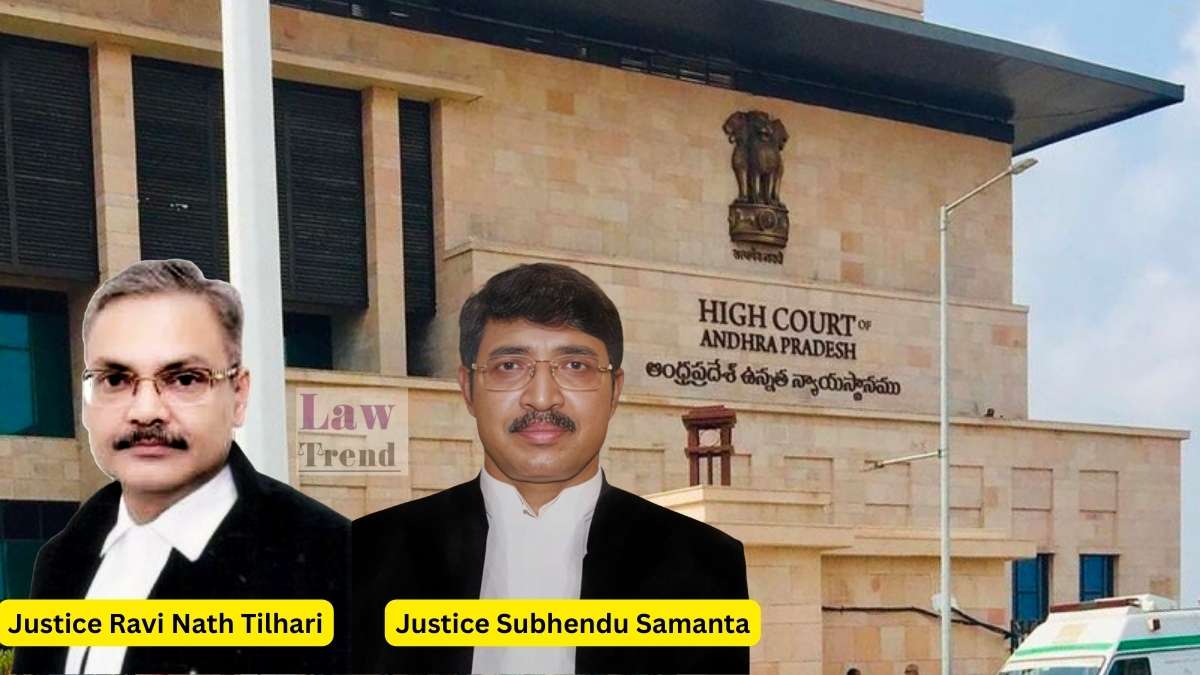

The High Court of Andhra Pradesh has ruled that consumer complaints against advocates alleging deficiency in legal services are not maintainable under the Consumer Protection Act. A Division Bench comprising Justice Ravi Nath Tilhari and Justice Subhendu Samanta dismissed a writ petition challenging the dismissal of a consumer complaint against a lawyer, reinforcing the legal position that services rendered by advocates fall under a “contract of personal service” and are thus excluded from the purview of consumer law.

Background of the Case

The petitioner, A.S.S.K. Durga Prasad, initially filed a complaint (Consumer Complaint No. 181 of 2014) in the District Consumer Disputes Redressal Commission No.1, Visakhapatnam (District Forum) against his advocate, who is the present respondent No. 4. The petitioner alleged deficiency in service with respect to a lawsuit filed on his behalf.

On March 4, 2022, the District Forum dismissed the complaint on its merits. The petitioner subsequently appealed this decision (F.A. No. 7 of 2022), which was dismissed by the Andhra Pradesh State Consumer Disputes Redressal Commission on November 16, 2022. Pursuing further recourse, the petitioner filed Revision Petition No. 8 of 2023, which was also dismissed by the National Consumer Disputes Redressal Commission (NCDRC) in New Delhi on September 20, 2023. Additionally, a complaint filed by the petitioner against the advocate before the State Bar Council was dismissed. The petitioner then approached the High Court of Andhra Pradesh via the present writ petition to challenge these three impugned orders.

Arguments of the Parties

During the proceedings, Sri Phani Babu Yalamanchili appeared as the learned counsel for the petitioner, while Sri Bonu Rama Sankar Rao represented respondent No. 4.

The High Court noted that the learned counsel for the petitioner was unable to satisfy the court regarding the maintainability of a consumer complaint against an advocate for an alleged deficiency in rendering legal services under the Consumer Protection Act.

The Court’s Analysis and Referenced Precedents

In evaluating the maintainability of the complaint, the High Court observed that the law is well settled: an advocate rendering legal services on the legal side is not covered under the Consumer Protection Act. The Bench extensively cited the landmark ruling of the Supreme Court of India in Bar of Indian Lawyers v. D.K. Gandhi PS National Institute of Communicable Diseases (2024) 8 SCC 430.

In that case, the Apex Court deliberated on whether the relationship between an advocate and a client should be classified as a contract “for services” or a contract “of service” (contract of personal service) under Section 2(1)(g) of the Consumer Protection Act, 1986, and Section 2(42) of the Consumer Protection Act, 2019, read alongside the provisions of the Advocates Act.

READ ALSO  Failure to Comply With Court Order Does Not Constitute a "Continuing Wrong" Unless Explicitly Pleaded and Proven: Supreme Court

Highlighting the unique nature of the legal profession, the Supreme Court had noted:

“51. When we examine the relationship between an advocate and his client from this point of view, the following unique attributes become clear: 51.1. Advocates are generally perceived to be their client’s agents and owe fiduciary duties to their clients. 51.2. Advocates are fastened with all the traditional duties that agents owe to their principals. For example, advocates have to respect the client’s autonomy to make decisions at a minimum, as to the objectives of the representation. 51.3. Advocates are not entitled to make concessions or give any undertaking to the court without express instructions from the client. 51.4. It is the solemn duty of an advocate not to transgress the authority conferred on him by his client. 51.5. An advocate is bound to seek appropriate instructions from the client or his authorised agent before taking any action or making any statement or concession which may, directly or remotely, affect the legal rights of the client. 51.6. The Advocate represents the client before the court and conducts proceedings on behalf of the client. He is the only link between the court and the client. Therefore, his responsibility is onerous. He is expected to follow the instructions of his client rather than substitute his judgment.”

The Supreme Court had further concluded:

“52. Thus, a considerable amount of direct control is exercised by the client over the manner in which an advocate renders his services during the course of his employment. All of these attributes strengthen our opinion that the services hired or availed of an advocate would be that of a contract “of personal service” and would therefore stand excluded from the definition of “service” contained in Section 2(42) of the CP Act, 2019. As a necessary corollary, a complaint alleging “deficiency in service” against advocates practising legal profession would not be maintainable under the CP Act, 2019.”

Summarizing these findings, the Apex Court had held:

“53. In that view of the matter, we summarise our conclusions as under- 53.1. The very purpose and object of the CP Act, 1986 as re-enacted in 2019 was to provide protection to the consumers from unfair trade practices and unethical business practices, and the legislature never intended to include either the professions or the services rendered by the professionals within the purview of the said Act of 1986/2019. 53.2. The legal profession is sui generis i.e. unique in nature and cannot be compared with any other profession. 53.3. A service hired or availed of an advocate is a service under “a contract of personal service”, and therefore would fall within the exclusionary part of the definition of “service” contained in Section 2(42) of the CP Act, 2019. 53.4. A complaint alleging “deficiency in service” against advocates practising legal profession would not be maintainable under the CP Act, 2019.”

The High Court also pointed out that in the same judgment, Justice Pankaj Mithal had delivered a concurring opinion, observing:

“80. In doing so, in India also the services of professionals more particularly that of lawyers have to be excluded from consumer protection law in accordance with the intention expressed in enacting the same.”

Justice Pankaj Mithal further added:

“81. With the above additional reasoning supplementing the various other grounds for excluding the services of the professionals from the Consumer Protection Act, I am in agreement with the opinion expressed by my esteemed Sister and I am of the view that the legislature in India as in some other countries, had not intended to include the services rendered by the professionals especially the lawyers to their client within the purview of the Consumer Protection Act, 1986 and re-enacted in 2019.”

The Supreme Court had specifically overruled the contrary stance previously held by the NCDRC, declaring:

“82. Accordingly, the view taken by the NCDRC to the effect that in respect of deficiency in service rendered by the lawyers, a complaint in Consumer Protection Act, 1986 would be maintainable, is incorrect and stands overruled.”

The Decision of the Court

Applying the established legal principles, the High Court of Andhra Pradesh concluded that the petitioner’s consumer complaint against respondent No. 4 was not maintainable under the law.

The Bench ruled that the consumer forums had rightly dismissed the complaint, and no grounds existed to interfere with the three impugned orders. Consequently, the High Court dismissed the writ petition. The court made no order as to costs, and all pending miscellaneous petitions were closed.

READ ALSO  Magistrate Can Add or Drop Offences at Cognizance Stage: Allahabad High Court Clarifies in Dowry Case

Case Details

Case Title: A.S.S.K.Durga Prasad Vs National Consumer Disputes Redressal Commission & 3 others
Case No.: Writ Petition No: 29425/2025
Bench: Justice Ravi Nath Tilhari, Justice Subhendu Samanta
Date: 24.06.2026

Law Trend
Law Trendhttps://lawtrend.in/
Legal News Website Providing Latest Judgments of Supreme Court and High Court

Related Articles

Latest Articles

