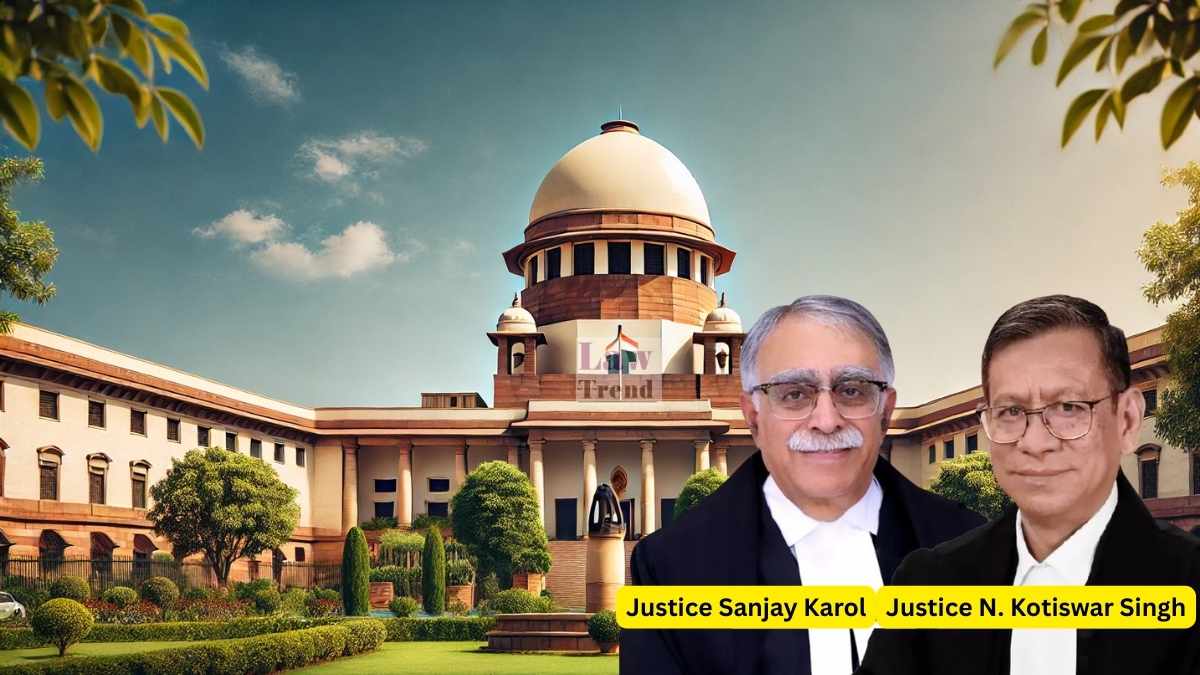
The Supreme Court of India, comprising a Bench of Justice Sanjay Karol and Justice N. Kotiswar Singh, held that any withdrawal of criminal cases against candidates in an election cycle requires mandatory approval from the concerned High Court. Addressing the pervasive issue of unaccounted cash and political influence in elections, the Court laid down a comprehensive framework governing search, seizure, investigation timelines, and prosecution of electoral offences to safeguard the purity of the democratic process.
Case Background
The matter originated from the 2014 Lok Sabha bye-elections for the Bellary constituency in Karnataka. A flying squad established by the Election Commission of India (ECI) conducted a raid on the residence and business premises of the respondent, Prathik Parasrampuria, based on an anonymous message alleging the hoarding of counterfeit currency intended for voter bribery. During the search, authorities seized Rs 20,48,355 in cash, a laptop, chequebooks, loose cheque leaves, and a pen drive.
Consequently, Crime No. 0107 of 2014 was registered under Sections 171E and 188 of the Indian Penal Code (IPC). The respondent approached the High Court of Judicature at Karnataka seeking to quash the complaint. On February 12, 2015, the High Court quashed the FIR on the grounds that the complaint contained no specific averments regarding whom the accused intended to bribe or the proposed mode of bribery. The State of Karnataka subsequently challenged this decision before the Supreme Court.
Evolution of the Scope and Arguments
Taking note of the systemic issues surrounding election-related crimes, the Supreme Court issued notice to the Election Commission of India and the Union of India on September 5, 2017. The Court observed that numerous criminal cases registered during elections were not being pursued effectively due to sole reliance on State prosecution machinery. By an order dated April 5, 2019, all State Governments and Union Territories were impleaded as parties. Senior Counsel Gaurav Aggarwal and Counsel Dr. Swapnil Tripathi were appointed as Amici Curiae to assist the Court in formulating guidelines.
The ECI placed on record Standard Operating Procedures (SOPs) for Flying Squads (FS) and Static Surveillance Teams (SST), along with statistical data regarding seizures and FIRs. The data revealed that 144,030 FIRs were filed during the 2019 Lok Sabha Elections, 387,430 FIRs during the 2024 Lok Sabha Elections, and 201,894 FIRs across State Legislative Assembly Elections held between 2019 and 2025.
The ECI raised strong concerns regarding the unilateral withdrawal of election-related cases by State Governments whenever political dispensations changed. Referring to its communication dated August 10, 2009, the ECI reiterated its consistent stand under Article 324 of the Constitution that cases involving electoral offences should not be withdrawn and must be pursued to their logical conclusion. The Department of Legal Affairs, Government of India, had similarly opined in 2009 that the power to withdraw prosecution under Section 321 of the Code of Criminal Procedure (CrPC) must be exercised in the interest of the administration of justice and cannot be done at the dictation of executive authorities.
The Amicus Curiae submitted a comparative note on global practices across 16 jurisdictions regarding electoral enforcement mechanisms, highlighting judicial oversight models in jurisdictions such as Indonesia and the Philippines.
Court’s Analysis and Observations
In its analysis authored by Justice Sanjay Karol, the Court emphasized the intrinsic link between democracy, the rule of law, and free elections. Examining the role of money power, the Court observed:
“If it is that this one chance at expression is itself tainted, it would not be an understatement to say that the very essence of democracy, which is a rule of the people, by the people and for the people, is compromised.”
Defining the menace of unaccounted funds, the Bench noted:
“Ill-gotten, undeclared money is one of the primary forms used. It is this which is called ‘black money’.”
Evaluating the SOPs of Flying Squads and Static Surveillance Teams, the Court noted that officers must record written reasons regarding their suspicion and the likelihood of seized material being used for voter inducement, thereby preventing harassment to ordinary citizens.
Addressing the necessity of timely investigations and trials in election offences, the Court stated:
“The under investigation tag can not be allowed to hang endlessly upon the heads of individuals. This becomes all the more important in the context of election-related matters where the public has a right to know, whether of not the candidate of their choice has indulged in corrupt practices or inducements which would be deemed illegal, unethical, unsavory and unacceptable.”
Regarding the practice of withdrawing prosecutions post-elections, the Court remarked:
“Once prosecution is initiated against them, change in political dispensation simpliciter will not let them of the hook. In other words, a Constitutional democracy expects from its representatives. The same decree of moral rectitude and uprightness.”
Key Directions Issued
To ensure the integrity of the electoral process, the Supreme Court issued the following directions:
- Reporting Seizures: Upon seizing cash or other assets, the seizing authority must report the action within 24 hours to the District Magistrate, Additional District Magistrate, or Court of competent jurisdiction, accompanied by written reasons demonstrating a prima facie nexus between the seized items and the suspected electoral offence.
- Investigation Timelines: Investigating Officers (IOs) must make every possible endeavor to complete investigations into election FIRs within one year from registration. If this timeline is exceeded, reasons must be recorded and communicated to the ECI.
- Status Reporting: The IO must submit quarterly status reports on the investigation to the ECI through the Nodal Officer, following approval by the Senior Superintendent of Police or Deputy Commissioner of Police of the concerned district.
- Income Tax Notification: Static Surveillance Teams finding cash exceeding Rs 10 lakh during checks must forward the information to Income Tax authorities.
- Special Designated Courts: High Courts are directed to designate special courts for prompt hearing and expeditious disposal of cases involving candidates, sitting Members of Parliament (MPs), and Members of Legislative Assemblies (MLAs).
- Mandatory High Court Approval for Case Withdrawal: Approval of the concerned High Court is mandatory for withdrawing any criminal cases registered against candidates in an election cycle.
- Expeditious Disposal: Trial courts must make all efforts to conclude pending cases related to the 2024 Lok Sabha and 2019–2025 Assembly elections with utmost expedition.
The Supreme Court directed the Election Commission of India and all State Governments to file compliance reports regarding these directions on or before November 18, 2026.
Case Title: The State of Karnataka & Anr. v. Prathik Parasrampuria
Case No.: SLP (Crl.) No. 3549 of 2016
Bench: Justice Sanjay Karol and Justice N. Kotiswar Singh
Date: August 17, 2026