

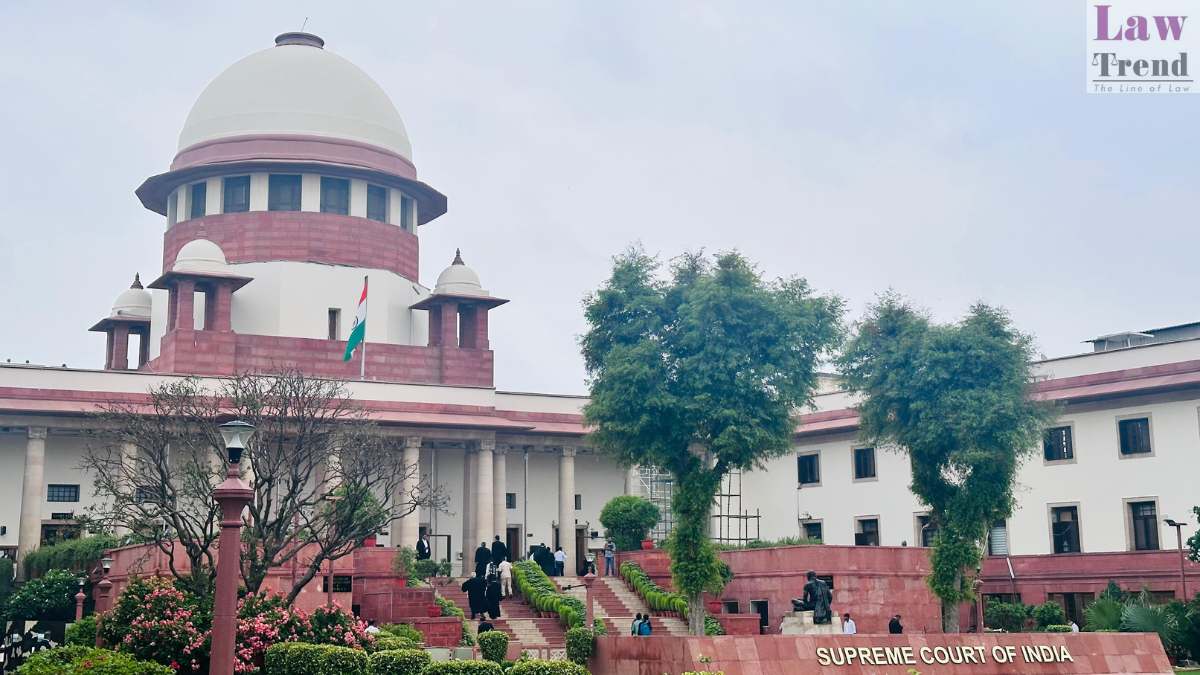
The Supreme Court has held that where a bareboat charterparty expressly provides for termination by notice and treats the charterer as a gratuitous bailee pending repossession, physical repossession of the vessel is not necessary to bring the demise charter to an end. A Bench of Chief Justice of India Surya Kant, Justice Joymalya Bagchi and Justice V. Mohana set aside a Madras High Court judgment that had sustained the arrest of M.V. Nereus Progress and directed that the vessel’s arrest be vacated.
The Court held that the bareboat charter between the registered owner of M.V. Nereus Progress and Nereides Marine Services had been validly terminated on November 13, 2025, well before the vessel was arrested on December 4, 2025. After the termination, Nereides held the vessel only as a gratuitous bailee and not as a demise charterer.
Background
The dispute arose between the registered owner of M.V. Nereus Progress and Om Freight Forwarders Ltd., which was a creditor of Nereides Marine Services.
The vessel owner had let M.V. Nereus Progress to Nereides, a UAE-based shipping operator, under a Bareboat Charterparty dated October 3, 2024, executed on the BIMCO BARECON 2017 form. Separately, Om Freight Forwarders had also let its vessel M.V. Bharadwaj to Nereides under another bareboat charter dated July 24, 2024.
Nereides subsequently defaulted on hire payments to the owner of M.V. Nereus Progress. The owner issued several demand notices between September and October 2025. It then issued an Anti-Technicality Notice on November 6, 2025, giving Nereides three banking days to cure the default.
When payment was still not made, the owner issued a Termination Notice on November 13, 2025 under Clause 31 of the charterparty. This was followed by a Repossession Notice dated November 19, 2025.
Nereides had also defaulted on payments owed to Om Freight Forwarders under the separate charter of M.V. Bharadwaj. Om Freight Forwarders therefore instituted Commercial Suit No. 314 of 2025 before the Madras High Court under Sections 5(1)(b) and 5(2) of the Admiralty (Jurisdiction and Settlement of Maritime Claims) Act, 2017.
It sought the arrest of M.V. Nereus Progress as a sister vessel on the basis that Nereides continued to be its demise charterer.
On December 4, 2025, before the registered owner could physically repossess M.V. Nereus Progress at Tuticorin Port, Om Freight Forwarders obtained an ex parte order for its arrest.
A Single Judge of the Madras High Court declined to recall the arrest. The Division Bench later affirmed the order, holding that a demise charter ordinarily does not cease merely upon contractual termination and that physical redelivery is generally required to bring the charterer’s status to an end.
Arguments Before the Supreme Court
Senior Advocates Atmaram Nadkarni and Shikhil Suri, appearing for the vessel owner, argued that Section 5(1)(b) of the Admiralty Act required Nereides to continue as the demise charterer on the date the arrest was effected.
They submitted that this requirement was not satisfied because the charter had already been terminated on November 13, 2025.
The appellant relied particularly on Clauses 31 and 32 of the BIMCO BARECON 2017 charter. Clause 32 provided that after termination and pending physical repossession, the charterer would hold the vessel only as a gratuitous bailee for the owner.
Counsel for Om Freight Forwarders, Ashwin Shanker, opposed the appeal. He contended that Nereides continued to exercise control over and commercially employ the vessel and that physical redelivery and repossession were necessary before its status as demise charterer could come to an end.
It was also argued that whether Nereides held the vessel as a gratuitous bailee or a demise charterer was a mixed question of fact that ought to be decided at trial rather than in proceedings seeking recall of the arrest.
Termination of Charter Was Valid
The Supreme Court examined the correspondence between the vessel owner and Nereides and noted that the latter had been called upon to clear arrears aggregating to USD 696,500.
Despite repeated demands and a further grace period of three banking days, no payment was made.
The Court also noted that Nereides never disputed the fact of its payment default. In its communication dated November 14, 2025, Nereides acknowledged the termination notice and sought another month’s extension, while assuring that it would accept the owner’s decision regarding termination and arrange an orderly handover if payment was not made.
The Bench therefore concluded that the contractual requirements preceding termination had been complied with.
“We accordingly hold that the termination of the BBC was proper and valid.”
The Court also referred to its decision in M/s Tomorrowland Limited v. Housing and Urban Development Corporation Limited & Anr., observing that commercial documents must be interpreted so as to give effect to the intention of the parties.
It said that where the contractual language is clear and the conduct of the parties is consistent with it, courts must give effect to the bargain struck rather than rewrite it.
Physical Repossession Was Not a Precondition
The Supreme Court noted that the precise question of whether physical repossession is necessary before a demise charter can be treated as terminated did not appear to have been authoritatively settled by an Indian court.
Both sides relied on foreign judgments taking divergent views.
The Singapore High Court in The Chem Orchid and the Sri Lankan Court of Appeal in Navi-Bunkering Corp had taken the view that the status of a demise charterer continues until actual physical possession of the vessel is restored to the owner.
On the other hand, the Federal Court of Australia in The Hako Fortress and the Court of First Instance in Hong Kong in M.V. Trident Dawn had held that a termination clause may operate by its own force upon the stipulated default and service of notice, independently of physical repossession.
The Supreme Court declined to mechanically adopt either line of foreign authority and held that the issue had to be decided on the express terms of the charterparty and the facts of the case.
The Court found Clause 32 crucial. It provided that after early termination, the owners would have the right to repossess the vessel and that, pending physical repossession, the charterers would hold the vessel only as gratuitous bailees.
The Bench observed:
“The opening words of Clause 32, ‘in the event of the early termination of this Charter Party’, make it clear that repossession of the Vessel is treated by the parties as a consequence flowing from a termination already accomplished, and not as an event upon which the termination itself is dependent.”
The Court explained that a demise charterer and a gratuitous bailee occupy fundamentally different legal positions. A demise charterer holds possession and control of a vessel with the right to employ it commercially, while a gratuitous bailee does not possess an independent right of use or commercial employment.
“There can be no doubt that once the charterparty designates the charterers as ‘gratuitous bailees’ upon termination, it necessarily displaces any continuing status as ‘demise charterer’.”
Reading Clauses 31 and 32 together, the Court held that termination took effect upon service of the notice under Clause 31. Clause 32 thereafter governed the practical process by which the owner recovered physical control of the vessel.
The Bench also highlighted the practical difficulty with making physical repossession a prerequisite for termination. A defaulting charterer could delay handover because of the vessel’s location, technical problems, non-cooperation of the crew or difficulties in securing a berth.
The Court said:
“If a charterer’s demise status were held to continue for as long as the charterer chooses or is able to withhold physical possession, despite a validly issued termination notice, the owner’s contractual right of termination would be held hostage to the very default that occasioned its exercise.”
Conditions for Sister-Ship Arrest Were Not Met
The Supreme Court then examined Section 5(1)(b) read with Section 5(2) of the Admiralty Act.
It noted that the maritime claim of Om Freight Forwarders arose from its charter of M.V. Bharadwaj and not from M.V. Nereus Progress.
For M.V. Nereus Progress to be arrested as a sister vessel, the statutory conditions under Section 5(1)(b) had to be independently satisfied.
The respondent therefore had to establish that Nereides was the demise charterer of M.V. Nereus Progress when the maritime claim arose and that it continued to be the demise charterer when the vessel was arrested on December 4, 2025.
The Court held that the second condition was not satisfied.
It found that the charter had already been validly terminated with effect from November 13, 2025. Independently, Clause 32 expressly provided that after termination and pending repossession, Nereides would hold the vessel only as a gratuitous bailee.
The Court also found that the vessel owner had continuously pursued repossession after terminating the charter and that the delay in obtaining physical possession was attributable to Nereides.
Nereides itself had acknowledged in its communications that the charter had been terminated and that an orderly handover and repossession were to follow.
Decision
The Supreme Court held that a validly issued termination notice under Clause 31(a) was sufficient to bring the demise charter to an end and that physical repossession thereafter merely completed the practical transfer of control.
It held that Nereides had ceased to be the demise charterer of M.V. Nereus Progress well before December 4, 2025, and was holding the vessel only as a gratuitous bailee.
Since the arrest proceeded on the contrary premise that Nereides remained the demise charterer on the date of arrest, the Court found that the order could not be sustained.
The Supreme Court accordingly set aside the Madras High Court judgment, allowed the appeal and vacated the arrest of M.V. Nereus Progress.
Case Details
Case Title: Owners and Parties Interested in M.V. Nereus Progress v. Om Freight Forwarders Ltd.
Case No.: Civil Appeal of 2026 arising out of SLP (C) No. 23834 of 2026
Bench: Chief Justice of India Surya Kant, Justice Joymalya Bagchi and Justice V. Mohana
Date: September 25, 2026




