

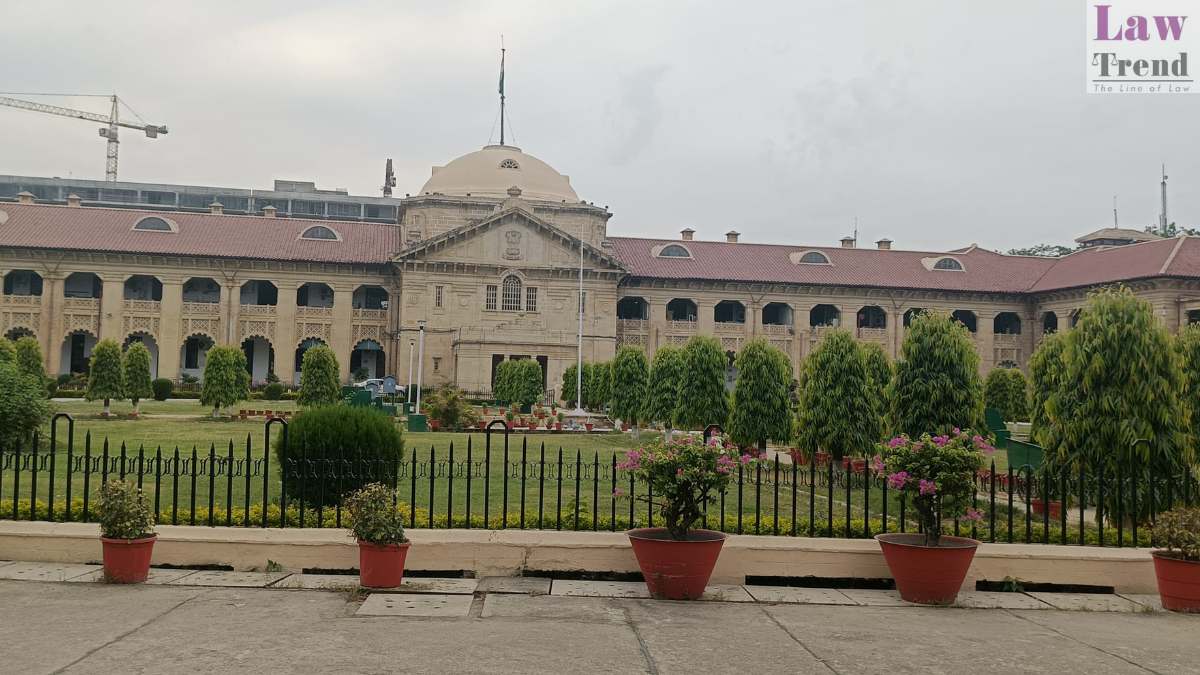
The Allahabad High Court, comprising Justice Chandra Dhari Singh and Justice Tarun Saxena, has ruled that registering multiple First Information Reports (FIRs) across different police stations for identical allegations arising out of the same continuous transaction amounts to an abuse of the judicial process. Allowing a criminal writ petition filed by an accused facing several FIRs over non-refund of society deposits, the Court held that the subsequent FIRs satisfy the “test of sameness” and directed that the earliest registered FIR be treated as the principal FIR, with all subsequent complaints treated as statements under Section 161 of the Code of Criminal Procedure (CrPC) or Section 180 of the Bharatiya Nagarik Suraksha Sanhita (BNSS).
Background of the Case
The matter originated from an FIR lodged on July 18, 2024, by complainant Yashwant Singh at Police Station Kotwali Lalitpur, District Lalitpur, registered as Case Crime No. 612 of 2024 under Sections 111, 318, 61(2), 352, and 351(3) of the Bharatiya Nyaya Sanhita (BNS), 2023. According to the complaint, residents of Village Satlinga, whose agricultural land had been acquired for the Bharat Dam Project, received compensation money. Representatives claiming to be agents of the Loni Urban Multi-State Credit & Thrift Co-operative Society (LUCC) approached them with promises that deposits would double after a maturity period of five years.
Relying on these representations, several depositors invested funds on March 26, 2019. Upon the completion of the five-year maturity term on March 26, 2024, the society and its agents failed to return the amounts. When the complainant demanded repayment on July 15, 2024, the named individuals allegedly abused and threatened him with dire consequences, prompting the lodging of the principal FIR.
Following the initial FIR, at least 13 subsequent FIRs were registered across various police stations in District Lalitpur—including Kotwali Lalitpur, Jakhaura, Mahrauni, Talbehat, and Narahat—under various sections of the BNS and Indian Penal Code (IPC), implicating society office-bearers, agents, and ordinary members, including the petitioner, Bharat Verma.
Aggrieved by the barrage of proceedings, Verma approached the High Court seeking a writ of mandamus to club and consolidate all subsequent FIRs with the first FIR (Case Crime No. 612 of 2024) and to direct that no further FIRs with identical allegations be entertained against him.
Arguments of the Parties
Appearing for the petitioner, counsel Anurag Tripathi contended that the allegations in all subsequent FIRs are identical and stem from the same cause of action. He argued that subjecting an individual to multiple investigations across different jurisdictions constitutes gross misuse of police machinery and harassment. Tripathi submitted that the petitioner was merely an ordinary member of the society with no management or decision-making role and could not be held vicariously liable for the actions of its elected committee.
Relying on the procedural scheme of Sections 154, 156, and 173 of the CrPC, Tripathi argued that only the earliest information sets the criminal law into motion, barring fresh investigations into the same transaction. In support of his contentions, he cited landmark judgments, including T.T. Antony v. State of Kerala, Babubhai v. State of Gujarat, Anju Chaudhary v. State of Uttar Pradesh, Amit Katyal v. State of Haryana, and Pranab Jyoti Barman v. Union of India.
Opposing the petition, the learned Additional Government Advocate (A.G.A.) for the State argued that the writ petition ought to be dismissed because each FIR was initiated by a different complainant residing in a different locality. He maintained that where occurrences take place at different times involving distinct individuals, they do not form part of the same transaction, and a uniform formula for clubbing cannot be applied. The A.G.A. also contended that consolidating the cases would inconvenience individual complainants by forcing them to travel to another jurisdiction for trial, citing Pramod Kumar Saxena v. Union of India and Anju Chaudhary v. State of Uttar Pradesh.
The Court’s Analysis
Analyzing the statutory framework and judicial precedents, the Bench examined the parameters governing the registration of second FIRs. The Court relied extensively on the Supreme Court’s ruling in T.T. Antony v. State of Kerala, which established that the police’s plenary power of investigation is subject to constitutional boundaries, and multiple investigations into the same cognizable offence undermine fundamental rights under Articles 19 and 21 of the Constitution.
Addressing the permissibility of successive FIRs, the Court observed:
“A conjoint reading of the aforesaid decisions leaves little room for doubt that there is no absolute prohibition against the registration of a second FIR. Equally, it is well-settled that a successive FIR cannot be sustained where it relates to the same transaction or the same incident.”
The Bench then turned to the principles in Babubhai v. State of Gujarat and Anju Chaudhary v. State of Uttar Pradesh, noting that the decisive inquiry is the “test of sameness”—whether subsequent reports concern two distinct occurrences or represent facets of one continuous transaction. The Court also referred to State (NCT Delhi) v. Khimji Bhai Jadeja, which affirmed the principle from S. Swamirathnam v. State of Madras that multiple acts of cheating executed under a common design form part of the same overarching transaction. Furthermore, the Court highlighted Amit Katyal v. State of Haryana, noting that consolidating connected proceedings avoids conflicting findings and secures the accused’s right to an effective defense.
Applying these benchmarks to the comparative chart of FIRs lodged against the petitioner, the High Court identified five conclusive factors:
- Unity of incident: The foundation of all FIRs is one common grievance.
- Continuity of action: Allegations disclose an unbroken continuity of events rather than independent crimes.
- Proximity of time and place: The complaints pertain to connected periods and geographic proximity.
- Nature of allegations/offence: The substance of offences alleged across all reports is identical.
- Similar accused persons: The named individuals were operating on behalf of the same entity.
Rejecting the State’s submission that differing police station boundaries negated the connection, the Court observed:
“In the considered opinion of this Court, the facts of the present case satisfy the ‘test of sameness’ as there is unity of purpose and design, proximity of time and place and continuity of action.”
The Decision
Holding that independent parallel proceedings would prejudice the administration of justice, the Court concluded:
“allowing all the FIRs to independently go ahead will be an abuse of the process of law. It will also be contrary to the settled legal position, which will result in much avoidable multiplicity of proceedings, conflicting findings and serious prejudice to the petitioner in the instant case.”
Consequently, the High Court disposed of the writ petition with the following directions:
- FIR dated July 18, 2024 (Case Crime No. 612 of 2024, registered at Police Station Kotwali Lalitpur) shall be treated as the Principal FIR.
- All subsequent FIRs and connected proceedings are clubbed with the Principal FIR, and their contents shall be treated as statements recorded under Section 161 of the CrPC (Section 180 BNSS).
- All subsequent FIRs where charge-sheets have not yet been submitted are to be transferred forthwith to Police Station Kotwali Lalitpur for a coordinated investigation.
- In instances where a competent court has already taken cognizance of a subsequent FIR or criminal case, those cases shall stand transferred and clubbed to be tried by the court having jurisdiction over the Principal FIR.
Case Title: Bharat Verma Versus State of U.P. and 14 others
Case No.: Criminal Misc. Writ Petition No. 10787 of 2026
Bench: Justice Chandra Dhari Singh and Justice Tarun Saxena
Date: September 23, 2026




