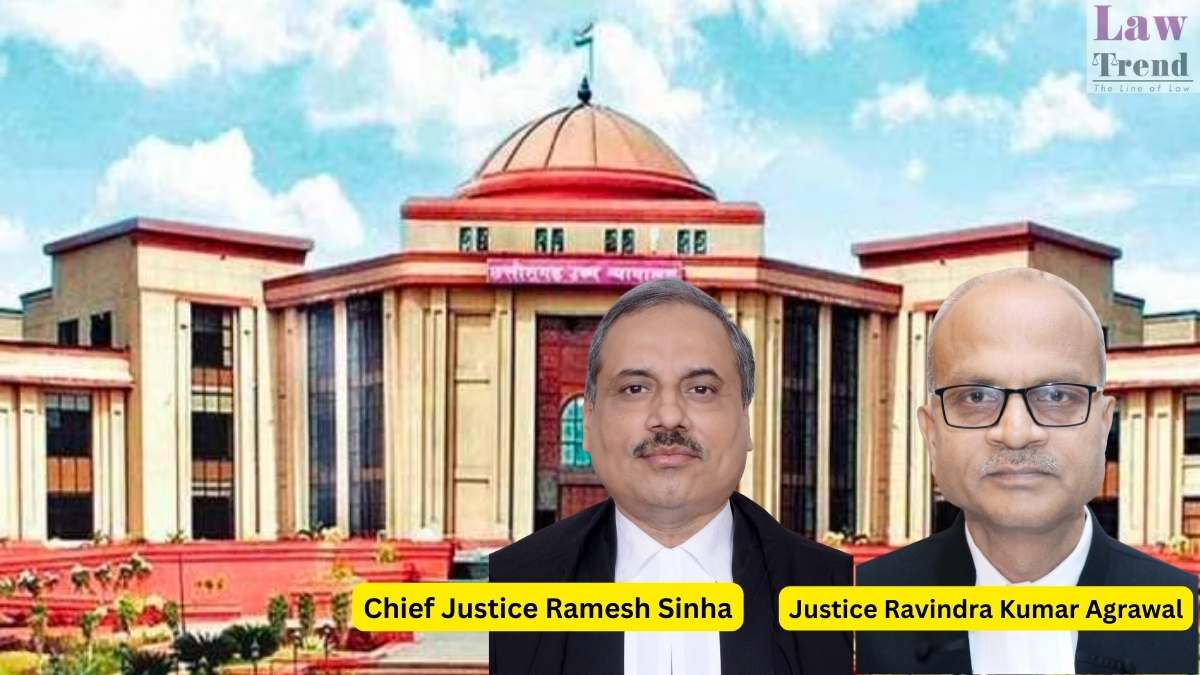
The High Court of Chhattisgarh at Bilaspur has ruled that in highly sensitive and Naxal-affected regions, the prosecution’s case cannot be discarded simply because independent witnesses turn hostile, provided the testimonies of official police witnesses are cogent, trustworthy, and credible. A Division Bench comprising Chief Justice Ramesh Sinha and Justice Ravindra Kumar Agrawal upheld the conviction of three individuals sentenced under the Explosive Substances Act, 1908, and the Unlawful Activities (Prevention) Act, 1967 (UAPA), for transporting explosive materials intended for active Naxalite cadres in Sukma district. The court dismissed both criminal appeals and affirmed the trial court’s decision, which had sentenced the appellants to rigorous imprisonment of up to seven years.
Background of the Case
The case originated on March 8, 2023, when Police Inspector Shivanand Singh received secret information that appellant Semal Deepak and his two associates were traveling to the Belpochcha jungle to supply explosive substances to Vetti Bhima, a commander of a banned Naxalite organization. After reducing the information to writing, the police team, led by SDOP Rohit Shukla, proceeded towards the location under safety protocols. On their way, they requested M. Mallika Arjun and Madvi Nitin to act as independent witnesses.
Near the Belpochcha forest, the search party intercepted three individuals riding a motorcycle who attempted to flee upon seeing the police. The individuals identified themselves as Semal Deepak, Nara Bhaskar, and Telam Mutta. On-the-spot searches of their bags revealed a significant cache of explosives. From Semal Deepak, the police recovered 20 batteries, 45 electronic detonators, a mobile phone, and a Naxalite banner. Nara Bhaskar was found in possession of 33 gelatin rods, a bundle of electric wire, and a mobile phone, while Telam Mutta carried 49 feet of cordex wire and 10 gelatin rods.
Given the highly volatile and Naxal-infested nature of the forest area, the police shifted the appellants and the seized materials to the nearby CRPF Camp in Murliguda to safely prepare the recovery and seizure memos. An FIR was subsequently registered at the Konta police station. The Special Judge (NIA/Scheduled Offences) Bastar, Jagdalpur, subsequently convicted the three appellants, while acquitting another suspected individual, Papi Putti Reddy, who had been apprehended separately.
Arguments of the Parties
Appealing their conviction, the appellants, represented by advocates Somkant Verma, Manoj Chouhan, and Amit Singh Chauhan, argued that the prosecution failed to establish its case beyond a reasonable doubt. They contended that the recoveries were fabricated from an open place, mandatory procedural safeguards were bypassed, and several key independent witnesses had turned hostile. They also relied on a defense witness, Purnachand Naidu, who testified that the appellants were road construction contractors taken by the police directly from their work site rather than being apprehended in the forest.
The Union of India, represented by advocate B. Gopa Kumar alongside Ms. Navya Gopan and Mr. Ayush Bhatt, countered that the prosecution’s case was fully established. He argued that minor contradictions in timing did not affect the core credibility of the official search and seizure witnesses. He highlighted that the appellants were apprehended in a dense forest with a massive quantity of dangerous explosives for which they could offer no legal authorization or plausible explanation.
The Court’s Analysis
The High Court evaluated the evidence and rejected the defense’s arguments. A major point of contention was the hostility of independent witnesses. The Bench noted that while some independent witnesses did not fully support the prosecution, one independent witness, Madvi Nitin, consistently supported the prosecution’s narrative regarding the interception and recovery.
More importantly, the court held that the testimony of official police witnesses cannot be discarded solely because of their professional status. Citing the Supreme Court precedent in Nathusingh v. State of M.P. (1974), the High Court noted that “the mere fact that they are police officers was not enough to discard their evidence. No reason was shown for their hostility to the appellant.”
The Bench further relied on Anil v. State of Maharashtra (1996), quoting the Supreme Court’s observation:
“There is, however, no rule of law that the evidence of police officials has to be discarded or that it suffers from some inherent infirmity. Prudence, however, requires that the evidence of the police officials, who are interested in the outcome of the result of the case, needs to be carefully scrutinised and independently appreciated. The police officials do not suffer from any disability to give evidence and the mere fact that they are police officials does not by itself give rise to any doubt about their creditworthiness.”
To address the initial trust placed in official actions, the court cited State (Govt. of NCT of Delhi) v. Sunil (2001), which held that there is no legal presumption that police officers are untrustworthy witnesses. Dealing with the practical challenges of securing public witnesses in remote and volatile regions, the High Court cited Ajmer Singh v. State of Haryana (2010), in which the Supreme Court held:
“…..it is normally expected that there should be independent evidence to support the case of the prosecution. However, it is not an inviolable rule. Therefore, in the peculiar circumstances of this case, we are satisfied that it would be travesty of justice, if the appellant is acquitted merely because no independent witness has been produced.”
The Supreme Court in Ajmer Singh had further observed:
“We cannot forget that it may not be possible to find independent witness at all places, at all times. The obligation to take public witnesses is not absolute. If after making efforts which the court considered in the circumstances of the case reasonable, the police officer is not able to get public witnesses to associate with the raid or arrest of the culprit, the arrest and the recovery made would not be necessarily vitiated. The court will have to appreciate the relevant evidence and will have to determine whether the evidence of the police officer was believable after taking due care and caution in evaluating their evidence.”
Applying these principles, the High Court found that the testimonies of the police officials and the SDOP were consistent, natural, and inspired confidence, with no demonstrated motive to falsely implicate the appellants. Chief Justice Ramesh Sinha noted that the documentation process was safely and appropriately moved to a secure CRPF camp due to the sensitive location.
The court also took into account the testimony of a protected witness (a former Naxalite commander) who identified Semal Deepak as a regular supplier of explosives to the banned organization, with Nara Bhaskar and Telam Mutta acting as his associates. In contrast, the testimony of defense witness Purnachand Naidu was dismissed by the court, as he failed to produce any documentary evidence of the alleged road construction partnership and admitted to having a prior criminal record.
Decision of the Court
The High Court concluded that the prosecution successfully proved conscious possession of the explosive materials by each of the appellants, as well as their active participation in aiding a banned organization. Finding no perversity, illegality, or misappreciation of evidence in the trial court’s judgment, the High Court dismissed both criminal appeals and affirmed the convictions and sentences of the appellants.
Case Title: Semal Deepak v. Union of India & Nara Bhaskar and Anr. v. Union of India
Case No.: CRA No. 2140 of 2025 & CRA No. 1010 of 2026
Bench: Chief Justice Ramesh Sinha and Justice Ravindra Kumar Agrawal
Date: 30/06/2026