The Andhra Pradesh High Court has granted divorce to a husband under Section 13(1A)(ii) of the Hindu Marriage Act, 1955, holding that the wife failed to prove that he had committed any “wrong” so as to disentitle him from seeking dissolution of marriage after non-compliance with a decree for restitution of conjugal rights.
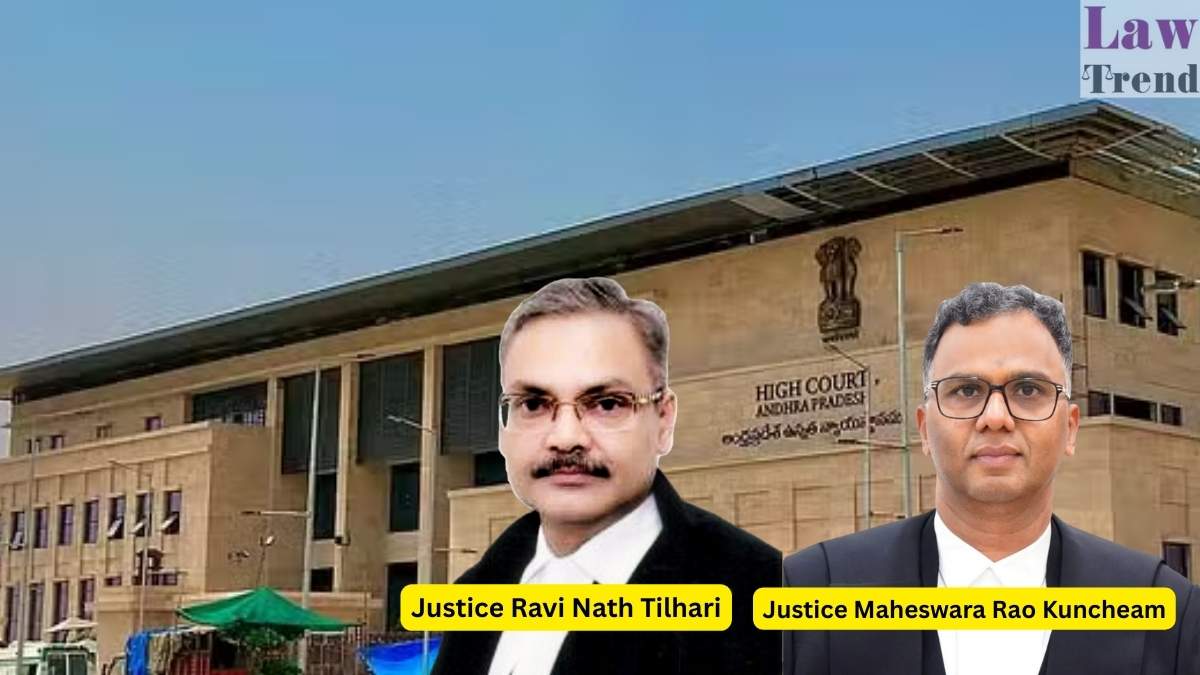
A Division Bench of Justice Ravi Nath Tilhari and Justice Maheswara Rao Kuncheam allowed the husband’s appeal against the dismissal of his divorce petition by the Family Court, Tirupati. The Court set aside the judgment and decree dated August 6, 2004, and dissolved the marriage solemnised between the parties on February 5, 1992.
The appeal arose from HMOP No.64 of 2002, in which the husband had sought divorce under Section 13(1A)(ii) of the Hindu Marriage Act on the ground that there had been no restitution of conjugal rights for more than one year after a decree in favour of the wife.
The parties had earlier litigated before the Family Court. The husband had filed OP No.113 of 1999 seeking divorce, while the wife had filed OP No.114 of 1999 seeking restitution of conjugal rights under Section 9 of the Act. By a common order dated July 12, 2001, the Family Court dismissed the husband’s divorce petition and allowed the wife’s petition for restitution of conjugal rights. The wife had also obtained an order of maintenance in MC No.35 of 1995 for herself and the son.
According to the husband, the wife did not join him after the decree for restitution of conjugal rights. He therefore filed a fresh petition for divorce after the expiry of the statutory period of one year. The wife opposed the petition, denying that she had refused to join him. She claimed that she repeatedly went to the husband’s house but he did not allow her to enter, and submitted that she was still ready to join him.
The Family Court dismissed the husband’s divorce petition. It held that a decree of divorce could not be granted automatically in the absence of bona fides on the husband’s part to comply with the earlier decree of restitution of conjugal rights. The trial court relied on the evidence of the wife and her witnesses to hold that the wife had made attempts to join the matrimonial home but the husband refused to allow her.
Before the High Court, the husband’s counsel argued that the decree for restitution of conjugal rights had not been complied with and that after the statutory period of one year, the husband was entitled to seek divorce under Section 13(1A)(ii). The wife’s counsel submitted that the husband could not take advantage of his own wrong, as he himself had allegedly prevented compliance with the restitution decree.
The High Court framed the central question as whether the Family Court had committed an error in dismissing the divorce petition on the ground that the husband was himself responsible for non-compliance with the decree for restitution of conjugal rights.
Referring to Section 13(1A)(ii), the Bench said the provision enables either party to a marriage to seek divorce where there has been no restitution of conjugal rights for one year or more after a decree for restitution of conjugal rights. The Court noted that the decree was passed on July 12, 2001, the one-year period expired on July 12, 2002, and the husband filed HMOP No.64 of 2002 on July 22, 2002.
The Bench then considered Section 23(1)(a) of the Hindu Marriage Act, which requires the court to be satisfied that the petitioner is not taking advantage of his or her own wrong for the purpose of obtaining relief.
Relying on Dr. N.G. Dastane v. Mrs. S. Dastane, the Court noted that relief under the Hindu Marriage Act can be granted only if the petitioner is not taking advantage of his own wrong. The Bench also referred to Dharmendra Kumar v. Usha Kumar, where the Supreme Court held that grounds under Section 13, including Section 13(1A), remain subject to Section 23.
The High Court quoted the principle from Dharmendra Kumar that, to amount to a “wrong” under Section 23(1)(a), the conduct must be more than mere reluctance to reunite. The judgment records:
“In order to be a ‘wrong’ within the meaning of Section 23(1)(a), the conduct alleged has to be something more than a mere disinclination to agree to an offer of reunion, it must be misconduct serious enough to justify denial of the relief to which the husband or the wife is otherwise entitled.”
The Bench also relied on Smt. Saroj Rani v. Sudarshan Kumar Chadha, where the Supreme Court considered when conduct could fall within the expression “his own wrong” under Section 23(1)(a). It further referred to Pavuluri Murahari Rao v. Povuluri Vasantha Manohari, observing that conduct prior to the decree for restitution of conjugal rights is not relevant and only subsequent conduct can be examined for the purpose of Section 23.
On facts, the High Court found that the wife’s evidence did not prove that the husband had committed any such “wrong”. The wife had stated that the husband never expressed willingness to take her back and that she was ready to join him if he took her. However, in cross-examination, she admitted that she had not taken execution proceedings after obtaining the decree and had not issued any lawyer’s notice despite alleging that the husband refused to take her back.
The Court also examined the evidence of an independent witness who claimed to have accompanied the wife to the husband’s house. The Bench found that the deposition did not inspire confidence because, in cross-examination, the witness stated that she had visited the husband’s house “nearly 12 years back” from January 22, 2004, which would take the alleged visit to 1992, much before the restitution decree dated July 12, 2001. The Court held that such evidence could not establish any post-decree misconduct by the husband.
As to another witness, the Court noted that she was related to the parties, as her daughter had been married to the husband’s brother. The Bench also found inconsistencies between the wife’s evidence and this witness’s version. While the witness claimed that she took the wife to the husband’s house in December 2001, the wife herself had not stated that she visited in December 2001 or that she was accompanied by that witness.
The High Court held that even if the wife’s evidence and the witness’s evidence were considered together, at most they indicated a disinclination on the husband’s part to take the wife back. The Bench said such disinclination, even if assumed, could not be treated as a “wrong” within the meaning of Section 23(1)(a).
The Court observed:
“Even if we do not consider the evidence of PW 1, the husband… still we are of the view that any ‘wrong’ within the meaning of Section 23 (1)(a) of the Hindu Marriage Act on the part of the husband could not be established or proved against him on preponderance of probabilities based on evidence on record neither as a fact nor in law.”
The Bench held that since the wife had alleged that the husband was taking advantage of his own wrong, the burden was on her to prove that she had made efforts to comply with the decree and that the husband had prevented such compliance. The Court found that the burden was not discharged.
It said the evidence of the wife and her witnesses was unreliable due to contradictions and lack of corroboration. The Court concluded that the Family Court had acted illegally in dismissing the divorce petition by holding that the husband was responsible for non-compliance with the decree.
The High Court further observed that the decree for restitution of conjugal rights had been passed against the husband and in favour of the wife. It said that in case of non-compliance, it was open to the decree-holder wife to execute the decree, for which Order 21 Rule 31 CPC specifically provides. However, there was nothing on record to show that the wife had put the decree into execution.
The Bench also noted that the appeal had been pending since 2004 and nothing had been brought on record to show efforts by either side to live together during this long period.
Allowing the appeal, the Court held:
“We are of the view that the ground for divorce under Section 13 (1-A) of the Hindu Marriage Act was made out and the learned Judge, Family Court was not correct in dismissing the OP which deserved to be allowed.”
Accordingly, the High Court set aside the Family Court’s judgment and decree dated August 6, 2004, and declared that the marriage dated February 5, 1992 between the parties stood dissolved. No order as to costs was passed.
Case Details
Case Title: T. Ravi v. T. Lakshmi Devi
Case No.: Civil Miscellaneous Appeal No. 4279 of 2004
Bench: Justice Ravi Nath Tilhari and Justice Maheswara Rao Kuncheam
Date: April 28, 2026
Counsel for Appellant: Sri K.A. Narasimham
Counsel for Respondent: Sri Anup Koushik Karavadi