

High Court Cannot Act as Appellate Court Under Article 227: Supreme Court Reverses Order Reducing NICE Land Compensation
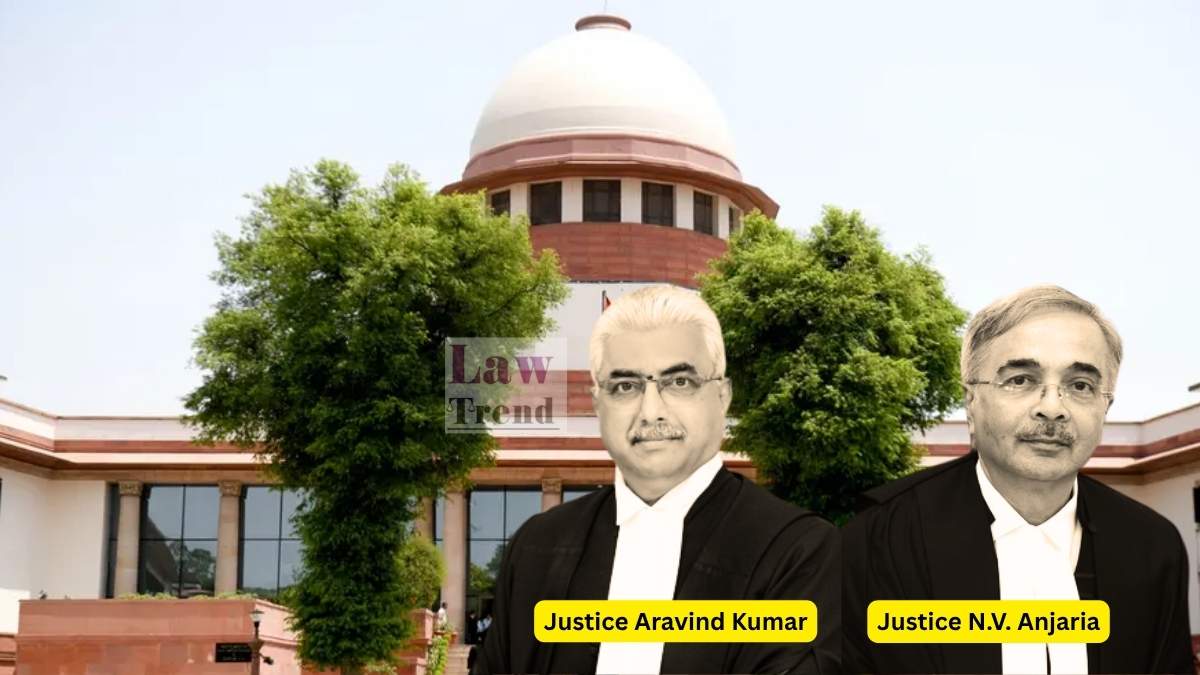

The Supreme Court of India has set aside a judgment of the High Court of Karnataka that had reduced the compensation payable by Nandi Infrastructure Corridor Enterprises (N.I.C.E.) to landowners from ₹1,000 per square foot to ₹500 per square foot. The Bench comprising Justice Aravind Kumar and Justice N.V. Anjaria ruled that the High Court had exceeded its supervisory jurisdiction under Article 227 of the Constitution by acting as an appellate court and substituting its own interpretation of government guidelines for a plausible view taken by the Executing Court.

Background of the Case

The dispute pertains to 3 acres 6 guntas of land in Kengeri Village, Bengaluru, which was part of the Bangalore Mysore Infrastructure Corridor Project (BMICP). A Framework Agreement was executed in 1997 between N.I.C.E. and the Government of Karnataka. The land in question, originally agricultural, was converted for industrial use in 2004.

In 2007, the parties entered into a Memorandum of Settlement (MOS) following a suit for permanent injunction filed by N.I.C.E. Under Clause (xiii) of the MOS, N.I.C.E. agreed that if it failed to convey an alternative “Schedule B” property to the landowners (Decree Holders) within a stipulated time, it would pay the “guideline value fixed by the Government as on today” for the land it utilized.

Upon N.I.C.E.’s failure to convey the alternative land, the Decree Holders filed an Execution Petition. The Executing Court, on May 31, 2012, determined the value to be ₹1,000 per square foot based on the 2007 Government Notification. However, the High Court, in a writ petition filed by N.I.C.E. under Article 227, reduced this to ₹500 per square foot, prompting both parties to approach the Supreme Court.

Arguments of the Parties

On behalf of the Decree Holders (Landowners): Senior Advocate Shri P. Vishwanatha Shetty argued that the Executing Court had strictly followed the 2007 Notification. The property, being within municipal limits and converted for industrial use, attracted a base value of ₹800 per square foot with an additional 25% increase for abutting a State Highway. He contended the High Court wrongly applied “Special Instruction No. 6” to reduce the value by 50% and erroneously impleaded the State Government at a late stage to interpret its own notification.

READ ALSO  Lawyer's Duty to Inform of Party's Death is Not Optional; Abatement Cannot Be Claimed When Death is Suppressed: Supreme Court

On behalf of N.I.C.E. (Judgment Debtors): Senior Advocate Mr. Anil Kaushik contended that the land was undeveloped agricultural land and should be valued at ₹1.56 crore per acre (approximately ₹350 per square foot) as per “Special Instruction No. 1.” N.I.C.E. argued that the High Court erred in treating the land as “developed” and that mandatory deductions for amenities should have been applied, citing the precedent in K.S. Shivadevamma and Others v. Assistant Commissioner and Land Acquisition Officer and Another (1996).

The Court’s Analysis

The Supreme Court primarily addressed whether the High Court exceeded its jurisdiction under Article 227. Referring to settled law, the Court emphasized:

READ ALSO  The person who asserts an act has to prove the same by leading evidence: Delhi HC

“The High Court is not vested with any unlimited prerogative to correct all kinds of hardship or wrong decisions made within the limits of the jurisdiction of the courts subordinate or tribunals. Exercise of this power and interfering with the orders of the courts or tribunal is restricted to cases of serious dereliction of duty and flagrant violation of fundamental principles of law or justice…”

The Bench noted that the High Court had essentially acted as an Appellate Court. The judgment states:

“What the High Court has done in the present matter is precisely what may be characterised as acting in the capacity of an Appellate Court, which is impermissible in the exercise of supervisory jurisdiction under Article 227… The High Court, in effect, acted as an appellate court, which is impermissible in law.”

The Court further criticized the High Court’s decision to implead the State Government and seek a clarification on the notification during the litigation. The Court observed:

“In our considered opinion, such impleadment ought not to have been resorted to, for the reason that the lis throughout was between private parties and arose solely out of a compromise decree. The State was thus placed in the position of being a rule-maker, interpreter, and adjudicator of its own notification simultaneously… Such an approach, in our considered view, is impermissible.”

Regarding the interpretation of the 2007 Notification, the Supreme Court found that the Executing Court’s application of “Column 6” was a plausible view. The Court held:

READ ALSO  Can Application Seeking Further Investigation Be Treated As Protest Petition? Supreme Court Answers 

“Applying Instruction No. 6 in the present factual matrix would lead to an anomalous and absurd outcome whereby converted urban land within BBMP limits is valued lower than agricultural land with conversion benefits, a result that courts have consistently cautioned against.”

Final Decision

The Supreme Court dismissed the appeal filed by N.I.C.E. and allowed the appeal filed by the Decree Holders. The Court ordered:

  1. The High Court’s judgment dated September 12, 2012, is set aside.
  2. The Executing Court’s order is restored, fixing the land value at ₹1,000 per square foot, totaling ₹13,72,14,000.
  3. N.I.C.E. is directed to pay the balance amount of ₹8,79,95,250 (after adjusting the ₹4.92 crore already deposited).
  4. The balance amount shall carry interest at the rate of 6% p.a. from August 20, 2007, as previously determined by the High Court in a related writ petition (W.P. No. 25158 of 2012).

Case Details:

  • Case Title: Nandi Infrastructure Corridor Enterprises Ltd. & Anr. v. B. Gurappa Naidu & Ors.
  • Case No.: Civil Appeal No. 1388 of 2013 (with Civil Appeal No. 1354 of 2013)
  • Bench: Justice Aravind Kumar and Justice N.V. Anjaria
  • Date: April 30, 2026

Law Trend
Law Trendhttps://lawtrend.in/
Legal News Website Providing Latest Judgments of Supreme Court and High Court

Related Articles

Latest Articles

