

University Visitor Who Appointed “First Registrar” Under Transitional Provision Retains Power to Terminate Services: Supreme Court
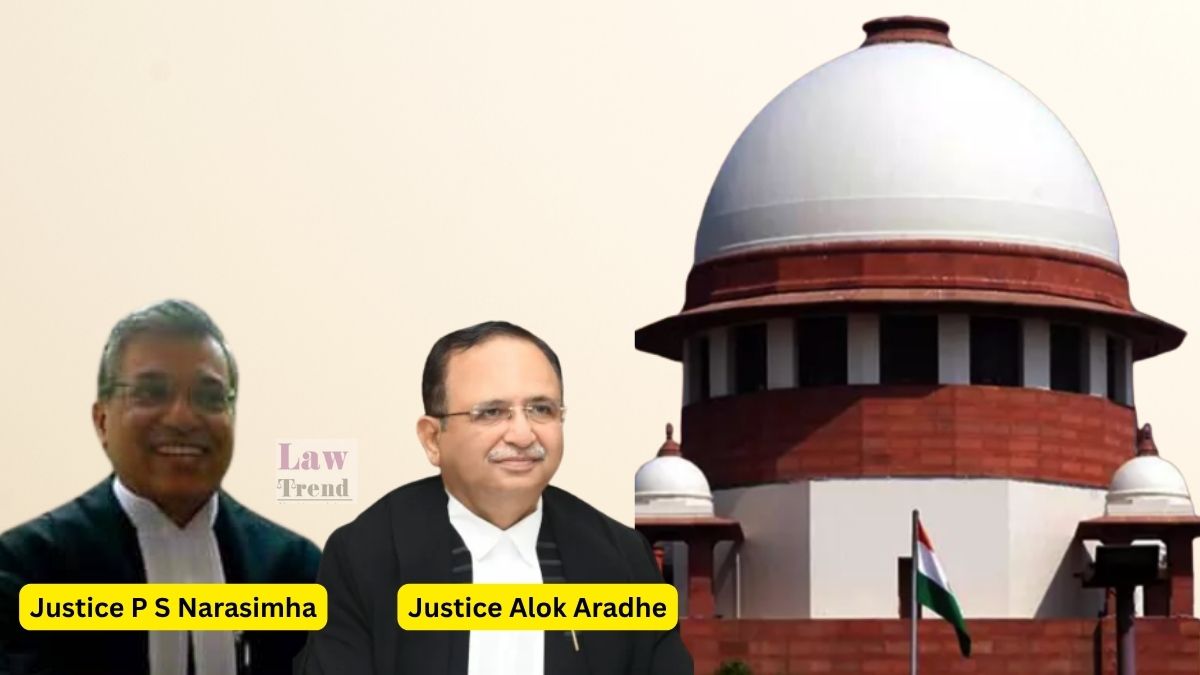

The Supreme Court of India, in its judgment in Vice Chancellor, Rajiv Gandhi National Aviation University v. Jitendra Singh & Ors. (2026 INSC 520), has held that the President of India, acting as the Visitor and the appointing authority of the First Registrar under transitional provisions, possesses the necessary legal authority to approve disciplinary action and terminate his services.

The division bench of Justice Pamidighantam Sri Narasimha and Justice Alok Aradhe clarified that under Section 16 of the General Clauses Act, 1897, the power to make an appointment inherently carries with it the power to suspend or dismiss. The Court, therefore, set aside the findings of the Division Bench of the High Court of Judicature at Allahabad, Lucknow Bench, which had ruled that the Visitor has no role in the disciplinary proceedings of the University.

However, given the expiry of the First Registrar’s tenure and the prolonged history of litigation between the parties, the Apex Court declined to interfere with the operative directions of the High Court.

Factual Background

The Rajiv Gandhi National Aviation University was established under the Rajiv Gandhi National Aviation University Act, 2013 (“the Act”), to facilitate and promote aviation studies. On March 7, 2016, the Central Government framed the Rajiv Gandhi National Aviation University, First Statute, 2016 (“the Statutes”), under Section 27(1) of the Act.

The President of India, in his capacity as the Visitor of the University, conveyed his approval on February 28, 2019, for the appointment of the respondent, Jitendra Singh, as the First Registrar of the University. Consequently, on March 1, 2019, the Vice Chancellor issued an offer of appointment to the respondent, placing him on probation for a period of one year. He assumed charge of the office on April 8, 2019.

During his probation, the respondent’s services were terminated by an order dated January 8/9, 2020, and he was paid one month’s salary in lieu of notice. The respondent initiated multiple rounds of litigation:

  1. He first filed two writ petitions challenging the termination and the subsequent advertisement for the post of Registrar, which were withdrawn on January 13, 2021, with liberty to file fresh petitions.
  2. He filed a fresh writ petition on January 22, 2021. On September 17, 2021, a Single Judge of the High Court directed the appellants to reinstate the respondent to the post of Registrar with all consequential benefits.
  3. The University challenged this before the Division Bench of the High Court, which on December 17, 2021, held that the termination during probation was ex-facie stigmatic. The matter was remitted to the University to proceed afresh in accordance with law within two months, while the entitlement to back wages was made subject to the final outcome.
  4. The respondent’s Special Leave Petition against this Division Bench order was dismissed by the Supreme Court on February 4, 2022, with liberty to raise all pleas by way of representation.
READ ALSO  CJI UU Lalit Says SC Disposed of 1293 Misc. Matters, 440 Transfer Pleas and 106 Regular Matters In The Last Four Days

Pursuant to the remand, the respondent was reinstated on December 31, 2021, but was placed under suspension on the very same day in contemplation of disciplinary proceedings. A Memorandum of Charges was served on him on February 22, 2022.

An Enquiry Committee comprising three members was constituted on February 25, 2022, which submitted its report on March 23, 2022, holding the charges of “indiscipline, gross insubordination, unprofessional conduct and obstruction of public servants in discharge of official duties” as proved. The report was forwarded to the Secretary, Ministry of Civil Aviation (“MOCA”), who submitted a proposal for the approval of the Visitor.

The Visitor approved the termination on April 20, 2022, which was communicated to the respondent on April 27, 2022, by the Deputy Secretary, MOCA.

The respondent challenged this second termination, as well as a fresh job advertisement, before the High Court. On April 25, 2023, the learned Single Judge ruled that because the respondent’s services were never extended beyond the initial one-year probation, he was only entitled to one month’s notice prior to termination and directed the appellants to pay him one month’s salary.

On an intra-court appeal, the Division Bench of the High Court, by an order dated May 22, 2024, set aside the orders of the Single Judge and the Deputy Secretary, MOCA. The Division Bench held that MOCA had no statutory role and that the Visitor has no role in disciplinary proceedings concerning officers and employees of the University. The entire action was declared to be without jurisdiction. The respondent was also held entitled to back wages and salary up to April 7, 2022. Aggrieved by this, the University and the Union of India preferred the present appeals before the Supreme Court.

Arguments of the Parties

For the Appellants (University and Union of India):

  • It was argued that the High Court erred in holding that the Visitor lacked the jurisdiction to initiate disciplinary action.
  • The senior counsel argued that the respondent was the “First Registrar” and his appointment was strictly governed by the transitional provisions of Section 46 of the Act. Under Section 46(b), the President of India (as the Visitor) conveyed the approval for his appointment. Therefore, the disciplinary action was rightly taken with the approval of the Visitor.
  • The appellants contended that Clause 7 of the Statutes applies exclusively to regular appointments and not to the appointment of the “First Registrar.”
  • The Additional Solicitor General, appearing for the Union of India, submitted that till the constitution of the first Executive Council, the Steering Committee of MOCA was required to function as the interim Executive Council, as per the proviso to Section 20(1) of the Act. Therefore, the Visitor was competent to take action against the First Registrar.
READ ALSO  WhatsApp Chats Inadmissible as Evidence Without Proper Certification Under Evidence Act: Delhi High Court

For the Respondent (First Registrar):

  • The senior counsel appearing for the respondent argued that while the Visitor is empowered to appoint the Vice Chancellor, the Visitor cannot exercise disciplinary authority on the recommendation of MOCA.
  • It was urged that MOCA has no statutory role in the disciplinary proceedings of the University’s employees.
  • The respondent was an employee of the University and not of MOCA; thus, no disciplinary action could have been initiated or processed by the Ministry.

The Court’s Analysis and Findings

The Supreme Court examined the statutory interplay between the Rajiv Gandhi National Aviation University Act, 2013, the First Statutes, 2016, and the General Clauses Act, 1897.

On the Nature of Transitional Provisions

The Court noted that Section 46 of the Act contains transitional provisions. Explaining the legal function of such provisions, the Court referred to Thornton on Legislative Drafting (3rd ed., 1987, p. 319):

“The function of a transitional provision is to make special provision for the application of legislation to the circumstances which exist at the time when the legislation comes into force.”

The Court further noted that a key feature of transitional provisions, as observed by the UK House of Lords in Britnell v. Secretary of State for Social Security ([1991] 2 All ER 726), is that:

“…its operation is expected to be temporary, in that it becomes spent when all the past circumstances with which it is designed to deal have been dealt with, while the primary legislation continues to deal indefinitely with the new circumstances which arise after its passage.”

Applying these principles, the Court observed that under Section 46(b), the First Registrar and the First Finance Officer are appointed by the Visitor on the recommendation of the Vice-Chancellor for a term of three years. The Court held:

“The power under Section 46(b) of the Act, exhausts itself when it is exercised by making an appointment.”

On the Appointing Authority’s Power to Dismiss

The Court distinguished the “First Registrar” from a “Regular Registrar.” While Statute No. 28 provides that the regular appointing authority for the post of Registrar is the Executive Council, the First Registrar was appointed under the transitional provision of Section 46(b) by the Visitor.

READ ALSO  Can't Deny Cooperative Society Membership to Lawful Tenants Merely on Delayed Contribution: Supreme Court

The Court invoked Section 16 of the General Clauses Act, 1897, which stipulates that where a power to make an appointment is conferred, the authority possessing that power also has the power to suspend or dismiss unless a contrary intention appears. The Court observed:

“Thus, the appointing authority necessarily possesses the power to terminate the services of the employee appointed by it.”

Applying this principle to the facts, the Court ruled:

“In the instant case, the First Registrar was appointed on 01.03.2019 and joined the services of the University on 08.04.2019… Therefore, in terms of Statute No.28(1), the services of the First Registrar were terminated by the Visitor who was also the appointing authority of the First Registrar. The action terminating services of the First Registrar appears to be in consonance with Statute No. 28(1).”

The Court explicitly disagreed with the Lucknow Bench of the Allahabad High Court, stating:

“We are, therefore, unable to concur with the finding recorded by the Division Bench of the High Court in its judgment dated 22.05.2024 that the Visitor had no role in the disciplinary proceedings against the First Registrar of University.”

The Decision

Despite ruling in favor of the appellants on the legal issue of the Visitor’s jurisdiction, the Supreme Court took a pragmatic approach regarding the relief. Considering the unique circumstances of the case, including the expiry of the respondent’s three-year term of appointment (which ended on February 28, 2022) and the multiple rounds of litigation, the Bench decided not to disrupt the actual outcome of the High Court’s order.

The Court concluded:

“However, having regard to the peculiar facts and circumstances of the case, namely, the expiry of period of appointment of the First Registrar and the repeated rounds of litigation between the parties, we are not inclined to interfere with the operative directions issued by the High Court.”

Accordingly, the Supreme Court disposed of the appeals with no order as to costs.

Case Details

  • Case Title: Vice Chancellor, Rajiv Gandhi National Aviation University v. Jitendra Singh & Ors. (with connected appeal)
  • Case No.: Civil Appeal No. ___ of 2026 [Arising out of SLP (C) No. 16265 of 2024] with Civil Appeal No. ___ of 2026 [Arising out of Diary No. 38863 of 2024]
  • Bench: Justice Pamidighantam Sri Narasimha and Justice Alok Aradhe
  • Date of Judgment: May 21, 2026

Law Trend
Law Trendhttps://lawtrend.in/
Legal News Website Providing Latest Judgments of Supreme Court and High Court

Related Articles

Latest Articles

