

Trial Courts Must Bestow Equal Attention To Defence Evidence As Prosecution Evidence: Supreme Court Acquits Husband In 26-Year-Old Case
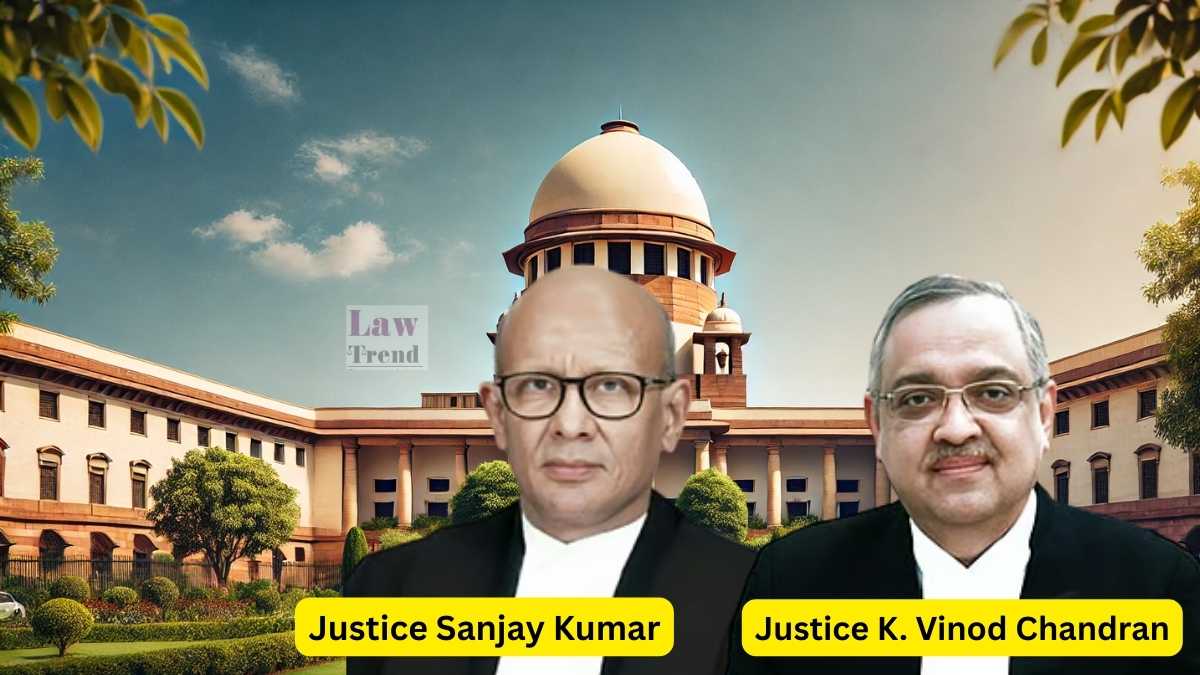

The Supreme Court of India, in a bench comprising Justice Sanjay Kumar and Justice K. Vinod Chandran, has ruled that trial courts must evaluate defence evidence with the same level of attention as prosecution evidence, holding that there is no cause to approach the case of an accused with distrust or skepticism. Adhering to this principle, the Court set aside the conviction of a husband accused of marital cruelty and dowry death, highlighting a series of severe procedural and evidentiary lapses by the prosecution.

The judgment resolved a long-standing legal battle stemming from an incident in April 2000, wherein the appellant, Brajesh Kumar alias Birjesh Kumar Singh, was accused of causing the death of his wife. While the trial court had convicted the husband, the High Court had subsequently remanded the matter for a fresh trial due to procedural irregularities during a joint trial. Overturning both decisions, the Supreme Court heard the matter on its merits to prevent further delays, ultimately acquitting the husband.

Background of the Case

The case originated from an incident on April 13, 2000, in Mirzapur, Uttar Pradesh, where the wife of the appellant sustained 40% burn injuries at her matrimonial home. She was first admitted to the District Hospital in Mirzapur and later transferred to a private nursing home in Allahabad, where she succumbed to her injuries on May 2, 2000.

A First Information Report (FIR No. 272 of 2000) was registered on June 1, 2000, at the Kotwali Police Station in Munger, Bihar (where the victim’s parental home was situated), based on a complaint filed by the victim’s father before the Chief Judicial Magistrate under Section 156(3) of the Criminal Procedure Code (CrPC). The complaint named 17 individuals, including the husband (A1), his brother (A2), and other joint family members, alleging persistent dowry demands of Rs. 50,000, harassment during pregnancy, a forced abortion, and a hasty cremation to avoid a postmortem examination.

The investigation led to two distinct final reports. The first report, Final Report No. 625 of 2000 dated October 31, 2000, was filed against the parents-in-law, who were in judicial custody, while directing further investigation against the remaining 15 accused. This first report resulted in Sessions Case No. 592 of 2001, ending in the acquittal of both parents-in-law on December 17, 2012.

READ ALSO  सुप्रीम कोर्ट का बड़ा फैसला: आपराधिक मामला लंबित होने पर भी मिल सकता है 10 साल का पासपोर्ट, अगर कोर्ट की हो 'नो ऑब्जेक्शन'

Concurrently, a second final report (Final Report No. 215 of 2005 dated May 31, 2005) was filed by a different investigating officer, stating that no evidence was found against the remaining 15 accused. However, the trial court took cognizance, which led to Sessions Case No. 504 of 2006. In this second trial, also decided on December 17, 2012, the trial court acquitted 14 of the accused relatives but convicted the husband.

The High Court later remanded the matter back to the trial court, noting that the husband was not present during the examination of certain witnesses prior to the clubbing of the two cases. The husband appealed this remand order before the Supreme Court.

Arguments of the Parties

Prosecution’s Arguments

The prosecution relied on the oral testimonies of the victim’s family members, including her father (PW6), her brothers (PW3, PW4, PW5, and PW14), a cousin (PW2), and family associates (PW1 and PW11). The witnesses reiterated that the appellant and his family had continuously demanded a dowry of Rs. 50,000 from the inception of the marriage. They argued that the victim was subjected to systematic cruelty, which ultimately led to her death, and claimed they had to rushedly cremate her because the in-laws were highly influential.

Defence’s Arguments

The appellant-husband (DW1) argued that he was falsely implicated after he refused the family’s demand to marry the deceased wife’s sister. The defence contended that the fire was entirely accidental.

To support this, the defence presented substantive documentary and oral evidence:

  • Call records (Exhibit B) and telegram receipts (Exhibits C and D) showing that the husband immediately informed his father-in-law about the accident on April 14, 2000.
  • Proof of joint financial investments made in the names of both the husband and wife, including Kisan Vikas Patra and National Saving Certificates, which far exceeded the alleged dowry demand of Rs. 50,000.
  • Medical certificate (Exhibit A) proving that the husband’s left hand was scorched in his attempt to save his wife.
  • Hospital receipts (Exhibits G to G/14) and medical prescriptions showing that the husband paid for her extensive medical care, refuting claims that the father had to return to his village to arrange treatment funds.
  • Testimony of the emergency medical officer (DW4) of the District Hospital, Mirzapur, who verified that the victim was fully conscious when admitted and that she did not have injured fingers, contradicting prosecution assertions designed to invalidate her thumbprint.
  • Testimony of the Executive Magistrate (DW5) and the treating doctor (DW2), who recorded a dying declaration (Exhibit 1/2) where the victim explicitly stated that the fire occurred accidentally when a gas stove pipe disconnected while she was boiling milk, and that her husband and in-laws had actively tried to save her.
READ ALSO  One Mark For Each Year of Practice to be Given, Clarifies Supreme Court on Process for Designation of Senior Advocates

The Court’s Analysis

The Supreme Court first addressed the procedural issues regarding the dual trials and the S.P.’s directive to split the investigation, clarifying that the Superintendent of Police had acted without authority. Under Sections 158 and 173(3) of the CrPC, such instructions must come through the proper legal channels, and the opinion on whether an accused should stand trial lies solely with the investigating officer.

The Court reviewed multiple precedents concerning investigation and cognizance. It cited H.N. Rishbud v. State of Delhi, which held that an invalid investigation does not automatically nullify a trial unless a miscarriage of justice is shown. Referencing Abhinandan Jha v. Dinesh Mishra and King Emperor v. Khwaja Nazir Ahmad, the Court underlined that while a Magistrate cannot compel the police to file a charge sheet upon receiving a closure report, the court has the absolute power under Section 190 of the CrPC to take cognizance independently based on the facts disclosed in the report. This principle was supported by Ram Naresh Prasad v. State of Jharkhand, H.S. Bains v. State (U.T. of Chandigarh), and Ramswaroop Soni v. State of M.P..

On the consolidation of split trials, the Court cited Banwari v. State of U.P., noting:

“…the validity of a joint trial before the Sessions Judge is dependent on the fact whether the provisions of the Code justify one joint trial or not”

Turning to the merits of the evidence, the Court expressed deep concern over the severe lapses in the prosecution’s investigation. No postmortem was conducted, and no wound certificate was produced. The prosecution failed to summon the treating doctor as a witness or produce the medical file. The Investigating Officer (PW15) admitted that, apart from the immediate family of the complainant, no one in the neighborhood supported the allegations of marital discord.

The Supreme Court observed that the prosecution’s witnesses merely offered a “bland repetition” of dowry demands, which was completely contradicted by the financial documents showing joint investments and a secure marital life. Conversely, the defence presented highly credible and consistent evidence that was left uncontroverted.

Critiquing the trial court’s dismissive approach to the exculpatory dying declaration and the defence’s evidence, the Supreme Court noted:

READ ALSO  सुप्रीम कोर्ट ने जिला न्यायाधीशों की नियुक्तियों में कथित अनियमितताओं को चुनौती देने वाली याचिका पर झारखंड हाईकोर्ट को नोटिस जारी किया

“The trial courts would do well to bestow equal attention to the defence evidence as that bestowed on the prosecution evidence. There is no cause to approach the defence evidence with distrust, suspicion or even scepticism.”

The Court invoked the landmark ruling in Sharad Birdhichand Sarda v. State of Maharashtra, stating:

“The accused is not obliged to prove his/her innocence and if a reasonable doubt is raised either from the unsatisfactory evidence led by the prosecution or from the evidence led by the defence its benefit should inure to the accused…”

Highlighting the strict standards required to sustain a criminal conviction, the Court cited Swaran Singh v. State of Punjab, reiterating that:

“in travelling from ‘may be true’ to ‘must be true’ the whole of the distance should be paved with ‘legal, reliable and unimpeachable evidence’.”

The Supreme Court concluded that the prosecution had completely failed to prove any dowry demands, marital cruelty, or involvement in the victim’s death, whereas the defence had successfully established a highly probable hypothesis of innocence.

The Decision

The Supreme Court allowed the appeal and acquitted the appellant, Brajesh Kumar alias Birjesh Kumar Singh. The Court reversed the conviction order passed by the Sessions Court and set aside the remand order of the High Court. The Court directed that the appellant’s bail bonds be cancelled, and if he remained in custody, he must be released immediately.

Case Details

Case Title: Brajesh Kumar @ Birjesh Kumar Singh Versus The State of Bihar

Case No.: Criminal Appeal No. 3117 of 2026 (@Special Leave Petition (Crl.) No. 474 of 2026)

Bench: Justice Sanjay Kumar, Justice K. Vinod Chandran

Date: July 13, 2026

Law Trend
Law Trendhttps://lawtrend.in/
Legal News Website Providing Latest Judgments of Supreme Court and High Court

Related Articles

Latest Articles

