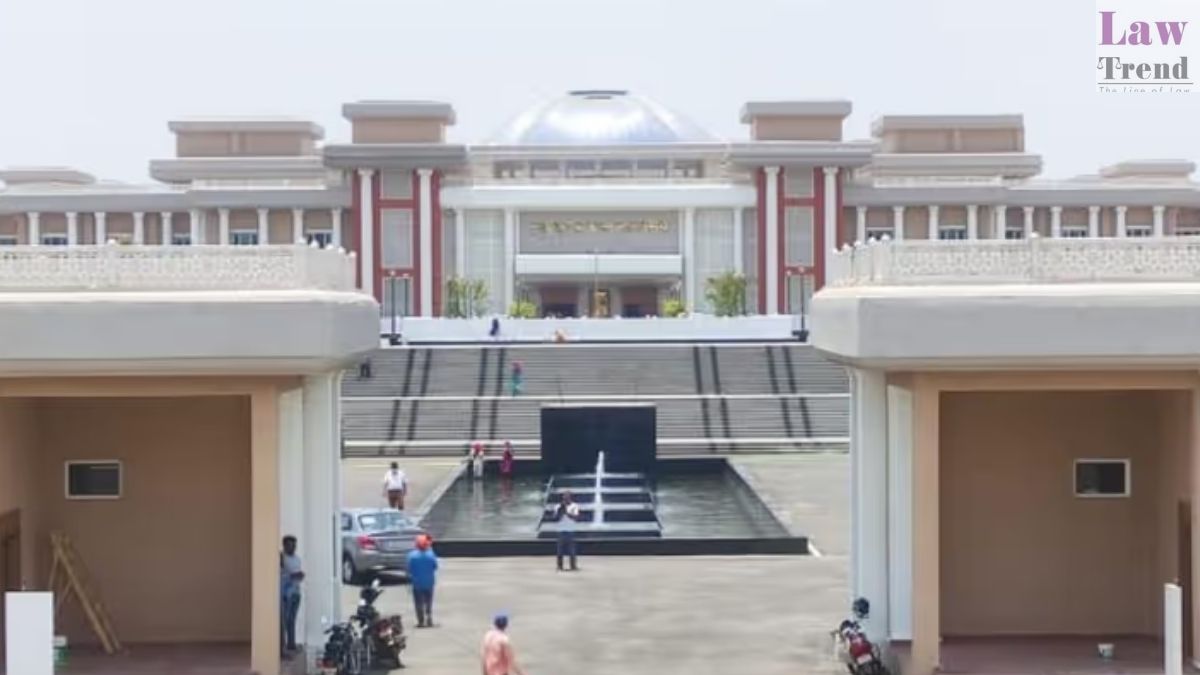
The Jharkhand High Court has ruled that extraordinary writ jurisdiction under Article 226 of the Constitution of India cannot be utilized to adjudicate complex and disputed questions of property facts, nor can it be used to interfere with the executive’s primary duty to maintain law and order. This ruling was delivered by Justice Sanjay Kumar Dwivedi while dismissing a writ petition that challenged an order passed by the Sub-Divisional Officer, Chas, which directed the deployment of police force to prevent encroachment and maintain public peace over a disputed land parcel in Bokaro.
Background of the Case
The dispute centers on 8 decimals of land situated in Plot No. 464, Khata No. 26, Mauja Tetulia, in the Bokaro district (formerly part of Dhanbad). The petitioner, Md. Shahid Raja, asserted that his father, Md. Khalil Ansari, purchased the 8 decimals of land from Smt. Kumari Ghatwalin on November 6, 1979, through a registered sale deed. He claimed that the land was subsequently mutated, rent was regularly paid, and his family remained in peaceful possession.
However, the petitioner approached the High Court in 2012 to challenge an order dated April 10, 2012, passed by the Sub-Divisional Officer (SDO), Chas. The SDO’s order, which was based on an investigation report submitted by the In-charge of the Sector-12 Investigation Centre, directed the deployment of police force to secure and maintain the possession of Respondent No. 5, Ram Bahadur Singh, over the land. The petitioner alleged that he was forcefully dispossessed due to this executive action and sought the quashing of the SDO’s order.
Arguments of the Parties
The learned senior counsel appearing for the petitioner argued that the SDO’s order directing the deployment of police force to grant possession to Respondent No. 5 was entirely without jurisdiction. He contended that the state’s actions were highly arbitrary and had resulted in the forceful dispossession of the petitioner. To support his arguments, the counsel relied on the Patna High Court ruling in Deba Jyoti Dutta and Ors. v. State of Bihar and Ors. and the Jharkhand High Court ruling in Shailendra Kumar Gupta and Another v. State of Jharkhand and Others, arguing that the High Court is fully competent under Article 226 to intervene when the State acts arbitrarily in the absence of valid legal proceedings.
Conversely, the learned counsel appearing for the State strongly opposed the petitioner’s plea. The State argued that the SDO’s order was passed strictly to maintain law and order in the locality. According to the State, Respondent No. 5 had purchased the 8 decimals of land from one Mehar Babu Ansari on August 20, 1979, constructed a boundary wall with a locked gate, and paid rent regularly. When certain individuals attempted to forcefully enter and grab the land, Respondent No. 5 filed a complaint. Following official land measurements and inquiries, the local administration deployed forces to protect the possession of the rightful owner and prevent public unrest.
The State further informed the Court that during the pendency of the writ petition, Respondent No. 5 sold the land to Smt. Sharda Devi (Respondent No. 6) on September 20, 2012. A physical spot verification conducted by the Circle Officer, Chas, in June 2023—ordered by a Co-ordinate Bench of the High Court—confirmed that Respondent No. 6 was in physical possession of the property, which featured a boundary wall, two asbestos rooms, a hand pump, and a steel gate. The State and Respondent No. 6 pointed out that the petitioner had consistently failed to produce his registered sale deed before the Court, and his claim lacked boundary details.
The Court’s Analysis
The Court carefully examined the pleadings and noted that although the petitioner asserted in multiple paragraphs of the writ petition that he would produce the relevant sale deeds at the time of the hearing, he failed to file them. The Court observed that this omission strongly suggested an intention to conceal the exact area and boundary details of the purchased plot.
Justice Sanjay Kumar Dwivedi noted that in property disputes concerning encroachment, facts cannot be determined in the absence of an agreed map. While the Circle Officer had conducted an official land demarcation for the respondents, the petitioner had never approached the competent authority for any land identification.
Addressing the maintainability of the writ petition under Article 226, the Court delivered a definitive finding on the limitations of its extraordinary jurisdiction:
The question remains that if such a disputed question of fact is there whether the writ court is competent to pass order under Article 226 of the Constitution of India or not? The answer is flatly “no”. If such things have been hidden by the petitioner himself even not approaching the High Court with clean hand that cannot be a subject matter of Article 226 of Constitution of India as the disputed question of fact can only be a subject matter of suit.
Furthermore, the Court emphasized that the scope of judicial review regarding executive functions aimed at maintaining public order is extremely limited. Citing the Supreme Court of India’s decision in State of Karnataka v. Praveen Bhai Thogadia (Dr.), the Court reiterated that administrative authorities are best suited to assess and handle local law-and-order situations, and courts should not substitute their views for those of the competent executive authorities.
The Court also highlighted that Article 226 cannot be used as an appellate forum to resolve complex factual controversies. Relying on the landmark Supreme Court ruling in City and Industrial Development Corpn. v. Dosu Aardeshir Bhiwandiwala, the Court highlighted the duties of a writ court:
The Court while exercising its jurisdiction under Article 226 is duty bound to consider whether adjudication of writ petition involves any complex and disputed questions of facts and whether they can be satisfactorily resolved.
Distinguishing the legal precedents cited by the petitioner, the Court found that Deba Jyoti Dutta and Shailendra Kumar Gupta were decided on entirely different factual matrices—involving lease renewals and uncompensated land acquisition for public drainage respectively—and thus offered no assistance to the petitioner’s case.
Decision of the Court
The High Court concluded that there was no illegality in the SDO’s order, as maintaining law and order falls squarely within the domain of the district administration. Finding that the dispute involved deeply contested factual issues that can only be resolved through a civil suit, the Court dismissed the writ petition.
Case Details:
Case Title: Md. Shahid Raja v. The State of Jharkhand and Others
Case No.: W.P. (C.) No. 4667 of 2012
Bench: Justice Sanjay Kumar Dwivedi
Date: 07.07.2026