

Motor Accident Claims Must Be Decided on Preponderance of Probabilities, Not Criminal Standard of Proof: Supreme Court
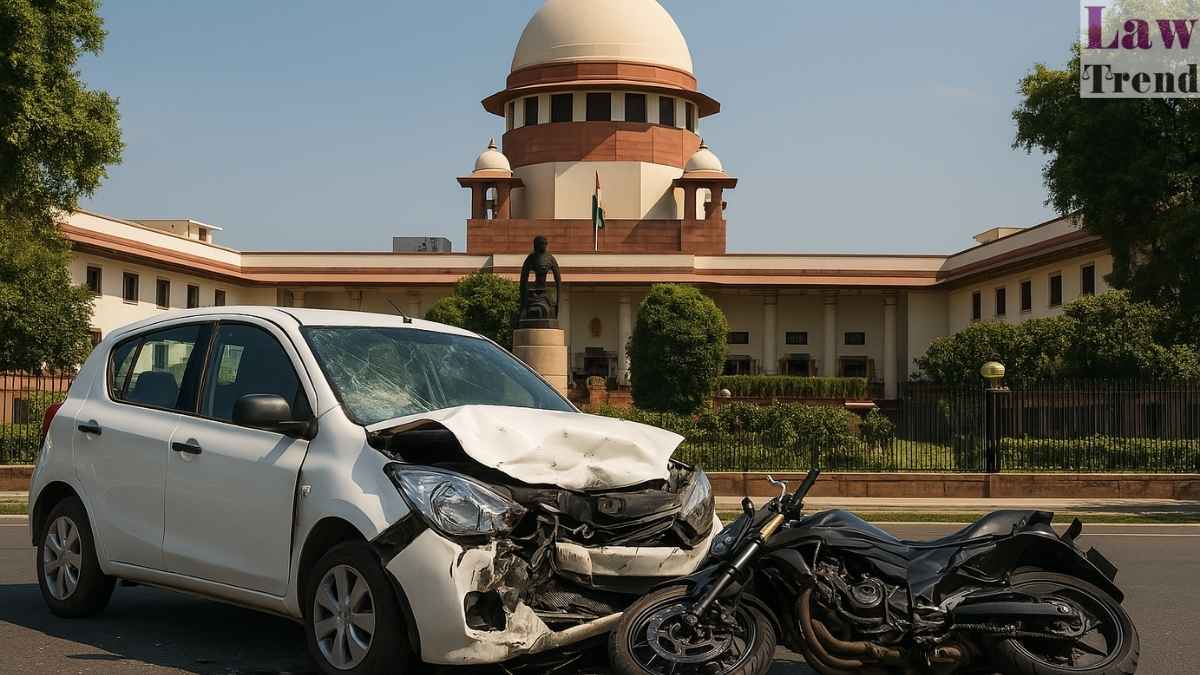

The Supreme Court of India, led by a bench comprising Justice Sanjay Karol and Justice Vipul M. Pancholi, has ruled that motor accident claim proceedings must be decided based on the preponderance of probabilities rather than the strict standard of proof beyond reasonable doubt required in criminal trials. Setting aside the concurrent orders of the High Court of Judicature at Allahabad and the Motor Accident Claims Tribunal, Jalaun at Orai, the Supreme Court allowed the appeals and awarded significant compensation to the families of three teachers who lost their lives in a road accident in 2002.

Background of the Case

The case arose from a fatal road accident that occurred on January 30, 2002, at approximately 10:00 p.m. A Maruti Car, bearing registration number UP-92A-2223, was traveling from Allahabad toward Orai on the Allahabad-Kanpur Road. The car was driven by Mata Prasad and occupied by Ajeet Singh, Roop Singh, and Dr. Dileep Kumar Katiyar. Near the Sarsaul Police Station, the car collided with a heavy tanker bearing registration number UP-81E-6258, which was driven by Vinod Kumar.

The impact of the collision was severe. Mata Prasad, Ajeet Singh, and Roop Singh succumbed to their injuries, while Dr. Katiyar survived with serious injuries. The deceased were all school teachers and the primary breadwinners of their families, earning monthly incomes of Rs. 10,071, Rs. 10,345, and Rs. 9,708, respectively. Their legal representatives filed separate claim petitions under Section 166 of the Motor Vehicles Act, 1988, seeking compensation.

Arguments of the Parties

The claimants consistently argued that the accident was caused solely by the rash and negligent driving of the tanker, asserting that the Maruti Car driver was not negligent.

In response, the respondents contended that the tanker was stationary on the left side of the road because its conductor had stepped away to attend to a call of nature. They alleged that the Maruti Car was driven rashly on the wrong side of the road, which led to the collision.

READ ALSO  सुप्रीम कोर्ट ने जजों के सुनवाई से अलग होने के लिए दिशा-निर्देश बनाने की याचिका खारिज की, कहा – फैसला करना सिर्फ संबंधित जज का विवेकाधिकार

The Tribunal accepted the respondents’ defense and dismissed the claim petitions under Section 166, granting only a basic award under “no-fault liability.” The Tribunal relied almost exclusively on photographs marked as Exhibits 3 and 4, which showed the tanker parked on the left side and the car on the wrong side of the road. The High Court subsequently affirmed this dismissal.

The Court’s Analysis

The Supreme Court examined the standard of proof applicable to motor accident claim proceedings. Justice Karol, delivering the judgment, pointed out that the Tribunal is not a criminal court and must not apply criminal standards of proof to civil liability. The Court cited several landmark cases, including Sithara N.S. & Ors. vs. Sai Ram General Insurance Company Limited (2025) and Prabhavathi & Ors. vs. The Managing Director, Bangalore Metropolitan, Transport Corporation (2025). The bench also noted the principle established in Sunita v. Rajasthan SRTC (2020) and reiterated in Rajwati alias Rajjo & Ors. v. United India Insurance Company Ltd. & Ors. (2022) that:

READ ALSO  पति-पत्नी ने एक दूसरे पर किए 60 मुक़दमे, सुप्रीम कोर्ट ने कहा ये वकीलों की चतुराई- जाने विस्तार से

“the standard of proof to be borne in mind must be of preponderance of probability and not the strict standard of proof beyond all reasonable doubt which is followed in criminal cases”.

Applying this standard, the Court found the testimony of the surviving eyewitness, Dr. Katiyar, to be highly credible. He testified that the car was driven at a controlled speed on the correct side of the road when the oncoming tanker collided with it.

Conversely, the Court found the respondents’ evidence to be highly suspect. The owner of the tanker admitted that the photographs used to deny the claim were taken 10 to 12 hours after the accident, meaning they did not reflect the position of the vehicles at the time of impact. Additionally, the respondents failed to produce the tanker’s conductor—the most material witness to support their defense—without offering any explanation.

The Court further noted that even if the tanker had been stationary, parking a heavy vehicle on a dark highway in January without warning indicators constituted a serious breach of duty. The Court held:

“Parking a heavy vehicle on a public road at night, without an adequate warning signal, as is in the present case, constitutes negligence in itself.”

Applying the doctrine of res ipsa loquitur (the thing speaks for itself), the Court ruled that the burden had shifted to the respondents to prove they had taken reasonable precautions, which they failed to do. The Court also noted that the police had filed a charge-sheet against the tanker driver, corroborating the claimants’ case.

READ ALSO  "India's Majority Population Could Become Minority": Allahabad HC Warns Against Forced Conversions

The Decision

Holding that “the concurrent findings recorded by the Tribunal and affirmed by the High Court are perverse and unsustainable in law,” the Supreme Court set aside the previous judgments.

To determine the quantum of compensation, the Court applied the established guidelines from Sarla Verma v. Delhi Transport Corporation (2009) and National Insurance Co. Ltd. v. Pranay Sethi (2017). The Court calculated and awarded the following final compensation amounts, which include 9% interest up to February 22, 2026, minus the Rs. 50,000 already received under no-fault liability:

  • In SLP (C) No. 10565/2025 (Manju Singh): A final compensation of Rs. 65,58,449.30.
  • In SLP (C) No. 33539/2025: A final compensation of Rs. 41,66,829.68.
  • In SLP (C) No. 33538/2025: A final compensation of Rs. 35,36,132.78.

The Supreme Court directed the respondent-Insurance Company to satisfy the award and deposit the compensation directly into the bank accounts of the claimants within eight weeks. The claimants are also entitled to interest at the rate of 6% per annum from the date of filing the claim petitions until realization.

Case Details:

Case Title: Manju Singh v. Avinash Singh & Ors.
Case No.: Civil Appeal No(s). of 2026 (Arising out of SLP (C) No(s). 10565/2025)
Bench: Justice Sanjay Karol and Justice Vipul M. Pancholi
Date: July 13, 2026

Law Trend
Law Trendhttps://lawtrend.in/
Legal News Website Providing Latest Judgments of Supreme Court and High Court

Related Articles

Latest Articles

