

2002 Exemption Notification Cannot Retrospectively Deprive Disabled CRPF Constable of Statutory Protection under 1995 Act: Supreme Court
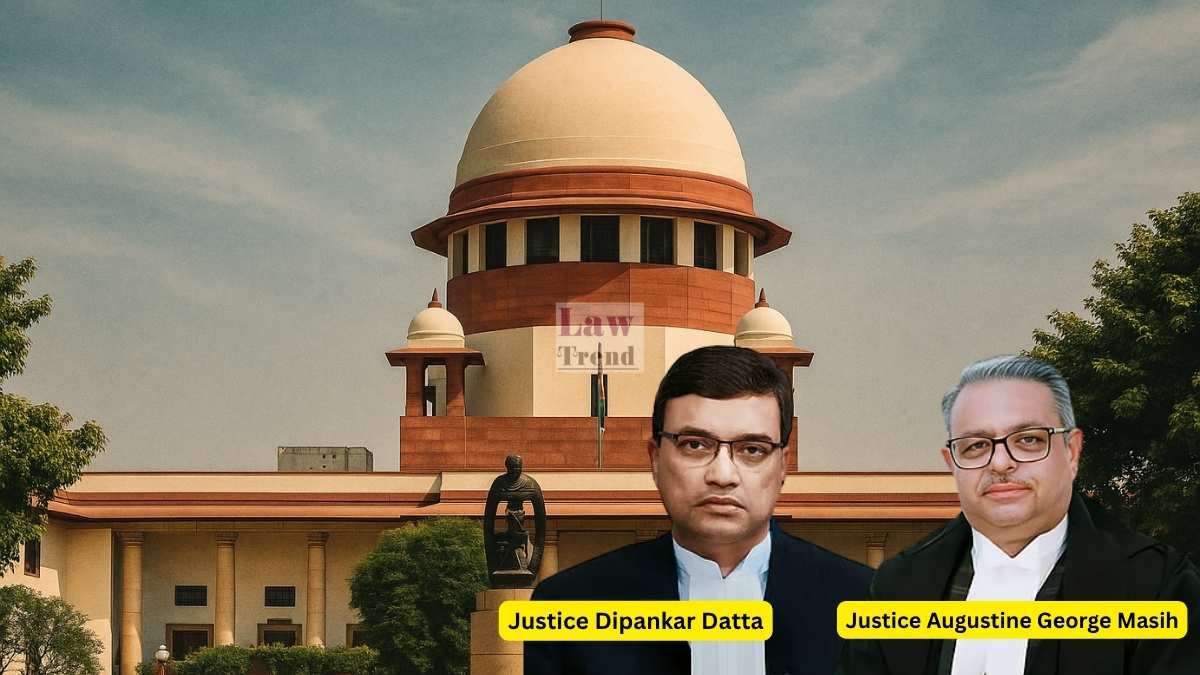

In a significant legal victory for disabled personnel, the Supreme Court of India has held that a retrospective exemption notification cannot deprive a paramilitary force employee of statutory service protections under the Persons with Disabilities (Equal Opportunities, Protection of Rights and Full Participation) Act, 1995 (PwD Act). The Division Bench consisting of Justice Dipankar Datta and Justice Augustine George Masih dismissed an appeal filed by the Union of India, declaring that the medical invalidation of a Central Reserve Police Force (CRPF) constable in 1998 was void ab initio because it took place prior to the government’s 2002 exemption notification. Consequently, the court ordered substantial financial restitution, modifying a High Court reinstatement order to award the retired constable a lump sum of Rs. 1.25 crore in back wages, interest, and costs.

Factual Background of the Dispute

The respondent, Bali Ram, was enrolled in the CRPF as a Constable (Driver) in 1985 after being declared medically fit. He served continuously until 1996 when he developed a severe ophthalmic condition. A medical evaluation conducted at the Government Hospital, Jammu, revealed that he was suffering from Disseminated Choroiditis and Retinal Atrophic Patches with Macular Involvement. This condition resulted in complete blindness in his left eye and partial impairment of vision in his right eye.

In 1997, the Medical Invalidation Board constituted at the Base Hospital, CRPF, Hyderabad, examined Bali Ram and concluded that he was permanently incapacitated and unfit for further service in any capacity within the CRPF. Despite submitting a representation seeking full financial and service benefits, Bali Ram was medically invalidated from service by an order dated March 11, 1998.

Subsequent administrative representations filed by Bali Ram were rejected. He approached the High Court of Himachal Pradesh, which directed the authorities to reconsider his grievance. On June 27, 2005, the appellants rejected his claim again, asserting that his visual impairment was neither attributable to nor aggravated by his service conditions, rendering him eligible only for a lump-sum payment of Rs. 15,000 under the applicable rules.

Bali Ram then instituted a writ petition in the High Court praying for invalid or disability pension on account of 100% disability. On August 11, 2008, a Single Judge of the High Court allowed the writ petition. Going beyond the specific prayers of the petition, the Single Judge invoked Section 47 of the PwD Act, 1995, and ordered Bali Ram’s reinstatement into service with all annual increments and back wages.

The Union of India challenged this decision before a Division Bench of the High Court. On December 23, 2014, the Division Bench dismissed the Letters Patent Appeal (LPA), holding that the mere receipt of an invalidity pension could not deny the constable the protection of Section 47 of the PwD Act. The appellants then appealed to the Supreme Court, which stayed the operation of the High Court’s judgment on November 23, 2015.

Rival Contentions of the Parties

Arguments on Behalf of the Appellants

The Additional Solicitor General, Mr. Banerjee, representing the Union of India, raised three primary contentions:

  1. Infeasibility of Alternate Posting: He argued that because Bali Ram was a driver and combatant who had completely lost vision in one eye and suffered partial loss in the other, he was permanently incapacitated for any duty in the CRPF. There was no suitable alternate post to accommodate him.
  2. The 2002 Exemption Notification: Mr. Banerjee contended that the Single Judge erred in relying on Section 47 of the PwD Act. He pointed to a government notification dated September 10, 2002, which exempted all categories of combatant personnel of the Central Para Military Forces (CPMFs), including the CRPF, from the application of Section 47. He cited Union of India v. Dileep Kumar Singh (2015) 4 SCC 421, where the Supreme Court upheld the validity of this exemption.
  3. The Doctrine of Waiver: The appellants argued that Bali Ram had waived his rights under Section 47 of the PwD Act because he never explicitly pleaded or prayed for reinstatement or protection under the Act in his original writ petition. Instead, he limited his prayers to receiving disability pension. Finally, the appellants argued that since Bali Ram had already reached the age of superannuation, reinstatement was impossible, and enforcing the full back wages would impose an excessive financial burden of over Rs. 82 lakh on the State exchequer.
READ ALSO  सुप्रीम कोर्ट ने विशेष आवश्यकता वाले बच्चों के लिए शिक्षकों की नियुक्ति के निर्देश जारी किए

Arguments on Behalf of the Respondent

Counsel for the respondent, Mr. Dhawan, countered these points by asserting:

  1. Mandatory Nature of Section 47: Relying on the landmark decision in Kunal Singh v. Union of India (2003) 4 SCC 524, he argued that Section 47 of the PwD Act casts an absolute, mandatory statutory obligation on the employer to protect and accommodate disabled employees.
  2. Prospectivity of the Exemption: Mr. Dhawan emphasized that the medical invalidation order was passed on March 11, 1998, whereas the exemption notification was only issued on September 10, 2002. Since the notification was prospective and contained no retrospective clause, the invalidation order was unlawful at the time it was issued.
  3. Absence of Waiver: He argued that waiver requires an intentional relinquishment of a known right. Bali Ram, having lost his sight and lacking legal awareness, was completely unaware of the statutory protections of Section 47. The appellants, who were under an obligation to act fairly, never informed him of his rights. Additionally, the plea of waiver was never raised by the appellants in the High Court or in their written grounds of appeal before the Supreme Court.

The Court’s Analysis and Legal Framework

Pleadings and the Power of Writ Courts

The Supreme Court addressed the appellants’ objection that the High Court went beyond the pleadings and prayers of the writ petition. While noting that civil courts are strictly bound by pleadings under the Code of Civil Procedure, 1908, the Bench observed that the writ jurisdiction under Article 226 of the Constitution is plenary, equitable, and discretionary.

READ ALSO  Can Writ Petition be Maintained Against Private Financial Institutions like HDFC? Allahabad HC

The Court established that an exception to the strict rule of pleadings arises when a petitioner is legally entitled to wider relief but fails to claim it due to ignorance, bona fide mistake, or inelegant drafting. The Bench warned that upholding procedural technicalities to shield an employer’s statutory breach would defeat the ends of justice.

The Doctrine of Waiver

Regarding the argument that Bali Ram had waived his rights, the Supreme Court outlined that waiver requires three key elements: the existence of a right, clear knowledge of that right, and a conscious, voluntary decision to give it up. Citing Krishan Lal v. State of J & K (1994) 4 SCC 422, the Court noted that waiver of statutory rights is heavily disfavoured when the statute serves a public welfare or public policy purpose.

The Bench found that the appellants failed to plead waiver in the lower courts, and failed to prove that Bali Ram had any knowledge of his rights under Section 47 of the PwD Act. Consequently, the plea of waiver was overruled.

Prospectivity of the Exemption Notification

The Court scrutinized the 2002 notification and applied three established legal principles: delegated legislation is ordinarily prospective (Federation of Indian Mineral Industries v. Union of India); it cannot apply retrospectively without clear express intent (Union of India v. Kartick Chandra Mondal); and exemption notifications taking cases out of the purview of beneficial legislation must be strictly construed (Mohinder Lal v. Saroj Kumari Verma).

The Supreme Court held that the September 10, 2002, notification was strictly prospective. Therefore, between 1995 and September 2002, Section 47 applied with full force to the CRPF. The Court observed:

“Therefore, the NOTIFICATION has no bearing on the legality of the order of medical invalidation. Respondent’s medical invalidation vide order dated 11th March, 1998 was made at a point of time when Section 47 of the PwD Act operated without any strings attached and the appellants were bound by its categorical mandate.”

The Court distinguished Dileep Kumar Singh (supra) because the employee in that case was invalidated in 2011, long after the 2002 notification came into effect.

Scope of Section 47 of the PwD Act

The Bench re-emphasized the principles laid down in Kunal Singh (supra), which held that the PwD Act is a special, social beneficial enactment. The Court noted that under Bhagwan Dass v. Punjab State Electricity Board (2008) 1 SCC 579, it is the duty of senior officers to apprise disabled employees of their statutory safeguards.

READ ALSO  SC issues directions to make uniform MACT procedures and make it claimant friendly

The Court further referenced Ravinder Kumar Dhariwal v. Union of India (2023) 2 SCC 209, pointing out that Section 47 enforces both formal and substantive equality through the principle of “reasonable accommodation.”

On the issue of whether the visual impairment was attributable to military service, the Bench clarified that the protection under Section 47 is completely unqualified and unconditional, operating irrespective of how the disability was acquired.

The Court’s Decision and Financial Restitution

The Supreme Court concluded that the Single Judge of the High Court was perfectly justified in finding the CRPF remiss. The Court observed:

“Language of Section 47 is plain and certain casting statutory obligation on the employer to protect an employee acquiring disability during service.”

The Court strongly criticized the CRPF’s failure to act as a model employer:

“Appellants were required to find a chair for the respondent, and not wait for the respondent to beg for one. By not offering alternate posting, the appellants failed in their role as a model employer and converted a welfare provision into a dead letter.”

Since Bali Ram had reached the age of superannuation during the decades of pending litigation, reinstatement was no longer possible. While the appellants presented a calculation of Rs. 82,80,195 as the total salary Bali Ram would have earned, the Supreme Court rejected their plea to limit the liability. Rejecting the principle of “no work, no pay” in this context, the Court noted:

“The situation of non-employment of the respondent is entirely the appellants’ creation. Respondent is, thus, entitled to full back wages and the appellants must bear the consequences of their own inaction.”

Holding that the preambular promise of the Constitution cannot remain symbolic, the Court concluded:

“Restitution of status with full back wages, interest and costs for the indignity of delay are the minimum we ought to order.”

To ensure comprehensive justice, the Supreme Court dismissed the appeal and modified the High Court’s relief. It awarded Bali Ram a lump-sum amount of Rs. 1,25,00,000 (Rupees one crore twenty-five lakh only) covering back wages, interest, and litigation costs, to be paid within eight weeks.

To safeguard the respondent’s future, the Court directed the Member-Secretary of the State or District Legal Services Authority in Himachal Pradesh to assist Bali Ram in safely investing a part of this amount in a high-yield fixed deposit at a nationalized bank to oversee his future medical needs.

Case Details

Case Title: Union of India & Ors. v. Bali Ram No.850808321
Case No.: Civil Appeal No. 13783/2015
Bench: Justice Dipankar Datta, Justice Augustine George Masih
Date: July 13, 2026

Law Trend
Law Trendhttps://lawtrend.in/
Legal News Website Providing Latest Judgments of Supreme Court and High Court

Related Articles

Latest Articles

