

Pre-2016 DRT Recovery Certificate Cannot Form Basis Of Insolvency Notice Under Presidency Towns Insolvency Act: Supreme Court
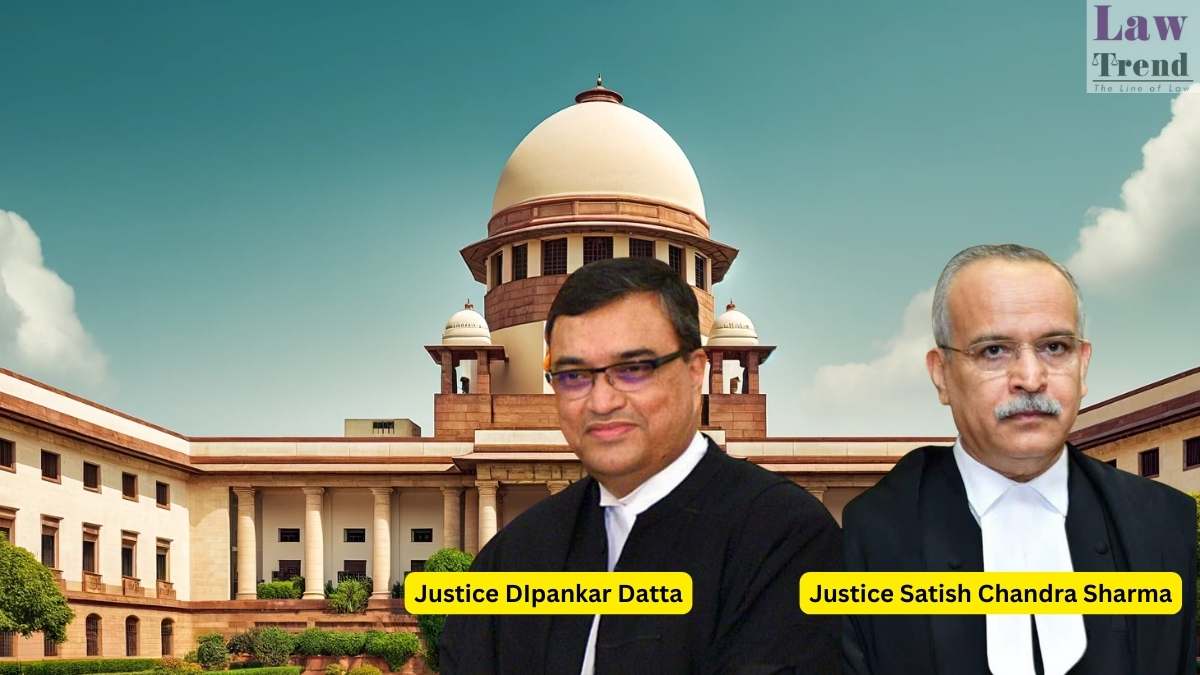

The Supreme Court of India has ruled that an insolvency notice under Section 9(2) of the Presidency Towns Insolvency Act, 1909 cannot be issued on the strength of a recovery certificate issued by a Debts Recovery Tribunal (DRT) prior to the 2016 amendment of the Recovery of Debts and Bankruptcy Act. Dismissing an appeal filed by HDFC Bank Limited, a bench comprising Justice Dipankar Datta and Justice Satish Chandra Sharma held that a recovery certificate issued before the insertion of Section 19(22A) in 2016 does not equate to a “decree or order” for the purpose of initiating insolvency proceedings under the 1909 Act.

Background of the Case

The case originated from credit facilities availed by Beautiful Diamonds Limited from a consortium of 15 banks, which included HDFC Bank Limited (the Appellant-Bank). The original respondent, Kishore K. Mehta, who was a director of the company, had executed personal guarantees to secure these credit facilities. Following a default in repayment, and after the invocation of personal guarantees failed, the Appellant-Bank approached the Debt Recovery Tribunal, Mumbai.

On October 26, 2004, the DRT Bombay directed the issuance of a recovery certificate for Rs. 14,74,51,929.35 against the original respondent, which was subsequently issued on November 30, 2004. Armed with this recovery certificate, the Appellant-Bank approached the Insolvency Registrar, who issued an insolvency notice under Section 9(2) of the Presidency Towns Insolvency Act, 1909.

Kishore K. Mehta challenged this notice before the High Court of Judicature at Bombay, arguing that a DRT recovery certificate could not legally form the basis of an insolvency notice. A Single Judge of the High Court held that no insolvency notice could be issued on such a basis. This view was subsequently upheld by a Division Bench of the High Court. The Appellant-Bank then appealed to the Supreme Court, which granted leave in 2010. During the pendency of this appeal, the original respondent passed away on May 20, 2024, and his legal representatives (his wife and three sons) were substituted in his place.

Arguments of the Parties

The Appellant-Bank argued that Section 9(2) of the Insolvency Act deliberately uses the general term “decree or order” instead of “decree or order of a Court,” unlike Section 9(1)(e) and (h) which specifically reference a “Decree of any Court.” It contended that the omission of the phrase “of any Court” in Section 9(2) indicated a conscious legislative intent to include orders passed by quasi-judicial and statutory authorities like the DRT.

READ ALSO  वायु प्रदूषण का मुद्दा कभी-कभी राजनीतिक बन जाता है: सुप्रीम कोर्ट के पूर्व न्यायाधीश एसके कौल

The Bank further argued that because the Recovery of Debts Due to Banks and Financial Institutions Act, 1993 (RDB Act) transferred high-value debt recovery jurisdictions from civil courts to the DRT, the tribunal effectively steps into the shoes of a civil court. It contended that it would be anomalous to allow a civil court decree for a minor sum to support insolvency proceedings while denying the same effect to a multi-crore DRT recovery certificate. Furthermore, the Bank relied on Section 19(22A), inserted into the RDB Act via an amendment in 2016, which explicitly deems a recovery certificate to be a “decree or order of the Court” for the purpose of initiating insolvency proceedings.

Conversely, the respondents opposed these submissions, arguing that the High Court had correctly relied on the Supreme Court’s precedent in Paramjeet Singh Patheja v. ICDS Ltd. They argued that the 2016 insertion of Section 19(22A) actually supported their stance, as it demonstrated that a recovery certificate did not enjoy the status of a decree or order prior to the amendment.

The Court’s Analysis

The Supreme Court examined the precedent in Paramjeet Singh Patheja v. ICDS Ltd., noting that although that case arose in the context of an arbitral award, its legal ratio rests on a wider, fundamental principle. The Court reiterated that the Insolvency Act must be strictly construed due to the severe civil consequences it carries.

Quoting from the Paramjeet Singh Patheja decision, the Court observed: “We are of the view that the Presidency Towns Insolvency Act, 1909 is a statute weighed down with the grave consequence of “civil death” for a person sought to be adjudged an insolvent and therefore the Act has to be construed strictly.”

The Court further cited the reasoning on what constitutes a decree: “The words “court”, “adjudication” and “suit” conclusively show that only a court can pass a decree and that too only in a suit commenced by a plaint and after adjudication of a dispute by a judgment pronounced by the court.”

Highlighting the gravity of insolvency actions, the Bench quoted: “Issuance of a notice under the Insolvency Act is fraught with serious consequences: it is intended to bring about a drastic change in the status of the person against whom a notice is issued viz. to declare him an insolvent with all the attendant disabilities.”

Addressing the Appellant-Bank’s reliance on Section 19(22A) of the RDB Act, the Court observed that the introduction of this deeming fiction in 2016 actually demolished the Bank’s case. The Bench pointed out that the very fact that Parliament felt the need to insert this sub-section in 2016 is clear legislative recognition that such an equivalence between a recovery certificate and a court decree did not exist prior to the amendment. Since the 2016 amendment was not given retrospective effect, treating pre-amendment recovery certificates as decrees would amount to supplying a casus omissus (legislative omission), which is impermissible.

The Court emphasized that the rights of the parties must be determined as they existed on the date the litigation commenced. To support this, the Bench relied on Rameshwar v. Jot Ram, which quoted P. Venkateswarlu v. Motor & General Traders: “it is basic to our processual jurisprudence that the right to relief must be judged to exist as on the date a suitor institutes the legal proceeding”

The Court also invoked the principle from Beg Raj Singh v. State of U.P.: “The ordinary rule of litigation is that the rights of the parties stand crystallized on the date of commencement of litigation and the right to relief should be decided by reference to the date on which the petitioner entered the portals of the court.”

Applying these principles, the Bench held that a claim which was legally untenable when the Bank entered the court in 2006/2007 could not be made tenable retrospectively by the subsequent 2016 statutory amendment.

READ ALSO  राजस्थान के फालोदी हादसे पर सुप्रीम कोर्ट की सख्ती: एनएचएआई और परिवहन मंत्रालय से दो हफ्ते में रिपोर्ट मांगी

The Decision

The Supreme Court dismissed the appeal and concluded that the insolvency notice issued against the deceased original respondent could not be sustained. The proceedings in the notice of motion before the Single Judge of the Bombay High Court were ordered to stand closed against the deceased original respondent.

The Court noted that although two of the deceased respondent’s sons were also certificate debtors, the Appellant-Bank had only proceeded against the deceased. While the Court made no direct orders against the sons, it clarified that the Appellant-Bank is free to work out its legal remedies against them in accordance with the law, provided such actions are not barred by limitation.

READ ALSO  Lack of 'Strict Proximity of Time' in Last Seen Theory: Allahabad High Court Acquits Two in 1992 Murder Case

Case Details

Case Title: H.D.F.C. Bank Limited v. Kishore K. Mehta (Dead) Thr. LRS.
Case No.: Civil Appeal No. 4211 of 2010
Bench: Justice Dipankar Datta, Justice Satish Chandra Sharma
Date: July 13, 2026

Law Trend
Law Trendhttps://lawtrend.in/
Legal News Website Providing Latest Judgments of Supreme Court and High Court

Related Articles

Latest Articles

