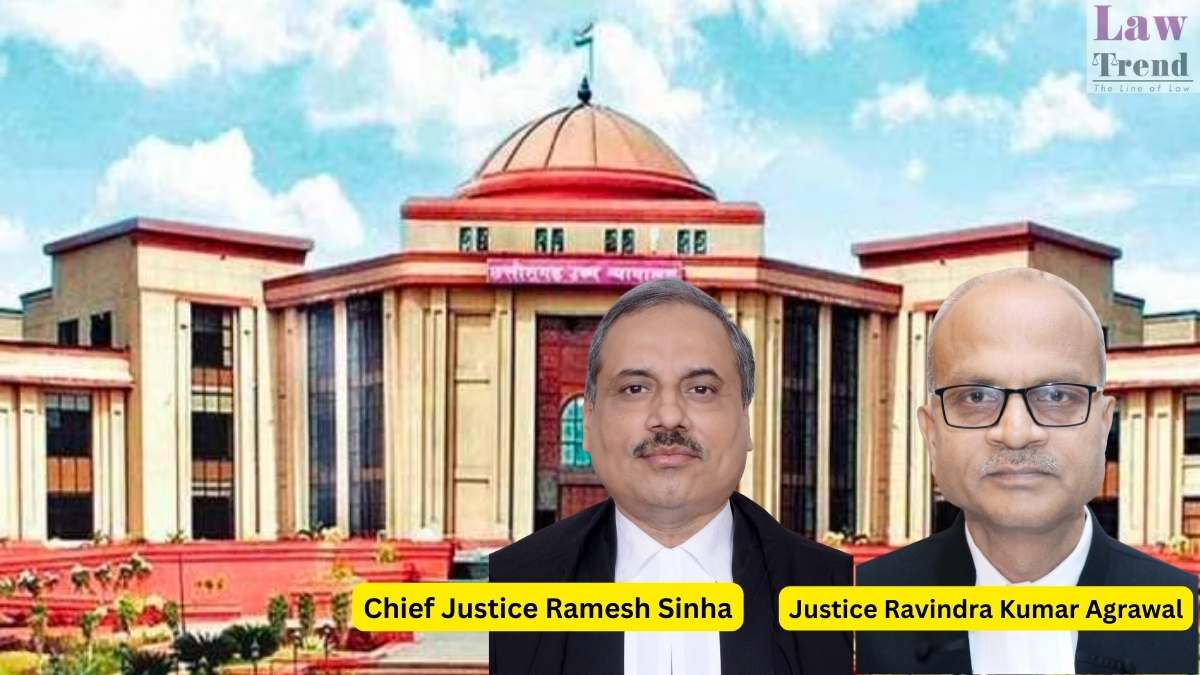
A division bench of the High Court of Chhattisgarh, comprising Chief Justice Ramesh Sinha and Justice Ravindra Kumar Agrawal, has set aside the trial court’s conviction and sentencing of seven individuals accused of possessing and selling commercial quantities of prohibited psychotropic substances under the Narcotic Drugs and Psychotropic Substances (NDPS) Act, 1985. The court held that strict compliance with the statutory procedural safeguards under the NDPS Act is mandatory, ruling that severe punishments under the Act necessitate scrupulous procedural adherence. Finding egregious lapses and timeline contradictions in the state police’s investigation, the High Court extended the benefit of doubt to all seven appellants and ordered their immediate release.
Background of the Case
The case originated on October 10, 2022, when Assistant Sub-Inspector Rajesh Mandle received secret information regarding two individuals selling intoxicating tablets near Mukut Nagar water tank in Raipur. The police intercepted Niyajuddin alias Vikky and J. Bhaskar Rao, recovering 120 Alprazolam tablets and 144 Tramadol capsules.
Subsequent interrogation and memorandum statements led to a wider chain of arrests and seizures:
- Ravindra Goyal, owner of Pratham Medical Store, was intercepted in a car, yielding 14,400 Tramadol Spasmo capsules.
- Mukesh Kumar Sahu was arrested after a search at his residence in village Karsa turned up 28,800 Tramadol Spasmo capsules.
- Mohammad Hasan and his son Sahil Hasan were apprehended at Mowa, Raipur, with 1,15,200 and 3,744 Tramadol Spasmo capsules respectively, alongside 41,600 Alprazolam tablets.
- Akash Vishwakarma, proprietor of Narmada Pharma in Jabalpur, and Viral Patel, a wholesaler in Gujarat, were subsequently arrested on the basis of co-accused disclosure statements.
The Special Court (NDPS Act), Raipur, on September 1, 2025, convicted and sentenced Ravindra Goyal, Sahil Hasan, and Mukesh Kumar Sahu to 15 years of rigorous imprisonment and a fine of Rs. 1,50,000 each under Section 22(c). Viral Patel and Akash Vishwakarma received 10 years of rigorous imprisonment and a Rs. 1,00,000 fine under Section 29 read with Section 22(c). Niyajuddin and J. Bhaskar Rao were sentenced to 10 years of rigorous imprisonment and a Rs. 1,00,000 fine under Section 22(b).
Arguments of the Parties
Senior Advocates Ms. Fouzia Mirza and Mr. Ashish Shrivastava, along with counsels for the other appellants, argued that the prosecution’s case was riddled with material inconsistencies and procedural violations of Sections 42, 50, 52-A, and 55 of the NDPS Act. They highlighted that:
- The document showing compliance with Section 42(2) was recorded as prepared at 16:00 hours, yet bore a receiving stamp from the CSP office at 15:25 hours—an inherent impossibility.
- Under Section 50, the accused were improperly given the option to be searched by the police officer himself.
- The sampling was not conducted before a Magistrate, violating Section 52-A.
- There was an unexplained discrepancy in the physical inventory; the seizure memo for J. Bhaskar Rao recorded strips of 8 capsules each, whereas the Forensic Science Laboratory (FSL) report recorded strips of 24 capsules.
- Viral Patel and Akash Vishwakarma were implicated solely on inadmissible confessional statements of co-accused, as no drugs were recovered from them.
The Government Advocate, Mr. Shaleen Singh Baghel, opposed the appeals, arguing that minor discrepancies should not dismantle the case given the massive quantity of psychotropic substances seized. He contended that the chain of supply was established, and the official witnesses of the raiding party had consistently supported the prosecution’s case.
The Court’s Analysis
The High Court analyzed the procedural adherence of the police and identified critical, fatal infirmities in the investigation.
1. Inherent Impossibilities in Section 42 Compliance
The court observed a temporal mismatch in the transmission of the secret information to superior officers. The receipt of the communication occurred 35 minutes before its recorded preparation. The court held that this contradiction raised serious doubts about whether the mandatory requirement was met before the search.
2. Defective Section 50 Search Options
The notices served to the accused stated they could be searched by a Gazetted Officer, a Magistrate, or the police officer himself. The High Court observed that Section 50 does not contemplate allowing the searching officer to conduct the search. Citing State of Punjab v. Baldev Singh (1999), the court noted:
“Conducting a search under Section 50, without intimating to the suspect that he has a right to be searched before a gazetted officer or a Magistrate, would be violative of the ‘reasonable, fair and just procedure’ and the safeguard contained in Section 50 would be rendered illusory, otiose and meaningless.”
3. Breach of Section 52-A and Chain of Custody (Section 55)
The court noted that the police failed to draw samples in the presence of a Magistrate as mandated by Section 52-A. Citing Union of India v. Mohanlal (2016), Yusuf @ Asif v. State (2023), and Surepally Srinivas v. State of Andhra Pradesh (2025), the court reiterated that magistrate-led sampling is not an empty formality.
Additionally, the court highlighted that the prosecution failed to produce any Malkhana or seal registers to prove safe custody under Section 55, raising the possibility of tampering. This was compounded by the fact that the FSL report described strips of 24 capsules, contradicting the seizure memo’s description of 8-capsule strips. Citing Ashok v. State of Madhya Pradesh (2011), the court emphasized that failing to establish an unbroken chain of custody materially damages the prosecution.
4. Inadmissibility of Co-accused Confessions
Regarding appellants Viral Patel and Akash Vishwakarma, from whom no contraband was recovered, the court ruled that their prosecution rested entirely on co-accused statements. Applying the Constitution Bench ruling in Tofan Singh v. State of Tamil Nadu (2021), the court observed:
“confessional statements recorded under Section 67 of the NDPS Act are inadmissible as confessions against the maker and cannot be made the foundation of conviction.”
Applying Balwinder Singh (Binda) v. Narcotics Control Bureau (2024) and Noor Aga v. State of Punjab (2008), the bench held that without independent corroborating evidence, such disclosures hold no legal value, and the statutory presumptions under Sections 35 and 54 of the NDPS Act cannot be invoked.
The Decision of the Court
The High Court allowed all the criminal appeals, setting aside the trial court’s judgment dated September 1, 2025, and acquitting all seven appellants.
Before parting, the court expressed deep concern regarding the negligent manner in which the state police handled the investigation of such a grave offense, pointing out that this was the second case on the same day displaying identical systemic errors (referencing Dorilal v. Directorate of Revenue Intelligence Raipur).
The court stated: “These are not isolated procedural irregularities but substantial violations having a direct bearing on the fairness and credibility of the prosecution.”
The court added: “They disclose a disturbing pattern of negligence, lack of professional competence and complete indifference towards the mandatory safeguards under the NDPS Act.”
The Registry was directed to forward the copy of the judgment to the Director General of Police, Chhattisgarh, to examine the lapses, identify and penalize the responsible officers, and issue comprehensive Standard Operating Procedures (SOPs) and training programs to ensure strict statutory compliance in future investigations.
Case Details
Case Title: Viral Patel v. State of Chhattisgarh
Case No.: CRA No. 2073 of 2025, CRA No. 2099 of 2025, CRA No. 2429 of 2025, CRA No. 2583 of 2025, CRA No. 2101 of 2025, CRA No. 598 of 2026, and CRA No. 771 of 2026
Bench: Chief Justice Ramesh Sinha and Justice Ravindra Kumar Agrawal
Date: July 1, 2026