

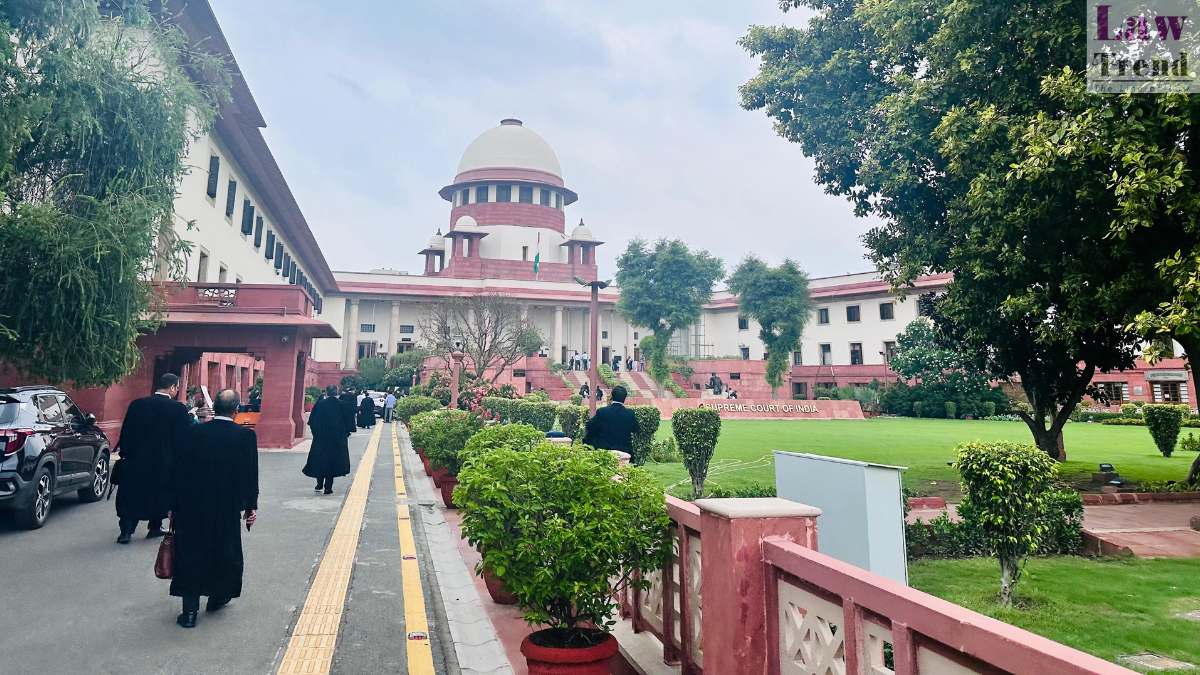
The Supreme Court of India has held that a Sessions Court is not competent to impose a sentence directing a convict to remain in prison for the remainder of their natural life to the exclusion of statutory remission powers under Section 302 of the Indian Penal Code, 1860. A Bench comprising Justice Aravind Kumar and Justice Vipul M. Pancholi clarified that the authority to award a “special category” sentence—bridging the gap between ordinary life imprisonment and the death penalty by barring remission—is vested exclusively in Constitutional Courts, namely the High Courts and the Supreme Court. Consequently, while upholding the murder conviction of two men for the premeditated killing of a woman and her two minor daughters, the apex court set aside the Trial Court’s whole-life imprisonment directive and substituted it with a fixed sentence of 25 years of rigorous imprisonment without statutory remission.
Background of the Case
The case originated from an incident on December 27, 2009, in Ludhiana, Punjab. The deceased, Pinki alias Simran, was married to Ashok Kumar (accused No. 1), with whom she had two minor daughters aged eight and five years. On the evening of December 27, Pinki and her daughters left their residence to purchase eatables and did not return. The following morning, their bodies were discovered near the railway tracks at Sandhu Nagar, Ludhiana, with fatal injuries inflicted by sharp-edged weapons.
An FIR was initially registered at Police Station Haibowal against unknown persons under Section 302 read with Section 34 of the Indian Penal Code (IPC). During the investigation, Ashok Kumar was produced before the police on December 30, 2009, by a local Mohalla Pradhan. Pursuant to his disclosures, police recovered a blood-stained jacket and the weapon of offence. His disclosure also led to the arrest of his brother Jyoti Kumar (accused No. 2) and his friend Naval Kishore (accused No. 3) at the Ludhiana Railway Station on December 31, 2009. Subsequent recoveries included blood-stained jackets and gold earrings belonging to the deceased.
The prosecution established that Ashok Kumar harboured suspicions regarding his wife’s character, doubted the paternity of the two children, and hatched a conspiracy to eliminate them to claim insurance money of Rs. 1–2 lakhs, offering Naval Kishore Rs. 50,000 for his assistance. Evidence relied upon included eye-witness testimony placing the accused near the railway lines, extra-judicial confessions, fingerprints on recovered glass tumblers, and DNA evidence confirming that hair found in the closed fist of the deceased Pinki belonged to Jyoti Kumar.
The Trial Court convicted all three accused on April 26, 2014, under Section 302 read with Section 34 IPC. By a sentencing order on April 28, 2014, the Trial Court sentenced them to rigorous imprisonment for life and directed them “to remain in prison till rest of their life”, alongside a fine of Rs. 2,500 each. On appeal, the High Court of Punjab and Haryana affirmed the conviction and sentence on December 12, 2022. However, the High Court did not independently examine the Trial Court’s specific direction that the convicts remain incarcerated for the rest of their natural lives. The appellants, Naval Kishore and Jyoti Kumar, then approached the Supreme Court.
Submissions of the Parties
Before the Supreme Court, the appellants did not contest their conviction, as the Court had already declined to interfere with the conviction on November 10, 2025. Counsel for the appellants, Ms. Sampa Sengupta Ray, contended that Section 302 IPC provides only for death or imprisonment for life, and the Trial Court had exceeded its statutory remit by directing imprisonment for the rest of their natural lives. Arguing that the convicts had undergone substantial periods of custody with satisfactory jail conduct, counsel prayed for an appropriate modification of the sentence and their release.
Opposing the plea, Additional Advocate General Mr. Vivek Jain and counsel Mr. Siddhant Sharma, appearing for the State of Punjab, highlighted the extreme gravity and brutality of the crime involving the premeditated murder of three individuals, including two minor children. The State submitted that the crime’s severe impact on the family and society warranted no interference with the whole-life incarceration direction affirmed by the High Court.
The Court’s Analysis and Precedents
The Supreme Court framed two principal questions: whether the Trial Court was competent under Section 302 IPC to order that convicts remain in prison for the remainder of their lives, and if not, what appropriate sentence should be awarded.
Examining Section 302 IPC, the Court noted that while Section 53 read with Section 45 of the IPC treats life imprisonment as incarceration for the convict’s natural life, ordinary life imprisonment remains subject to executive powers of remission and commutation under Sections 432 to 435 of the Code of Criminal Procedure (CrPC) and constitutional powers under Articles 72 and 161.
Tracing the evolution of alternative sentencing, the Bench reviewed the landmark judgment in Swamy Shraddananda (2) v. State of Karnataka (2008), where the Court created a special category of sentence to bridge the vast hiatus between a 14-year term (often resulting from remission) and capital punishment. The Court recalled the observations from Swamy Shraddananda (2):
“A far more just, reasonable and proper course would be to expand the options and to take over what, as a matter of fact, lawfully belongs to the Court i.e. the vast hiatus between 14 years’ imprisonment and death. It needs to be emphasised that the Court would take recourse to the expanded option primarily because in the facts of the case, the sentence of 14 years’ imprisonment would amount to no punishment at all.”
The Bench pointed out that the Constitution Bench in Union of India v. V. Sriharan alias Murugan (2016) confirmed this special sentencing power while expressly confining it to Constitutional Courts. The Constitution Bench had held:
“We, therefore, reiterate that the power derived from the Penal Code for any modified punishment within the punishment provided for in the Penal Code for such specified offences can only be exercised by the High Court and in the event of further appeal only by the Supreme Court and not by any other court in this country. To put it differently, the power to impose a modified punishment providing for any specific term of incarceration or till the end of the convict’s life as an alternate to death penalty, can be exercised only by the High Court and the Supreme Court and not by any other inferior court.”
Reiterating its recent pronouncements in Kiran v. State of Karnataka (2025) and Ravinder Singh v. State (NCT of Delhi) (2024), the Bench underscored that a Court of Session has no authority to strip the appropriate government of its statutory remission powers under Sections 432 to 435 CrPC. In Kiran, the apex court had noted:
“Hence, the sentence of life imprisonment cannot be directed to be till the end of natural life, by the Sessions Court which direction would be in conflict with the provisions of the Cr. P.C. The power of remission or commutation conferred on the State cannot be taken away and the sentence as awarded by the trial court and confirmed by the High Court for the offence under Section 302 of the Penal Code, 1860 is confirmed as imprisonment for life.”
The Court further drew attention to legislative developments, specifically the Criminal Law (Amendment) Act, 2018, where Parliament consciously inserted express language in Sections 376AB, 376DA, and 376DB of the IPC defining life imprisonment as “imprisonment for the remainder of that person’s natural life.” The Bench observed that because Parliament refrained from introducing similar wording into Section 302 IPC, Trial Courts cannot read such an expanded statutory punishment into the murder provision.
Decision of the Court
Having held the Trial Court’s direction legally unsustainable, the Supreme Court turned to determining the appropriate modified sentence, guided by the sentencing principles detailed in Navas alias Mulanavas v. State of Kerala (2024). The Bench balanced the aggravating factors—the premeditated and brutal murder of three individuals, including two minor children, with sharp-edged weapons—against mitigating aspects, including the appellants’ custody of over 11 and 12 years and satisfactory jail discipline.
The Court held that an ordinary life sentence subject to statutory remission after 14 years would be grossly inadequate, whereas whole-life imprisonment would be disproportionate.
Exercising its powers as a Constitutional Court, the Supreme Court set aside the Trial Court’s direction ordering the appellants to remain in prison till the rest of their lives. In substitution, the Bench sentenced both Naval Kishore and Jyoti Kumar to undergo 25 years of rigorous imprisonment without the benefit of statutory remission, while affirming their conviction under Section 302 read with Section 34 IPC.
Case Title: Naval Kishore & Anr. Versus State of Punjab
Case No.: Diary No. 56431 of 2025
Bench: Justice Aravind Kumar and Justice Vipul M. Pancholi
Date: September 24, 2026




