

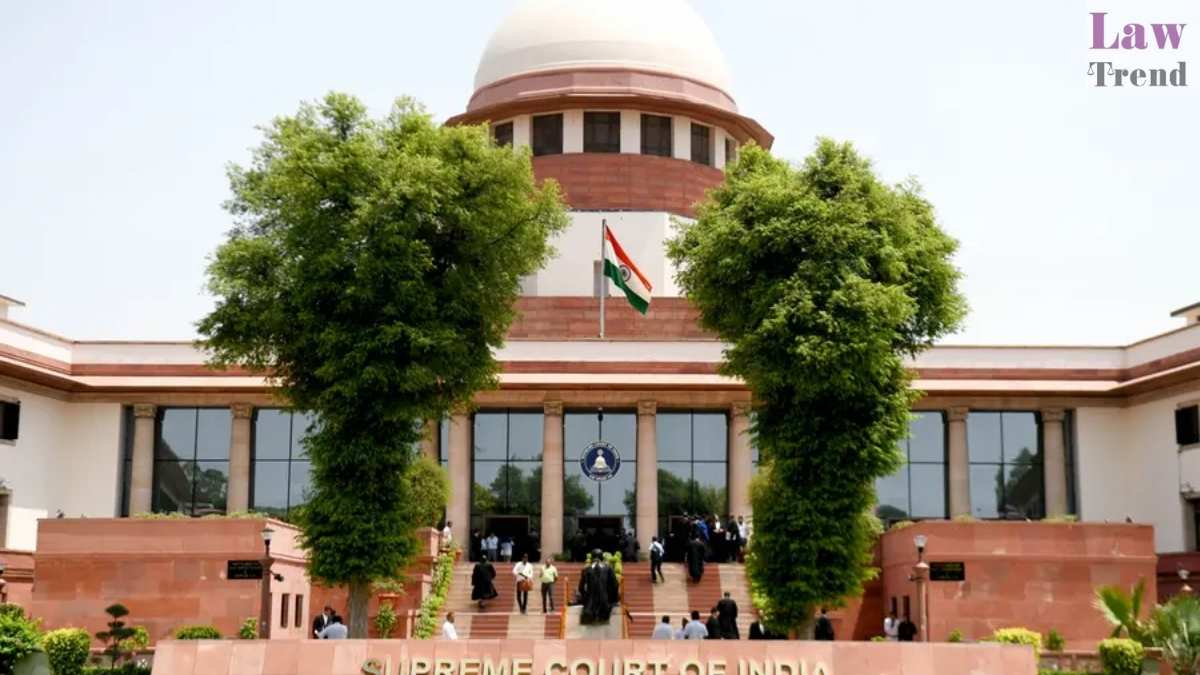
A three-judge bench of the Supreme Court of India comprising Justice Vikram Nath, Justice Sandeep Mehta, and Justice Vijay Bishnoi has upheld the conviction of a man for the aggravated penetrative sexual assault and murder of his six-year-old step-daughter, while commuting his death sentence to imprisonment for the remainder of his natural life without remission. Resolving a significant question on capital sentencing under Section 354(3) of the Code of Criminal Procedure, 1973 (CrPC), the Court held that even where a crime involves the grave aggravating feature of “instrumental silencing” to suppress evidence of sexual violation, the death penalty cannot be sustained if the State fails to lead evidence proving that the convict is beyond the possibility of reformation, especially when the intermediate sentencing alternative of whole-life imprisonment without remission is available.
Background of the Case
The case arose from an incident in village Kushalgarh, District Ratlam, Madhya Pradesh. The mother of the victim, having lost her first husband, married the appellant, Waris, on August 4, 2017, and moved into his house with her six-year-old daughter. The prosecution alleged that the appellant subjected the child to repeated sexual abuse within the household and threatened the mother with death and social disgrace if she disclosed it.
The immediate events unfolded on the night of April 21, 2018, when the appellant confined the mother to a separate room and sexually assaulted the child. Over the next two days, the child suffered severe pain, vomiting, and physical deterioration. The appellant refused repeated pleas by the mother to obtain medical treatment, claiming the child was pretending. On the morning of April 23, 2018, following two telephone calls from the mother, the appellant returned home at around noon. His first enquiry was whether the child had disclosed anything. Shortly thereafter, upon hearing the child scream, the mother witnessed the appellant throttling the girl with both hands.
The child died of manual strangulation. The appellant attempted to have the child buried immediately at Kushalgarh, but the mother insisted on taking the body to her parental relatives in Jaora, where she revealed the crime and the appellant admitted to the family that he had throttled the child. A post-mortem examination conducted on April 24, 2018, confirmed that the cause of death was asphyxia due to throttling and documented a fresh tear with bleeding at the fourchette, establishing recent sexual assault.
On December 17, 2018, the Second Additional Sessions Judge and Special Judge under the POCSO Act, Jaora, convicted the appellant under Sections 302, 376(2)(f), 376(2)(n), 376AB, and 201 of the Indian Penal Code, 1860 (IPC), and Sections 5 and 6 of the Protection of Children from Sexual Offences Act, 2012 (POCSO Act). The Trial Court awarded the death sentence on the same day for the offences under Section 302 and Section 376AB IPC. On November 18, 2019, the High Court of Madhya Pradesh (Indore Bench) dismissed the convict’s appeal and confirmed the death penalty in Criminal Reference No. 1 of 2019.
Curative Cross-Examination Ordered by the Supreme Court
During the appellate proceedings before the Supreme Court, it emerged that the trial court had appointed a legal aid counsel for the appellant on July 16, 2018—the very day the mother (PW-1) was examined—and concluded her entire cross-examination on that single day without granting counsel adequate preparation time. Noting that this fell short of effective legal assistance under Article 21, the Supreme Court, by an interim order dated May 8, 2025, invoked Section 391 read with Section 367 of the CrPC to direct a curative further cross-examination of PW-1.
That further cross-examination was conducted on June 14, 2025, by counsel of the appellant’s choice. The Supreme Court concluded that this proportionate measure fully cured the procedural infirmity without vitiating the trial, enabling the Court to evaluate the augmented record.
Submissions of the Parties
Senior Counsel appearing for the appellant argued that the conviction rested on the uncorroborated testimony of a solitary witness (PW-1) whose court statements suffered from material omissions when compared to her statements under Sections 161 and 164 of the CrPC. The defence highlighted internal contradictions, alleged unnatural conduct in failing to raise an immediate alarm or flee, and argued that the call detail records (CDR) showing incoming and outgoing calls negated her claim of captive isolation. The defence also relied on an alibi plea, an alternative narrative that the mother herself beat the child, and alleged police coercion. On sentence, the appellant contended that the case did not meet the “rarest of rare” test, citing good prison conduct, absence of criminal antecedents, childhood socio-economic deprivation, and the lack of any evidence from the State establishing that he was incapable of reformation.
Opposing the appeal, counsel for the State maintained that the mother’s core testimony remained unshaken across two cross-examinations conducted seven years apart. The State submitted that her account was corroborated by medical evidence of throttling and genital injury, the child’s spontaneous disclosure, call records, the appellant’s extra-judicial confession, and his incriminating conduct. On sentence, the State underscored the extreme vulnerability of the six-year-old child, the breach of parental trust, and the calculated murder committed to silence the victim.
The Court’s Analysis on Conviction
Delivering the judgment, Justice Vikram Nath systematically addressed each evidentiary challenge.
1. Appreciation of the Solitary and Related Witness
Relying on Section 134 of the Indian Evidence Act, 1872, and the decision in Vadivelu Thevar v. State of Madras, the Court reaffirmed that evidence must be weighed and not counted. Addressing the defence contention that the mother was an interested witness, the Court cited Dalip Singh v. State of Punjab, State of Rajasthan v. Kalki, and Goverdhan v. State of Chhattisgarh, noting that a related witness is not inherently interested. The bench observed:
“A mother is, in the considered view of this Court, ordinarily the last person who would shield the murderer of her own child and substitute an innocent man in his place.”
2. Material Omissions and the Rule of Sifting Evidence
Examining the alleged omissions under Section 145 of the Evidence Act and Section 162 CrPC, the Court applied the Constitution Bench ruling in Tahsildar Singh v. State of U.P. and Vijayakumar v. State of Tamil Nadu. The Court observed that the mother’s earliest statements never omitted the core allegations of sexual assault and manual strangulation, and that background details regarding domestic ill-treatment omitted by an illiterate woman do not destroy the core. Reaffirming State of U.P. v. M.K. Anthony and Selvamani v. State of T.N., the Court held that the maxim falsus in uno, falsus in omnibus is not a rule of law in India, and courts are duty-bound to separate the grain from the chaff.
3. The Entrapped Witness and Behavioural Realities
The Court firmly rejected the argument that the mother’s conduct was unnatural because she did not immediately report the abuse or escape when the house was unlocked. Citing Rana Partap v. State of Haryana, XYZ v. State of M.P., State of Punjab v. Gurmit Singh, and Tulshidas Kanolkar v. State of Goa, the Court held that courts must not measure female victims against stereotyped notions of ideal behaviour.
Referring to psychological literature on coercive control and learned helplessness by Dr. Lenore E. Walker and Dr. Judith Lewis Herman, as well as empirical data from the National Family Health Survey (NFHS-5) showing widespread underreporting of spousal violence, the Court observed:
“A man may not first reduce a woman to silence and then claim acquittal from the silence he imposed, nor purchase his escape by blackening the one witness whom his own hand left behind to accuse him.”
The Court also rejected the defence argument founded on call records, noting that the possession of a phone by an illiterate woman whose outgoing calls were restricted by saved numbers did not equate to freedom.
4. The Victim’s Dying Declaration and Medical Substratum
The Court held that the child’s statement to her mother describing the sexual assault was admissible under Section 32(1) of the Evidence Act as a circumstance of the transaction resulting in her death, citing Pakala Narayana Swami v. King-Emperor, Sharad Birdhichand Sarda v. State of Maharashtra, and Rattan Singh v. State of Himachal Pradesh, as well as res gestae under Section 6. The bench stated:
“The victim, silenced in life, is not silenced in law, and her voice, reaching the Court through her mother and confirmed by the marks upon her body, bears witness to what was done to her.”
The Court found this disclosure directly corroborated by the post-mortem findings of fresh tears and bleeding at the fourchette, and manual strangulation. Applying Section 106 of the Evidence Act and Trimukh Maroti Kirkan v. State of Maharashtra, the Court noted that the appellant, as an inmate of the house where the child suffered fatal injuries, failed to provide any plausible explanation.
His alibi plea was discarded under Dudh Nath Pandey v. State of Uttar Pradesh and Binay Kumar Singh v. State of Bihar, as his own statement placed him back at the home before the murder occurred. His extra-judicial confession to the family (Sahadevan v. State of Tamil Nadu) and guilty conduct under Section 8 of the Evidence Act (Anant Chintaman Lagu v. State of Bombay) further completed the chain of evidence. The Court also held that administrative omissions in the investigation did not vitiate a proven case (Karnel Singh v. State of Madhya Pradesh, State of Karnataka v. K. Yarappa Reddy, and C. Muniappan v. State of Tamil Nadu).
Consequently, the Court affirmed the appellant’s conviction under Sections 302, 376(2)(f), 376(2)(n), 376AB, and 201 IPC, alongside Sections 5 and 6 of the POCSO Act.
The Court’s Analysis on Sentencing
Turning to the death sentence, the Supreme Court noted that the Trial Court erred under Section 235(2) CrPC and Allaudin Mian v. State of Bihar by pronouncing conviction and capital punishment on the same day without an individualised sentencing hearing. The High Court had similarly erred in mechanically assessing the “crime test at one hundred per cent and the criminal test at zero per cent.”
Revisiting the landmark framework of Bachan Singh v. State of Punjab, Machhi Singh v. State of Punjab, and Shankar Kisanrao Khade v. State of Maharashtra, the Court stressed that capital punishment requires assessing both the crime and the criminal:
“The sentence of death is reserved not for the gravest crimes as a class, but for those cases within the gravest class in which, after the circumstances of the criminal have been weighed, the alternative of life imprisonment is found to be unquestionably foreclosed.”
While identifying the act of throttling the child to conceal the rape as an aggravating circumstance of the highest order—designated as “instrumental silencing”—the Court held that this did not automatically establish that the convict was beyond redemption.
In light of contemporary sentencing mandates in Manoj v. State of Madhya Pradesh, Rajendra Pralhadrao Wasnik v. State of Maharashtra, and Mohd. Mannan v. State of Bihar, the Court reviewed a comprehensive Mitigation Investigation Report, a psychological evaluation from a medical board, and jail conduct reports. The Court found genuine mitigating factors: the appellant’s childhood deprivation and early maternal loss, absence of prior criminal convictions, unblemished prison conduct over eight years, efforts toward basic literacy and spiritual engagement, and continuing family ties. Crucially, the State had failed to lead any evidence demonstrating that he was incorrigible or incapable of reformation.
The Court examined comparable child rape and murder precedents, including Lochan Shrivas v. State of Chhattisgarh, Irappa Siddappa Murgannavar v. State of Karnataka, and Vasanta Sampat Dupare v. Union of India, where death sentences were commuted to fixed-term or life imprisonment without remission.
Relying on the Constitution Bench ruling in Union of India v. V. Sriharan, the Court emphasized the availability of the “middle path”—a sentence of life imprisonment extending to the remainder of natural life without remission—which allows the judiciary to impose severe retribution without taking human life where the possibility of reform is not foreclosed.
The Decision
The Supreme Court commuted the sentence of death imposed on the appellant under Section 302 and Section 376AB IPC to imprisonment for the remainder of his natural life, directing that no remission shall be granted. All substantive sentences and fines for the remaining offences were affirmed and directed to run concurrently.
Case Title: Waris v. The State of Madhya Pradesh
Case No.: Criminal Appeal Nos. 429-430 of 2020
Bench: Justice Vikram Nath, Justice Sandeep Mehta, Justice Vijay Bishnoi
Date: September 24, 2026




