

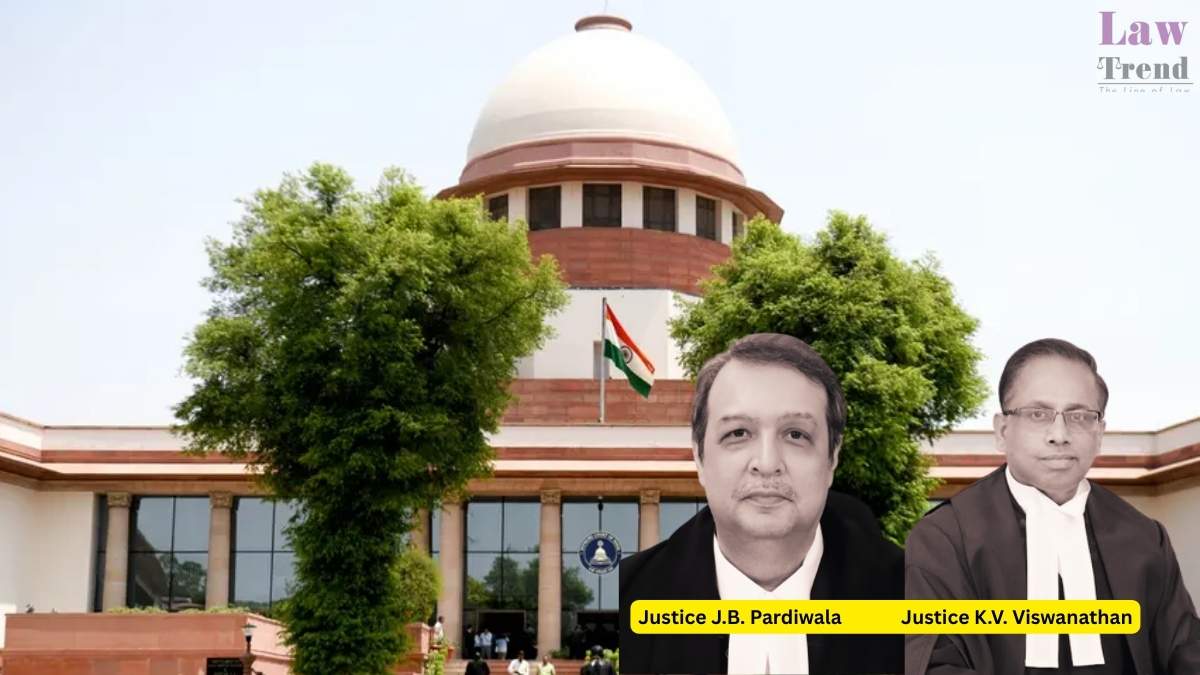
Addressing the troubling trend of penal provisions being weaponised in marital warfare, a Supreme Court Bench comprising Justice J.B. Pardiwala and Justice K.V. Viswanathan ruled that police cannot make hasty or mechanical arrests in cases under the Protection of Children from Sexual Offences (POCSO) Act arising out of matrimonial disputes without prior evaluation by a child psychology or psychiatry specialist. Quashing a POCSO First Information Report (FIR) lodged by an estranged wife against the father of a nine-year-old girl, the Court held that the legal custody of the child remains with the father and directed a structured reintegration process under expert guidance.
Delivering the judgment, Justice Viswanathan expressed grave concern over the escalation of marital battles into spurious sexual abuse allegations:
“To be caught in the crossfire between warring parents would undoubtedly be a painful experience for any child. When the acrimony, however, is escalated to the level of unjustifiably attributing sexual assault of the child by one parent, the matter acquires a different dimension altogether. Quite apart from the trauma that the minor child is put through in the process, the accusation can damage the very fabric of the parent-child relationship and the resultant wound is bound to leave an indelible scar in the minds of both. This is independent of the hurt, humiliation and the public opprobrium the accused parent faces, even long after exoneration from the charges. What is alarming is that this tendency of making false accusations is on the rise. Instances are not infrequent where gullible parties are misguided by their advisors, including in some cases by recalcitrant legal professionals, who in their pursuit of the motto of ‘win at any cost’, end up fuelling the fire.”
Background of the Case
The parties, identified in redacted cause titles as appellant husband ‘R’ and respondent wife ‘E’, married in 2011, and their daughter ‘M’ was born in 2015. Following domestic discord, the wife left the matrimonial home with the child in April 2018. The husband initiated a guardianship petition under Section 25 of the Guardians and Wards Act, 1890, alongside a divorce petition before the Family Court in Bengaluru.
On March 3, 2022, the Family Court allowed the father’s guardianship plea and directed the mother to hand over custody within a month. The Karnataka High Court dismissed the mother’s appeal on January 31, 2023, while formulating detailed visitation terms. Her subsequent challenge before the Supreme Court was dismissed on March 29, 2023. Following habeas corpus proceedings and the issuance of non-bailable warrants against the mother, physical custody was handed over to the father on June 7, 2023.
While visitation modifications and contempt proceedings were pending before the Supreme Court, the mother lodged FIR No. 76/2024 on March 28, 2024, at Jayaprakash Nagar Police Station, Bengaluru. The complaint alleged offences under Section 10 of the POCSO Act, Section 75 of the Juvenile Justice (Care and Protection of Children) Act, 2015, and Sections 323, 504, and 506 read with Section 34 of the Indian Penal Code, claiming the father and his family members had subjected the minor child to sexual harassment and physical violence.
CBI Investigation and Expert Findings
Taking note of the sensitivity of the charges, the Supreme Court stayed parallel proceedings and transferred the investigation to the Central Bureau of Investigation (CBI) on April 7, 2026. A committee headed by a Deputy Inspector General of Police, comprising SP Vinayak Varma and SP Shilpa D., alongside child mental health experts Dr. Lakshmi Sravanti Tanuku and Dr. Anamika Sahu from the National Institute of Mental Health and Neurosciences (NIMHANS), Bengaluru, conducted the investigation.
The CBI submitted an eight-chapter final report encompassing forensic CCTV examinations, statements from school teachers, tutors, and neighbours, and a 79-page comprehensive psychological evaluation of the child. Medical examinations showed no physical signs of abuse. CCTV footage contradicted the timelines and dates alleged in the complaint. Furthermore, mental health experts found no trauma consistent with sexual abuse, concluding that prolonged parental conflict, ongoing custody battles, repeated interrogations, and exposure to adult family narratives had influenced the child’s disclosures.
Citing the CBI’s final conclusions, the Court noted:
“In conclusion, the investigation believes that the testimony of the victim does not appear reliable or trustworthy. The contradictory testimonies, the absence of independent corroborative proof, the CCTV footages that suggest a different series of events, as well as the psychiatric/psychological evaluation, are sufficient to raise doubt as to the reliability and trustworthiness of the allegations. While each individual aspect may be insufficient in itself to negate the allegations, but taken together in their entirety, the Committee finds that the allegations are not made out against the accused and the matter is not fit for prosecution.”
Court’s Analysis on Abuse of POCSO and Matrimonial Litigation
The Supreme Court took judicial notice of the growing tendency of using the POCSO Act as an instrument of extortion and vengeance in domestic disputes.
Referring to Geddam Jhansi and Anr. vs. State of Telangana and Ors. (2025), the Court reiterated:
“Criminalising domestic disputes without specific allegations and credible materials to support the same may have disastrous consequences for the institution of family, which is built on the premise of love, affection, cordiality and mutual trust.”
Citing Achin Gupta vs. State of Haryana & Anr. (2025), the Bench observed:
“In matrimonial disputes the main sufferers are the children. The spouses fight with such venom in their heart that they do not think even for a second that if the marriage would come to an end, then what will be the effect on their children… The police machinery cannot be utilised for the purpose of holding the husband at ransom so that he could be squeezed by the wife at the instigation of her parents or relatives or friends.”
The Court also highlighted observations made in Ishwar Chand Sharma and Ors. vs. State of Uttar Pradesh and Anr. (2026):
“A recent trend in this regard is when the wife resorts to filing false complaints and cases under POCSO Act alleging that the husband, who is also the father of the minor child, has committed wanton acts which are sexual in nature especially against the minor daughter. At the centre of this sort of litigation is a child who is often used by her mother against her father, against her will and wishes, so as to make false and vexatious complaints against her father and other male members of her paternal family in order to exact revenge or as an arm-twisting tactic to obtain a higher monetary settlement or to simply harass.”
Judicial precedents from High Courts were also affirmed, including the Kerala High Court ruling in Suhara vs. Muhammed Jaleel (2019), which held that mere registration of a POCSO case cannot be used as a ruse to deny custody to a parent, and the Madras High Court decision in N. Chandramohan vs. State and Another (2019) regarding the severe repercussions of false allegations under POCSO. The Bench pointed to the 240th Parliamentary Standing Committee Report, which emphasized that the “provision of this proposed law is not meant for settling scores and such attempts need to be curbed.”
Mandatory Safeguards Against Hasty Arrests
Examining the police power of arrest under Section 35 of the Bharatiya Nagarik Suraksha Sanhita, 2023 (BNSS) (corresponding to Sections 41 and 41-A of the Code of Criminal Procedure, 1973), alongside rulings in Joginder Kumar vs. State of U.P. (1994) and Arnesh Kumar vs. State of Bihar (2014), the Court stressed that:
“No arrest can be made because it is lawful for the police officer to do so. The existence of the power to arrest is one thing. The justification for the exercise of it is quite another.”
Under Section 35(1)(b) and 35(1)(c) of the BNSS, an arresting officer must have an objective “reason to believe” that the accused committed the offence. To assist investigating agencies when faced with strained marital backgrounds, the Court laid down mandatory guidelines:
- Threshold Conditions: The safeguards apply when an offence under the POCSO Act is alleged against a parent or family member living under the same roof, and a matrimonial dispute exists between the parents, which the police must verify at the outset.
- Psychological Evaluation in Police Cases: Following the registration of an FIR, the investigating officer or Special Juvenile Police Unit (SJPU) shall not act in haste or effect immediate arrest. They must engage an expert in child and adolescent psychiatry or clinical psychology from the register maintained by the District Child Protection Unit (DCPU) under Rule 5 of the POCSO Rules, 2020. The evaluation must be conducted independently, and only in exceptional cases where material is palpable may it be dispensed with by recording written reasons. The expert opinion will assist the officer in assessing whether a bona fide “reason to believe” exists to make an arrest or file a final report.
- Private Complaints Under Section 33 of the POCSO Act: When a direct complaint is filed before a Special Court amid a matrimonial dispute, the Special Court must not mechanically take cognizance or issue summons. It must seek a psychological evaluation report of the child before issuing process, unless exceptional reasons are recorded in writing.
- Custody Proceedings: In accordance with the principles of child welfare under Rosy Jacob vs. Jacob A. Chakramakkal (1973), Family Courts cannot treat the registration of a POCSO FIR as an automatic disqualification of a parent’s claim for custody, and must independently examine the prima facie veracity of the allegations.
The Decision
Holding that the FIR was lodged solely to overturn custody orders that had attained finality, the Supreme Court quashed FIR No. 76/2024 (re-numbered as CBI Case RC035202650003) against the father and his family members.
The Court held that the legal custody of the child remains with the father. To ensure a smooth transition of physical custody from the mother to the father, the Supreme Court remitted the matter to the IVth Additional Principal Judge, Family Court, Bengaluru. The Family Court will be advised by an Expert Committee comprising CBI officers Vinayak Varma and Shilpa D., alongside NIMHANS experts Dr. Lakshmi Sravanti Tanuku and Dr. Anamika Sahu. The parties and the child were directed to appear before the Family Court on September 28, 2026.
Additionally, the Bench quashed a 2018 cross-complaint (Crime No. 165/2018) filed by the father against the mother, terminated a fresh guardianship petition filed by the mother (GWC No. 194/2024), and disposed of the pending contempt proceedings. The Court directed the circulation of the judgment to all High Courts and Chief Secretaries of all States and Union Territories for onward transmission to subordinate courts and police stations across the country.
Case Title: ‘R’ Versus ‘E’ & Anr.
Case No.: Civil Appeal No. 13119 of 2026 (@Special Leave Petition (C) No. 1092/2024) with Criminal Appeal No. 4534 of 2026, Criminal Appeal No. 4533 of 2026, Contempt Petition (Civil) No. 208/2024, and Criminal Appeal Nos. 4535-4536 of 2026 Bench:
Justice J.B. Pardiwala and Justice K.V. Viswanathan
Date: September 24, 2026




