

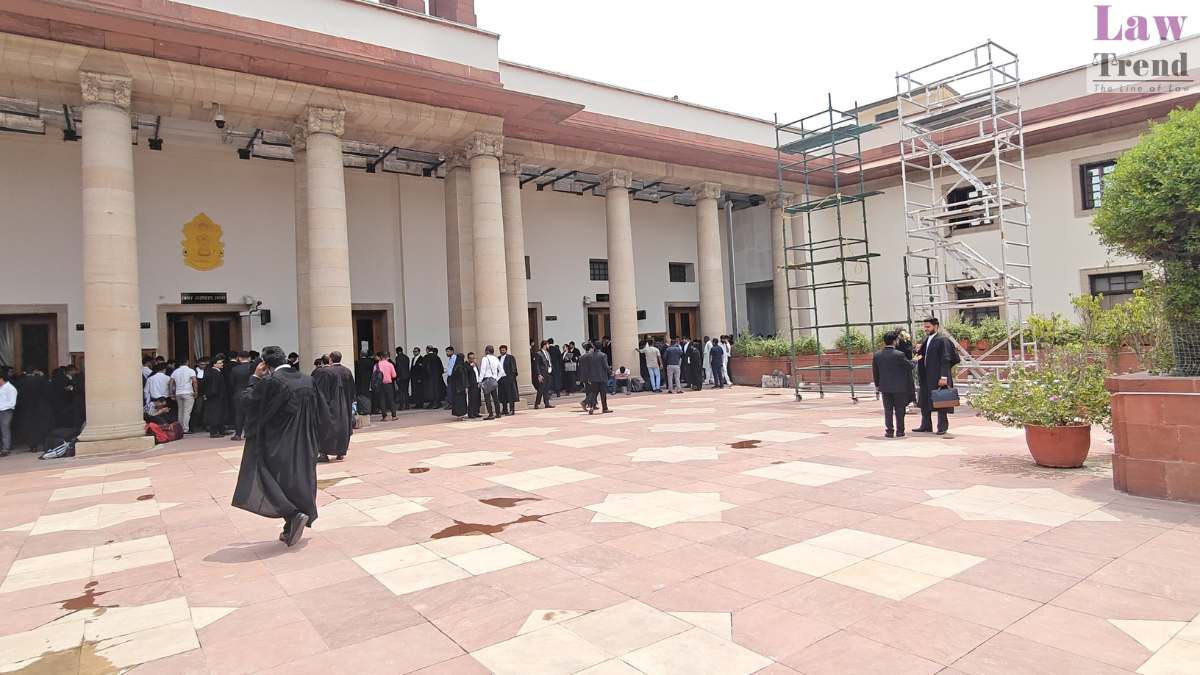
The Supreme Court on Tuesday witnessed a heated exchange between Solicitor General Tushar Mehta and former Orissa High Court Chief Justice and Senior Advocate S Muralidhar over the use of the term “Naxalite” during the hearing of a challenge to the 2026 amendment to the Prevention of Insults to National Honour Act.
A Bench comprising Chief Justice of India Surya Kant and Justices Joymalya Bagchi and V Mohana was hearing a petition filed by Carnatic vocalist TM Krishna challenging the constitutional validity of the amendment, which makes intentionally preventing the singing of the National Anthem or National Song, or disrupting an assembly engaged in such singing, punishable with imprisonment of up to three years.
Krishna has also challenged directions issued by the Ministry of Home Affairs requiring the complete six-stanza version of Vande Mataram to be sung at specified government, ceremonial and cultural occasions.
Muralidhar Questions Scope Of Penal Provision
Appearing for Krishna, Muralidhar argued that the amended provision penalises preventing the singing of the National Song without defining what constitutes the National Song.
He submitted that if the government intended to rely on an office memorandum to give meaning to a penal statute carrying consequences of imprisonment, it should clarify its position. He also criticised the manner in which the amendment was introduced, saying such a measure required greater clarity.
The Bench observed that anyone who took the trouble to read the history would know what the National Song was.
Solicitor General Mehta then urged the Court not to issue notice on the petition, submitting that doing so could create a “sensation”.
Muralidhar responded that history did not bind constitutional decision-making and argued that such questions should ideally evolve through the building of public opinion. He said his submission concerned the larger issue of the law-making process.
‘Naxalite’ Remark Triggers Heated Exchange
Responding to Muralidhar’s submissions, Mehta said objections had already been raised in Parliament and that decisions were taken by Parliament in accordance with the Constitution, not in the manner in which “Naxalites” decide.
Muralidhar immediately objected to the expression and told the Bench that he did not want such a remark from the Solicitor General of India to go out during a live proceeding. He asked that Mehta repeat the expression he had used.
Mehta said he had used the expression because Muralidhar was questioning the constitutional decision-making process.
Muralidhar replied that such language did not befit a law officer and said he had never heard a law officer use expressions of that kind.
The Court then said it would not take the use of the word on record and indicated that it was confining itself to the legal issue involving constitutional interpretation.
Mehta, however, repeated his stand, saying that decision-making was done by Parliament through the constitutional process and again referred to what “the Naxalite wants”. He added that he was not sorry for the remark.
Muralidhar then told the Bench that Mehta had repeated the expression despite the objection and registered what he described as his strongest protest. He also accused the Solicitor General of playing to the gallery.
Mehta clarified that he was not labelling anyone individually and said his comment was directed at an ideology.
Senior Advocate Sanjay Hegde then remarked that thinking did not make a person a Naxalite.
Challenge To Six-Stanza Vande Mataram Direction
Krishna’s petition challenges Section 3 of the Prevention of Insults to National Honour Act, 1971, as amended in 2026.
The amended provision makes it punishable with imprisonment of up to three years, a fine, or both to intentionally prevent the singing of the National Anthem or National Song, or to cause disturbance to an assembly engaged in such singing.
The petition contends that the Centre’s directions requiring the rendition of all six stanzas of Vande Mataram go beyond merely regulating protocol at public functions.
According to Krishna, the requirement effectively compels citizens to participate in singing the last four stanzas, which the plea says contain references to Hindu deities including Durga, Lakshmi and Saraswati.
The petition argues that the State action does not merely prescribe a uniform code of conduct for public functions but compels assent to a symbol whose third to sixth stanzas are devotional and invoke deities.
Krishna has challenged the measures under Articles 14, 15(1), 19(1)(a), 21 and 25(1) of the Constitution, relating to equality, protection against discrimination, freedom of speech and expression, life and personal liberty, and freedom of conscience and religion.
Reliance On Bijoe Emmanuel Judgment
The petition relies on the Supreme Court’s 1986 judgment in Bijoe Emmanuel v State of Kerala, where the Court protected schoolchildren who stood respectfully during the National Anthem but did not sing it because of their religious beliefs.
Krishna contends that the criminal penalty under the amended law makes the present controversy fundamentally different from a protocol governing national functions.
The plea argues that requiring all six stanzas to be sung under threat of penal consequences transforms what it describes as a historically contested symbol into a compelled orthodoxy.
It also contends that the first two stanzas of Vande Mataram were originally composed as a separate patriotic lyric, while the remaining four were added when the song was incorporated into Bankim Chandra Chattopadhyay’s novel Anandamath.
According to the petition, the later stanzas are religiously and musically distinct from the first two.
The plea further refers to the Congress Working Committee’s 1937 decision to restrict Vande Mataram at national gatherings to its first two stanzas following objections from Muslim members.
Krishna has argued that although the 2026 directions are formally neutral, their effect is religiously coded and results in expressive subordination of believing Muslims and other conscientious objectors.




