

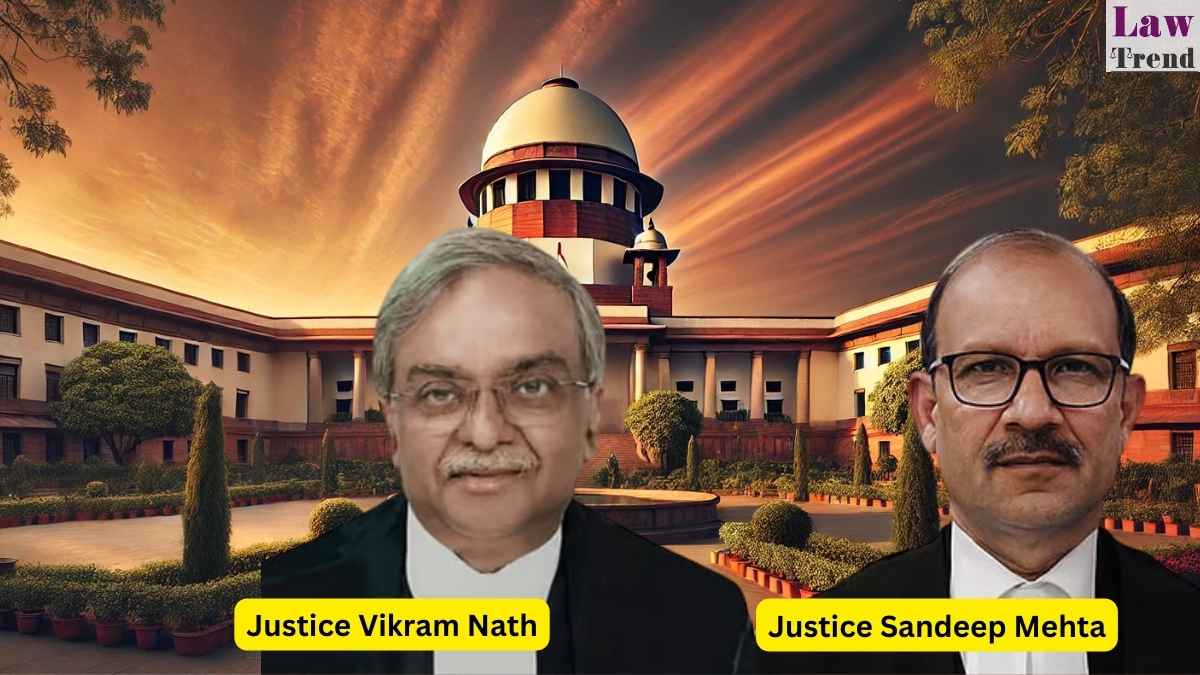
The Supreme Court has held that a father facing prosecution under the Protection of Children from Sexual Offences Act, 2012 cannot, during the pendency of such proceedings, be entrusted with custody of the children when their welfare and safety are at stake. A bench of Justice Vikram Nath and Justice Sandeep Mehta permitted the mother, for the present, to take her two minor children to the United Kingdom and enrol them in a school there, while continuing the stay on orders that had granted sole custody to the father.
The Court was considering appeals filed by the mother against a January 23, 2026 judgment of the Delhi High Court, which had upheld a Family Court order declaring the father sole custodian of the two children and had also rejected the mother’s request to relocate them to the United Kingdom.
Background
The parties married in September 2011. Their son was born in April 2013 and their daughter in January 2019. According to the judgment, matrimonial relations deteriorated in 2018, when the mother was four months pregnant. She left the matrimonial home and subsequently regained custody of the son in September 2018. The daughter remained with her from birth.
The mother, an academician specialising in Computer Science and Engineering, later worked at different institutions, including IIT Jodhpur and VIT University, before moving to Bengaluru. She eventually secured employment as a lecturer at the University of Hull in the United Kingdom, earning approximately ₹3 lakh per month. The father was stated to be working as a part-time lecturer in West Bengal, earning ₹17,000 per month.
In July 2024, the Family Court allowed the father’s guardianship petition and declared him sole custodian of both children. The Delhi High Court affirmed that decision in January 2026 and rejected the mother’s relocation plea.
During the custody litigation, the son was taken to NIMHANS, Bengaluru, after he began exhibiting signs of aggression. The judgment records that he made disclosures indicating alleged sexual abuse by the father. This resulted in registration of an FIR under the POCSO Act in November 2023. A chargesheet was subsequently filed, while the father’s petition seeking quashing of the criminal proceedings remained pending before the Calcutta High Court.
Children Showed Strong Reluctance to Meet Father
During the proceedings before the Supreme Court, the judges interacted with the parents and the children in chambers. The Court recorded that the son was emphatic that he did not want to remain in the father’s company and that his body language reflected fear at the thought of being with him. The Court consequently stayed the Delhi High Court and Family Court orders in February 2026.
The Court later arranged supervised visitation between the father and the children during the summer vacation. Counsellors reported that both children displayed strong reluctance to interact with him. The daughter showed fear and emotional distress, while both children expressed a preference to remain with their mother.
The Supreme Court said the visitation exercise established that the son had shown extreme reluctance to remain in his father’s company. It also noted that the daughter, who was born after the mother had left the matrimonial home, had hardly interacted with the father apart from the temporary court-ordered visitation.
Mother’s Arguments
Senior Advocate Zoheb Hossain, appearing for the mother, argued that she had remained the primary caregiver of both children for several years and that disturbing their settled living arrangement would not serve their welfare.
He submitted that her changes in employment had been necessitated by circumstances and that it was unjustified to characterise her career-related relocations as a “nomadic lifestyle”. He also relied upon the children’s wishes, their academic performance and the counsellors’ reports showing their reluctance to remain with the father.
On the POCSO proceedings, the mother argued that the child’s disclosures before NIMHANS could not be brushed aside at the custody stage, particularly when a chargesheet had been filed after investigation. She further submitted that relocation to the UK would provide the children with financial stability, educational opportunities and a stable environment under her care.
Father’s Arguments
Senior Advocate Shyam Divan, representing the father, argued that financial disparity between the parents could not by itself decide custody. He contended that the case involved parental alienation and alleged that the mother had deliberately distanced the children from their father.
He also opposed relocation to the UK on the ground that it could distance the children from their Bengali cultural roots and potentially result in their permanent settlement abroad. On the POCSO case, he relied upon the pendency of the father’s quashing petition and argued that the filing of a chargesheet should not automatically deprive him of his claim to custody.
Supreme Court Rejects ‘Nomadic Life’ Finding
The Supreme Court strongly disagreed with the approach of the courts below in treating the mother’s employment-related movement between cities as evidence of a nomadic lifestyle.
The Court observed that after leaving the matrimonial home, the mother had attempted to establish herself professionally and secure employment compatible with her qualifications for the welfare of herself and the children.
The bench said:
“This attempt of the appellant-mother has been branded as a ‘nomadic life’ by the Courts below, which, in our opinion, is absolutely unjustified and far removed from reality.”
The Court also found that the mother’s efforts to pursue employment and achieve financial security for the children weighed substantially in her favour while considering custody.
Delhi High Court’s Remarks on POCSO Case Expunged
The Supreme Court further criticised the Delhi High Court for making observations questioning the veracity of the POCSO allegations while the criminal proceedings were still pending.
It noted that the FIR followed a disclosure made by the son to a psychiatrist at NIMHANS and that the police had subsequently filed a chargesheet after investigation.
The bench held:
“We are of the firm opinion that the observations made by the High Court in the impugned judgment on the veracity of the POCSO FIR were out of place, uncalled for and premature.”
Those observations were expunged and directed not to be taken into account in proceedings arising from the FIR.
Father Facing POCSO Prosecution Cannot Get Custody
The Supreme Court held that once a chargesheet had been filed against the father after investigation into allegations constituting an offence under the POCSO Act, giving him custody would be unwarranted.
The Court stressed that the best interests of the children must remain the primary consideration in a custody dispute. It referred to the principles of participation, best interest, safety and non-waiver of rights under Section 3 of the Juvenile Justice (Care and Protection of Children) Act, 2015.
The bench observed:
“Under no circumstances, the respondent-father, as long as he is facing prosecution, can be considered to be a person entitled to custody of the children.”
The Court added that even if the father ultimately succeeds in his pending quashing petition, the circumstances in which the child’s disclosure was made could not automatically be erased or treated as irrelevant while assessing the child’s welfare and custody.
Relocation to UK Permitted
The Supreme Court also rejected the argument that moving abroad would necessarily cause the children to lose their Bengali cultural values, holding that no such presumption could be made merely because of relocation to another country.
Considering the mother’s employment in the United Kingdom, the father’s present disentitlement to custody and the circumstances of the children, the Court found the mother’s request to relocate justified.
It permitted her, for the present, to take both children to the UK and secure their admission to a good school. She was directed to file an affidavit giving details of their schooling within six weeks and to undertake that she would produce the children before the Supreme Court or any other court whenever directed.
The father’s quashing petition before the Calcutta High Court was directed to be decided independently on its own merits, uninfluenced by observations made either by the Delhi High Court or by the Supreme Court in the custody proceedings.
The appeals will next be heard in January 2027.
Case Details
Case Title: Debarati Bhunia Chakraborty v. Suman Sankar Bhunia
Case No.: Civil Appeal Nos. 12774 and 12775 of 2026
Bench: Justice Vikram Nath and Justice Sandeep Mehta
Date: September 23, 2026




