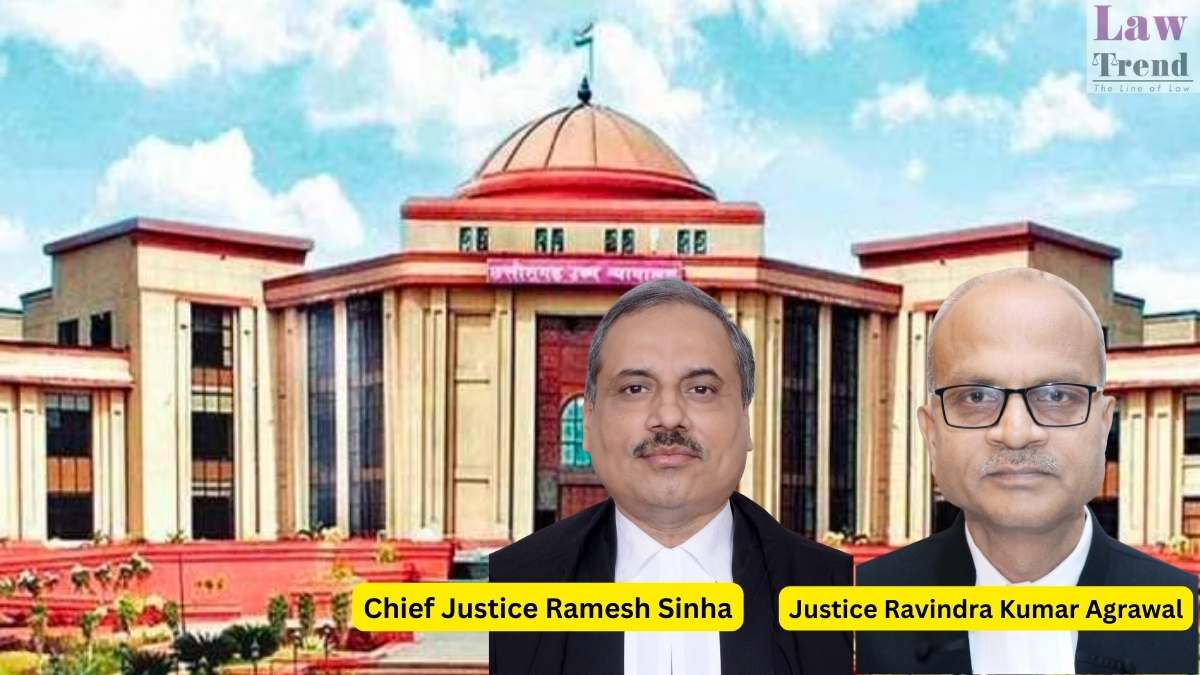
The High Court of Chhattisgarh has dismissed a criminal appeal filed by a man convicted of repeatedly sexually assaulting his minor stepdaughter. A Division Bench comprising Chief Justice Ramesh Sinha and Justice Ravindra Kumar Agrawal affirmed that the testimony of a minor victim, if found cogent and trustworthy, is sufficient for conviction without independent corroboration.
Background
The case originated from a 2014 incident where the appellant, Vishwanath Soni, allegedly took his minor stepdaughter (the victim) to a house in Khairbar under the pretext of work. According to the prosecution, he subjected her to heinous sexual acts, including forced ingestion of urine and rape at a secluded location. The abuse allegedly continued for nearly two years.
The matter came to light in December 2015 when an awareness program was conducted by ‘Child Line 1098’ at the victim’s school. Encouraged by the program, the victim disclosed the ordeal to a friend and later to Child Line personnel. On December 17, 2015, a First Information Report (FIR) was lodged at Ambikapur Police Station.
The Trial Court (Additional Sessions Judge, F.T.C., Surguja) convicted the appellant on November 24, 2018, under Section 377 of the Indian Penal Code (IPC) and Sections 5(l)/6, 5(m)/6, and 5(n)/6 of the POCSO Act, sentencing him to life imprisonment.
Arguments of the Parties
The counsel for the appellant argued that the Trial Court’s findings were erroneous and lacked proper appreciation of evidence. It was contended that the prosecution failed to prove the guilt beyond reasonable doubt and that the victim’s testimony suffered from “material contradictions and infirmities.” The defense further argued that the medical evidence did not conclusively support the allegations and that the possibility of false implication could not be ruled out.
Conversely, the Additional Advocate General for the State supported the Trial Court’s judgment, asserting that the conviction was based on valid legal grounds and required no interference.
Court’s Analysis
The High Court focused its analysis on two primary questions: the minority of the victim and the veracity of the rape allegations. Based on the dakhil-kharij register (Ex.P-13C), the Court established that the victim was a minor at the time of the incident.
Evaluating the victim’s testimony (PW-9), the Court observed that her account was “consistent, cogent, and natural.” The Bench noted:
“The victim’s statements remain substantially consistent from the earliest point of disclosure to her deposition before the Court. The minor variations, if any, are trivial and do not affect the substratum of the prosecution case.”
The Court highlighted that the victim’s initial hesitation to disclose the abuse was a natural behavioral pattern for child victims of sexual offences. Referring to the “sterling quality” of the witness, the Bench cited several Supreme Court precedents, including Rameshwar v. The State of Rajasthan and Rai Sandeep @ Deenu v. State of NCT of Delhi, to emphasize that a victim of sexual assault is not an accomplice and her testimony carries great weight.
The Court observed:
“In the Indian society refusal to act on the testimony of the victim of sexual assault in the absence of corroboration as a rule, is adding insult to injury… there is inbuilt assurance that the charge is genuine rather than fabricated.”
Decision
The High Court concluded that the prosecution had successfully proved the charges beyond reasonable doubt. The Bench upheld the conviction and the life sentence awarded by the Trial Court.
The Court further noted:
“The testimony of the minor victim, if found cogent, consistent, and trustworthy, is sufficient to form the basis of conviction without the need for independent corroboration.”
The appellant, who was on bail, was ordered to surrender within four weeks to serve the remaining sentence.
Case Details:
- Case Title: Vishwanath Soni v. State of Chhattisgarh
- Case No.: CRA No. 1814 of 2018
- Bench: Chief Justice Ramesh Sinha and Justice Ravindra Kumar Agrawal
- Date: May 6, 2026