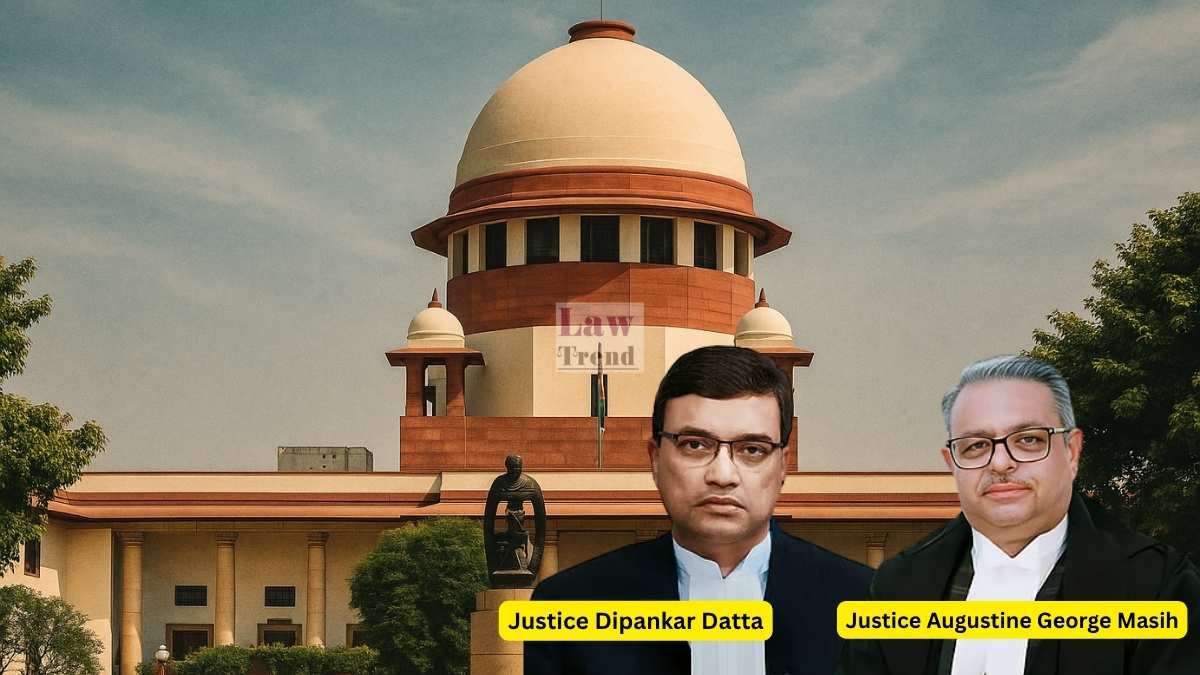
In a key judgment concerning public recruitment, the Supreme Court of India, comprising a bench of Justice Dipankar Datta and Justice Augustine George Masih, held that selection committees cannot fix unprescribed qualifying or cut-off marks to exclude candidates when statutory rules provide a specific shortlisting procedure. Setting aside a judgment of the Allahabad High Court, the apex court directed the State of Uttar Pradesh to interview eligible candidates holding Craft Instructor Training Scheme (CITS) certificates and offer them appointments against existing vacancies for the post of ITI Instructors.
Background of the Case
To enhance the skills of the nation’s workforce, Industrial Training Institutes (ITIs) were established in the 1950s. On July 24, 1996, the Directorate General of Employment & Training under the Ministry of Labour issued directions enhancing the qualifications for Vocational Instructors and directing States to amend their rules to make a one-year CITS certificate a mandatory condition. The State of Uttar Pradesh accepted this direction and incorporated it into the Uttar Pradesh Industrial Training (Instructors) Services Rules, 1991 through an amendment on August 8, 2003.
However, in 2014, the State Government framed the Uttar Pradesh Industrial Training Institutes (Instructors) Service Rules, 2014, superseding earlier rules and diluting the CITS requirement from an essential qualification to a “preferential qualification.” Pursuant to advertisements issued in 2014 (for 2,498 posts) and 2015 (for 559 posts), CITS certificate holders applied for appointment. When non-CITS candidates were considered and many CITS certificate holders were excluded from interviews, litigation was initiated.
The candidates challenged Rules 9(B), 16(3)(a)(iii), and 17(3) of the 2014 Rules along with the recruitment advertisements before the Allahabad High Court. A total of 43 writ petitions were dismissed by the High Court on January 4, 2023, leading to the present appeals before the Supreme Court.
Arguments and Preliminary Objection
Before the Supreme Court, the State of Uttar Pradesh raised a preliminary objection, arguing that the appellants had applied under the advertisements with full knowledge that CITS was only a desirable qualification and were thus estopped from challenging the selection process after participating in it.
The Supreme Court acknowledged the general principle that a candidate who participates in a selection process without objection cannot ordinarily challenge it. However, the Court clarified that an exception applies where arbitrariness or illegality in the selection process is writ large, as a candidate cannot be presumed to have accepted an illegality that vitiates the entire process.
Court’s Analysis and Findings
Examining the recruitment mechanism under Rule 16 of the 2014 Rules, the Court noted that marks secured in High School (maximum 50 marks), National Trade Certificate/National Apprenticeship Certificate or Diploma/Degree (maximum 20 marks), and CITS/POT test (maximum 15 marks) were to be aggregated out of 85 marks to prepare a merit list for interviews (15 marks).
Rule 16(3)(b)(i) allowed shortlisting by restricting interview candidates to four times the number of vacancies only when applications were received in large numbers. However, data furnished by the State showed that against 2,498 advertised posts in 2014, offer letters could only be issued to around 2,200 candidates, leaving substantial vacancies unfilled.
Analyzing Rule 16(3)(b)(i), the Supreme Court observed that “while the rule envisages a mechanism for reducing the pool of candidates only when their number is disproportionately high, no room is provided for excluding candidates from the zone based solely on the marks secured under sub-clauses (i), (ii) and (iii) of clause 3(a) (supra) and without they being called for interview.”
The Court held that the exclusion of eligible candidates occurred solely because the Selection Committee and the State Government superimposed qualifying or cut-off marks that were completely absent from the 2014 Rules.
Observing the illegality in this approach, the Court stated: “Once the rule-making authority has consciously provided only one mode of shortlisting, namely limiting the candidates to be called for interview to four times the number of vacancies where applications are received in large numbers, it was not open to the Selection Committee/SoUP to superimpose an additional eligibility threshold.”
The Court further held that “The fixation of qualifying or cut-off marks resulted in ouster of a substantial number of candidates including the appellants and, thereby, vacancies remained unfilled despite the availability of candidates otherwise eligible under the Rules. Such fixation has to be characterised as arbitrary and contrary to the recruitment procedure prescribed by the 2014 Rules as well as the overall object behind them.”
Emphasizing that the selection rules could not be altered mid-stream, the Court noted that “The rules of the game, mid-way, could not have been changed by the Selection Committee/SoUP to the detriment of a number of candidates.”
Court’s Decision and Directions
Noting that 5,507 instructors are currently in position against 7,768 sanctioned posts, leaving over 2,200 posts vacant, the Supreme Court held that denying relief to the appellants merely due to passage of time would cause injustice.
Allowing the appeals, the Supreme Court issued the following directions:
- Liberty is granted to the appellants and impleaded candidates to approach the appointing authority within two weeks.
- The respondents shall hold interviews for the eligible candidates at the earliest, determine inter-se merit as per the rules, and offer appointments against currently vacant posts in relevant disciplines within four months.
- If the number of eligible candidates exceeds available vacancies, supernumerary posts shall be created for them.
- Appointments will be prospective, subject to qualification verification as on the application date and antecedent verification.
- If appointment is declined to any candidate, a reasoned order must be passed and communicated without delay.
- Appointees will be entitled to all service benefits (excluding back wages, seniority, and promotion), as well as pension and gratuity subject to applicable rules upon superannuation.
Case Details:
Case Title: Arvind Kumar & Ors. v. State of U.P. & Ors.
Case No.: Civil Appeal Nos. 8257-8259 of 2026
Bench: Justice Dipankar Datta and Justice Augustine George Masih
Date: July 24, 2026