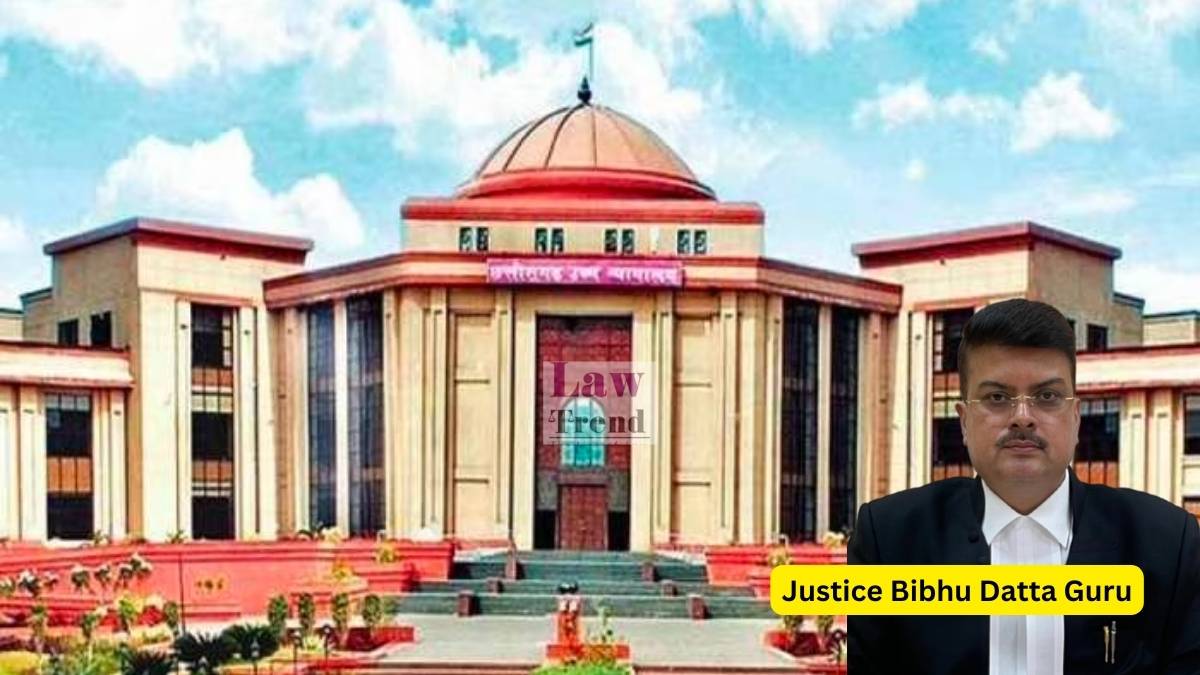
In a significant ruling concerning public employment and administrative service conditions, the High Court of Chhattisgarh has held that the fixation and alteration of recruitment and promotional quotas across feeder cadres fall squarely within the policy domain and prerogative of the employer. A single-judge bench of Justice Bibhu Datta Guru dismissed a writ petition filed by 39 Junior Engineers challenging the reduction of the promotional quota for the post of Assistant Engineer from 70% to 40% and the consequential enhancement of the direct recruitment quota to 50%. The Court firmly reiterated that while an employee possesses a right to be considered for promotion under the extant rules, there exists no vested or indefeasible right to promotion itself, nor does a mere diminution in promotional prospects violate Articles 14 or 16 of the Constitution of India.
Background of the Case
The petitioners were appointed as Junior Engineers (Plant) under the Chhattisgarh State Power Generation Company Limited (CSPGCL) in the year 2018 and were subsequently regularized and confirmed in service. At the time of their induction, the recruitment criteria for the post of Assistant Engineer stood at 40% through promotion, 50% via open direct recruitment, and 10% through departmental recruitment.
However, pursuant to a decision of the Board of Directors communicated via memo on March 19, 2021, the recruitment quota was altered: the promotional quota was enhanced to 70%, open direct recruitment was reduced to 20%, and departmental recruitment remained at 10%. Having completed the qualifying tenure, the petitioners were placed in the gradation list dated February 21, 2024, becoming eligible for promotional consideration.
Subsequently, CSPGCL prepared a detailed departmental note in 2024 proposing to revert to the earlier quota structure. The Board of Directors of the Chhattisgarh State Power Transmission Company Limited (CSPTCL) met on April 8, 2025, and passed Resolution No. 117/07, restoring the promotional quota to 40% and direct recruitment to 50%. This was followed by an administrative order dated May 5, 2025, and a final order dated July 22, 2026. Consequentially, a recruitment advertisement was issued on August 7, 2026, seeking to fill 60 posts of Assistant Engineer (Generation) through direct recruitment. Aggrieved by the reduction of their promotional quota and the direct recruitment notice, the petitioners approached the High Court under Article 226 of the Constitution.
Arguments on Behalf of the Petitioners
Appearing for the petitioners, Senior Advocate Manoj Paranjpe contended that reducing the promotional quota from 70% to 40% severely curtailed the legitimate promotional avenues of qualified and experienced Junior Engineers who had completed their qualifying service. It was pointed out that even after the quota revision order dated May 5, 2025, the respondents promoted 23 Junior Engineers on April 20, 2026, under the earlier quota, indicating arbitrariness.
Counsel argued that the company already possessed an ample pool of experienced and technically qualified in-house engineers, making the justification for increasing direct recruitment untenable. Relying on Supreme Court precedents, including State of Punjab v. Bandeep Singh and A. Satyanarayana v. S. Purushotham, the petitioners prayed for the quashing of the orders dated May 5, 2025, and July 22, 2026, alongside the recruitment notice of August 7, 2026, and sought restoration of the 70% promotional quota.
Arguments on Behalf of the Respondents
Resisting the petition, Senior Advocate Prafull N. Bharat, appearing for CSPGCL (Respondents No. 2 and 4), submitted that the impugned orders merely restructured the recruitment quota without extinguishing the promotional avenue, as 40% posts remained reserved for promotion and 10% for departmental recruitment. It was argued that the petitioners held no vested right to insist on the perpetual continuation of a 70% promotional quota, since mere chances of promotion do not constitute a condition of service.
The respondents explained that the decision was taken in view of upcoming projects, including new 2×660 MW power plants and Pump Storage Projects, which specifically necessitate Graduate Engineers for panel operations and maintenance in line with Central Electricity Authority (CEA) guidelines requiring units of 210 MW or more to be manned by graduate engineers. It was also clarified that the promotion of 23 engineers in April 2026 stemmed from a Departmental Promotion Committee (DPC) convened well prior to the formal restructuring. The state and transmission company counsels supported these submissions, reiterating that judicial review in administrative policy decisions is strictly limited.
The Court’s Analysis and Observations
Examining the records and departmental deliberations, Justice Bibhu Datta Guru noted that the administration had undertaken a thorough internal assessment before reverting to the 40:10:50 ratio. The Court observed that an employee’s right remains confined to fair consideration under the rules in force at the material time, and the earlier 70% quota could not be treated as an immutable service condition.
The bench stressed that courts must exercise caution and restraint before interdicting recruitment processes, observing:
“Courts will have to be cautious and slow in dealing with the recruitment process adopted by the recruitment agency. A lot of thought process has gone into applying the rules and regulations. Merely because the recruitment agency is not in a position to satisfy the Court, relief cannot be extended to the candidates.”
Emphasizing the foundational principle governing service jurisprudence, the Court reaffirmed:
“It is the trite law that reduction in the chances of promotion, if any, on account of a change or amendment in the rules would not affect the fundamental rights of an employee, as a public servant has only a right to be considered for promotion in accordance with the extant rules.”
In reinforcing this position, the Court extensively cited the Supreme Court’s ruling in Dwarka Prasad v. Union of India (2003), quoting:
“Fixation of quotas or different avenues and ladders for promotion in favour of various categories of posts in feeder cadres based upon the structure and pattern of the Department is a prerogative of the employer, mainly pertaining to the policy-making field. The relevant considerations in fixing a particular quota for a particular post are various such as the cadre strength in the feeder quota, suitability more or less of the holders in the feeder post, their nature of duties, experience and the channels of promotion available to the holders of posts in the feeder cadres. Most important of them all is the requirement of the promoting authority for manning the post on promotion with suitable candidates. Thus, fixation of quota for various categories of posts in the feeder cadres requires consideration of various relevant factors, a few amongst them have been mentioned for illustration. Mere cadre strength of a particular post in the feeder cadre cannot be a sole criterion or basis to claim parity in the chances of promotion by various holders of posts in feeder categories.”
The High Court further drew support from the Supreme Court rulings in Dilip Kumar Garg v. State of Uttar Pradesh (2009), Dr. Jaya Thakur v. Union of India (2023), and Union of India v. Pushpa Rani (2008) to hold that the employer remains the best judge of administrative necessities, and policy determinations cannot be overturned in the absence of manifest arbitrariness, mala fides, or statutory infringement.
Decision of the Court
The High Court concluded that the petitioners had failed to establish any violation of their constitutional or legal rights. The Court affirmed that prescription or alteration of promotional quotas is an employer’s policy decision, and mere diminution in chances of promotion does not attract Articles 14 or 16 of the Constitution. Finding no perversity, illegality, or arbitrariness in the impugned quota orders or the consequential recruitment advertisement, the Court dismissed the writ petition as devoid of merit.
Case Title: Ashish Banjare and Others versus State of Chhattisgarh and Others
Case No.: WPS No. 6238 of 2026
Bench: Justice Bibhu Datta Guru
Date: 7th September, 2026