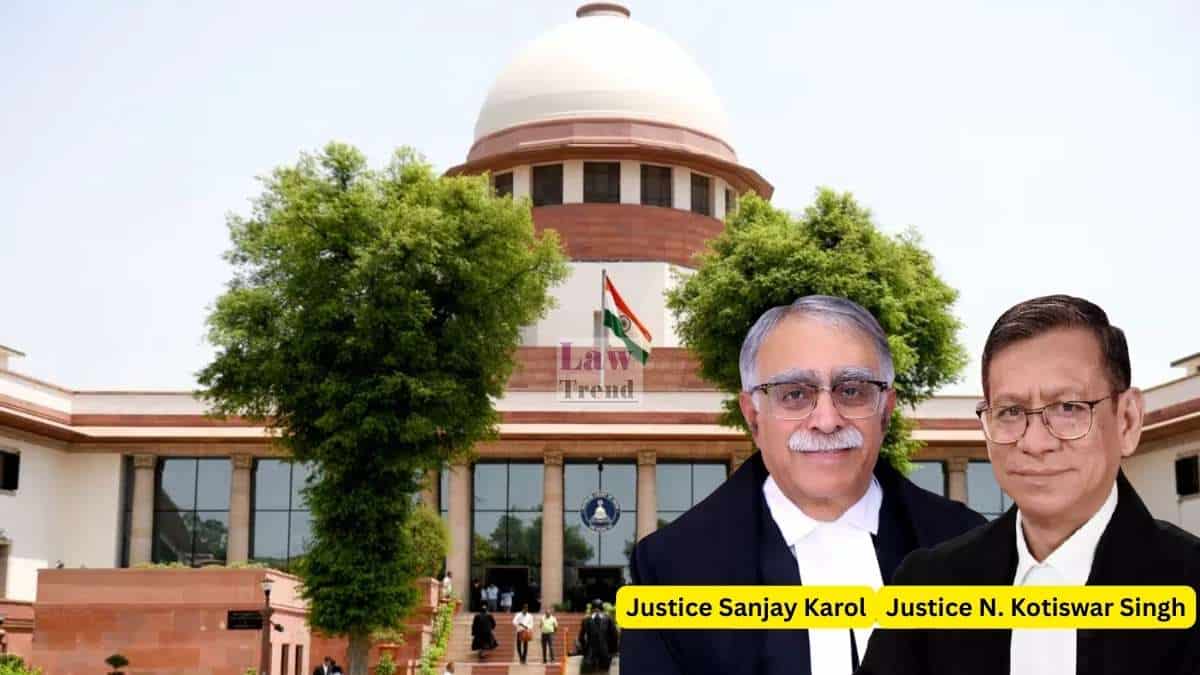
The Supreme Court of India has ruled that the principle of constructive res judicata cannot be used to bar a subsequent title suit when the previous litigations were limited only to challenging specific, unauthorized sale transactions. A bench comprising Justice Sanjay Karol and Justice N Kotiswar Singh allowed the civil appeal of a landowner, setting aside a judgment of the High Court of Chhattisgarh, Bilaspur, which had dismissed the landowner’s title suit by misapplying the doctrine under Section 11 of the Code of Civil Procedure (CPC). The Court held that applying the rule under such circumstances to deprive a person of undisputed family property would be offensive to both law and equity.
Background of the Dispute
The case traces back to a property dispute beginning in the 1960s involving the descendants of one Gokul Rai. The properties originally belonged to Gokul Rai’s grandson, Mahabir Rai. On July 27, 1960, Mahabir Rai transferred a portion of his property totaling 95.80 acres in favor of his mother, Raj Mohani (also known as Rupjhari), and his minor son, Makardhwaj Ram (the appellant).
On April 23, 1962, Mahabir Rai, his wife Gulmati, and his mother Raj Mohani executed a General Power of Attorney (GPA) in favor of Rambhajan, Mahabir Rai’s cousin. Rambhajan subsequently used this GPA to execute two unauthorized land sales in early 1969:
- On January 27, 1969, he sold 21.43 acres to Prem Prakash.
- On February 4, 1969, he sold 33.76 acres to Chandra Sao.
The grantors cancelled the GPA on June 25, 1969. Following these sales, two separate suits were instituted while the appellant was still a minor to challenge the unauthorized transactions:
- Mahabir Rai sought the cancellation of the 21.43-acre sale deed. This suit was dismissed on October 21, 1989, because the appellant (as the successor-in-interest of Mahabir Rai) could not establish his status as successor-in-interest in that specific proceeding.
- Gulmati, acting as the guardian of her minor children, challenged the second sale of 33.76 acres. This suit was also dismissed on July 31, 1975.
The trigger for the current round of litigation occurred in 1985 when Rambhajan applied to mutate his name in the Revenue Records for the entire property. While initially rejected, the mutation was allowed on appeal. Threatened by this attempt to claim the entire property—far exceeding the sold portions—the appellant, Makardhwaj Ram, filed a civil suit in 1986 seeking a declaration of title and possession.
By a judgment dated May 7, 1993, the Trial Court partly decreed the suit, holding the appellant entitled to 43.69 acres out of the claimed 95.80 acres. This was affirmed by the First Appellate Court on March 11, 1996. However, on September 18, 2009, the High Court of Chhattisgarh allowed the second appeal and dismissed the suit as being barred by constructive res judicata. The High Court reasoned that because the appellant did not assert his ownership flowing from the 1960 deed in the earlier suits, he had given up his stronger title claim.
Arguments of the Parties
The appellant argued before the Supreme Court that there was a clear distinction between the two rounds of litigation. The earlier suits sought to recover specific portions of land lost to unauthorized sales, whereas the present suit sought a declaration of title and possession over the remaining land. Relying on Nagabhushanammal v. C. Chandikeswaralingam (2016) 4 SCC 434, the appellant submitted that res judicata applies only when the cause of action is identical and the plaintiff had an occasion to seek the same relief in the prior proceedings. Additionally, the appellant argued that res judicata is a mixed question of law and fact, and the defendants failed to produce the necessary prior pleadings to establish their claim.
Conversely, the respondents contended that there is no absolute requirement to produce prior pleadings when the court judgments clearly reflect similar causes of action. They argued that if the 1960 deed was indeed the source of the appellant’s claim, it ought to have been pleaded as the primary ground of attack in the earlier proceedings, and failing to do so barred the subsequent suit under Explanation IV of Section 11, CPC.
Court’s Analysis and Key Precedents
The Supreme Court examined the statutory provisions of Section 11 and Explanation IV of the CPC, which define constructive res judicata. The bench discussed several historical and modern precedents to outline the scope of the doctrine.
The Court referred to the Privy Council decision in Kameswar Pershad v. Rajkumari Ruttun Koer (1892), quoting Morris LJ: “That it ‘might’ have been, made a ground of attack is clear. That it ‘ought’ to have been, appears to their Lordships to depend upon the particular fact of each case. Where matters are so dissimilar that their union might lead to confusion, the construction of the word ‘ought’ would become important…”
It also cited the Constitution Bench ruling in Daryao v. State of U.P. (1961), which highlighted the public policy foundation of the rule: “It is in the interest of the public at large that a finality should attach to the binding decisions pronounced by Courts of competent jurisdiction, and it is also in the public interest that individuals should not be vexed twice over with the same kind of litigation.”
Referencing further rulings in State of Karnataka v. All India Manufacturers Organisation (2006) and Samir Kumar Majumder v. Union of India (2024), the Supreme Court summarized the key principles governing constructive res judicata:
- It mandates that all grounds that “might and ought” to have been employed in a proceeding must be raised to avoid multiplicity of litigations.
- It is a legal deeming fiction whose application depends on the specific facts, requiring due regard to the scope of earlier proceedings and the nature of the controversy.
- The word “ought” implies a threshold above mere possibility, demanding reasonable diligence.
- The principle applies even when the omission of a ground occurs due to negligence, inadvertence, or accident.
The Supreme Court’s Decision
Applying these principles to the facts, the Supreme Court disagreed with the High Court’s findings. The Court noted that the appellant was already the undisputed owner of the larger portion of the land by virtue of the 1960 deed. There was no occasion or legal necessity for him to assert his title over the remaining undisputed land during the previous suits, which were narrowly tailored to contest the unauthorized transfer of specific portions.
The Court observed: “Where and how does the question of asserting his right over the larger parcel of land emerge when the same already rests undisputedly in his favour by virtue of the 1960 deed? When the apprehension arose by virtue of Rambhajan’s application to mutate his name in the relevant records with respect to the entire property in excess of what was part of sale transaction, came the suit by Makardhwaj, asserting his right which had, in his view, be hitherto unquestioned. This question missed the attention of the High Court.”
The Court emphasized that when adjudicating family disputes, a judge must look at the surrounding circumstances rather than rigidly enforcing strict legal technicalities. The bench stated: “The application of law, especially when it comes to inter family disputes is not akin to enforcing the black letter of the law but calls upon the Judge to understand the surrounding facts and circumstances and in the light thereof come to a conclusion in accordance with law.”
The Court concluded that depriving the appellant of his lifelong family property through a misapplication of the res judicata rule would be highly unjust: “The part of the appellant-plaintiff’s right which was threatened was challenged so in effect, he through his guardians, was protecting his rights. There was no occasion to do anything further. When this is the reality, to apply a principle of law which would lead to an unduly harsh and unjust consequence, would be offensive to both law and equity in these circumstances.”
Accordingly, the Supreme Court allowed the appeal and set aside the High Court’s judgment, leaving the parties free to take recourse in law as may be permissible.
Case Details
Case Title: Makardhwaj Ram v. Jagdish Rai (Dead) Th. LRs. & Anr.
Case No.: Civil Appeal No. 2950 of 2011
Bench: Justice Sanjay Karol and Justice N Kotiswar Singh
Date: June 11, 2026