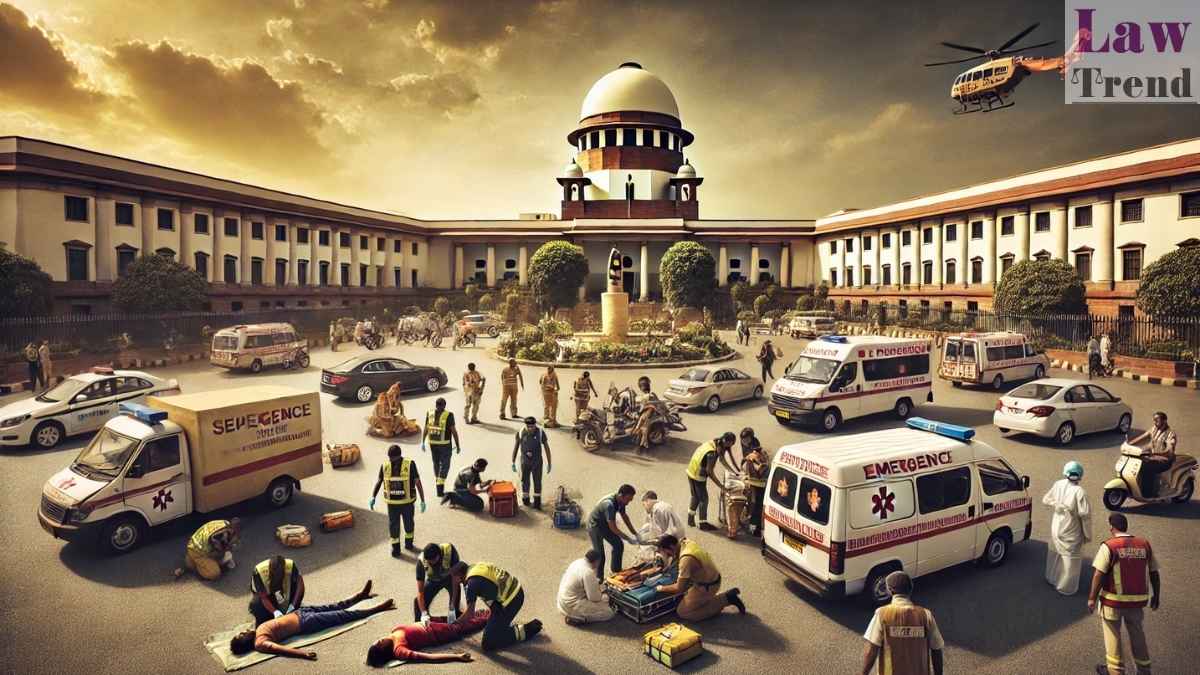
The Supreme Court of India has ruled that a motor accident claim is not maintainable under the Motor Vehicles Act, 1988 (MVA) if the motor vehicle itself plays no active or proximate role in the accident. A bench comprising Justice Sanjay Karol and Justice N Kotiswar Singh clarified that for a claim under Section 166 of the MVA to succeed, there must be a proximate causal relationship between the injury and the use of the motor vehicle. The ruling came in an appeal filed by the Bruhat Bangalore Mahanagara Palike (BBMP) challenging its apportionment of liability after a roadside tree branch fell on a stationary auto-rickshaw during a heavy rainstorm, severely injuring a passenger. While settling this legal question in favor of the civic body, the Court invoked its extraordinary powers under Article 142 of the Constitution to enhance the victim’s compensation to Rs 25 lakh on humanitarian grounds.
Background of the Case
The incident occurred on June 23, 2007, when Respondent No. 1, K.K. Umesh Kumar, was travelling in an auto-rickshaw from Queens Road to Chinnaswamy Stadium in Bangalore. Due to heavy rain, the passenger requested the driver to pull over to the side of the road. While the vehicle was stationary underneath an older roadside tree, a branch detached and fell on top of the vehicle, causing severe spinal and physical injuries to him.
The respondent filed a claim petition before the Motor Accidents Claim Tribunal (MACT), Bangalore, seeking Rs 50 lakhs in compensation. In April 2013, the Tribunal dismissed the petition, categorizing the incident as a natural calamity. The High Court of Karnataka subsequently dismissed the appeal on the grounds of delay. Upon challenge, the Supreme Court remanded the matter back to the High Court, which then heard the case on merits.
In the second round, the High Court awarded a compensation of Rs 17,10,500. It directed that 50% of the liability be borne by the Insurer of the auto-rickshaw, 25% by the Horticulture Department of Karnataka, and 25% by the Bruhat Bangalore Mahanagara Palike (BBMP). The BBMP challenged this apportionment of liability before the Supreme Court.
Arguments of the Parties
The BBMP and the Horticulture Department of the State of Karnataka argued that they bore no responsibility for the unfortunate incident. They contended that the falling of the branch was a natural occurrence over which the authorities had no control, effectively raising the legal defense of an “Act of God” (Vis Major).
The Court’s Analysis of ‘Act of God’ and Civic Liability
To evaluate the defenses raised, the Supreme Court examined several historical and statutory precedents. The Court referred to English rulings such as Nichols v. Marsland (1876), which accepted “Act of God” as a defense to strict liability, and Greenock Corporation v. Caledonian Railway Co. (1917). It also cited the 1897 US Supreme Court decision in The Majestic, which defined the “Act of God” as an “inevitable accident, without the intervention of man and public enemies” and a “loss happening in spite of all human effort and sagacity.”
Turning to Indian jurisprudence, the Court referenced S. Vedantacharya v. Highways Deptt. of South Arcot (1987) and Vohra Sadikbhai Rajakbhai v. State of Gujarat (2016). In the latter, the Court defined the legal standard of the defense:
“An act of God is that which is a direct, violent, sudden and irresistible act of nature as could not, by any amount of ability, have been foreseen, or if foreseen, could not by any amount of human care and skill have been resisted. Generally, those acts which are occasioned by the elementary forces of nature, unconnected with the agency of man or other cause will come under the category of acts of God.”
Furthermore, the Court relied on Rajkot Municipal Corpn. v. Manjulben Jayantilal Nakum (1997) concerning the negligence and duty of municipal authorities when a tree falls on a pedestrian. In that case, the Supreme Court had noted:
“When the defendant is under a statutory duty to take care not to create latent source of physical danger to the property or the person who in the circumstances is considered to be reasonably foreseeable as likely to be affected thereby, the defendant would be liable for tort of negligence. If the latent defect causes actual physical damages to the person, the defendant is liable to damages for tortious liability. The negligent act or omission of the statutory authority must be examined with reference to the statutory provisions, creating the duty and the resultant consequences. The negligent act or omission must be specifically directed to safeguard the public or some sections of the public to which the plaintiff was a member, from the particular danger which has resulted.”
Applying these rules, the bench observed that while municipal authorities have a duty to maintain city trees, it is impossible to predict every occurrence. The Court noted:
“It would be unrealistic to expect that authorities of the Corporation can maintain a constant vigil over each tree/shrub.”
Similarly, the Court stated:
“while it may be perfectly within contemplation that an old branch of an old tree may give way at any time, the prudent call cannot be that all branches are slashed with a saw.”
Scope of the Motor Vehicles Act: “Use” and “Proximate Cause”
The Supreme Court then addressed the core legal question: does the falling of a tree branch on a stationary vehicle constitute a motor vehicle accident under Section 165(1) and Section 166 of the MVA?
The Court referred to Shivaji Dayanu Patil v. Vatschala Uttam More (1991), which established that the “use” of a motor vehicle has a wide connotation and covers periods when the vehicle is stationary. It also cited Government Insurance Office of N.S.W. v. R.J. Green (an Australian High Court case), noting that the term “arising out of” requires a less proximate relationship than “caused by.”
However, the Court distinguished the present case on the grounds of proximate cause. It found that the auto-rickshaw itself did not play an active role. If the respondent had been a pedestrian seeking shelter under the tree, the exact same accident would have occurred. Thus, the vehicle was not a proximate cause of the injury, making a claim specifically under Section 166 of the MVA inappropriate.
The Court’s Decision
While settling the question of law in favor of the appellant, the Supreme Court refused to leave the respondent without financial remedy. The medical reports revealed the extreme severity of his injuries, listing the disabilities as:
“1. Total paraplegia both lower limbs with bladder and bowel incontinence. 2. ‘X’ ray of the spin shows fracture healing and implants position good.”
Emphasizing the duty of the judiciary in such tragic circumstances, the Court observed:
“A person who has suffered such life altering grievous injuries, being left in lurch, without any money to sustain himself, does not appeal to the conscience of justice.”
Invoking its extraordinary jurisdiction to do complete justice, the Court held:
“It is within our domain, as the final Court of the country to ensure the law, as implemented, specially in cases like these, is humane and in accordance with the salutary principles of the Constitution.”
Consequently, under Article 142 of the Constitution, the Supreme Court enhanced the total compensation to Rs 25,00,000 along with interest as determined by the High Court, to be calculated from the date of filing of the claim petition. The apportionment of liability (25% BBMP, 50% Insurer, 25% Horticulture Department) remains undisturbed, and the parties have been directed to deposit the amount directly into the respondent’s bank account within four weeks.
Case Details
Case Title: The Commissioner, Bruhat Bangalore Mahanagara Palike v. K.K. Umesh Kumar & Ors.
Case No.: Civil Appeal No. of 2026 (Arising out of SLP (C.) No. 1039 of 2021)
Bench: Justice Sanjay Karol and Justice N Kotiswar Singh
Date of Judgment: June 11, 2026