The High Court of Judicature at Allahabad (Lucknow Bench) has quashed a supplementary charge sheet and a subsequent cognizance order passed against an accused under Sections 302 and 201 of the Indian Penal Code (IPC). The Court ruled that further investigation conducted by the police on the administrative directions of the Superintendent of Police, without prior permission from the trial court, is unlawful and against the settled proposition of law. The Court further held that a Magistrate cannot take cognizance twice under the same case crime number. Consequently, the High Court allowed the application, set aside the trial court’s order rejecting the discharge application, and quashed the subsequent proceedings.
Background of the Case
The matter arose from FIR No. 0139 of 2021 registered at Police Station Malipur, District Ambedkar Nagar, initially under Sections 379 and 328 of the IPC. Following the initial investigation, a charge sheet was filed against a co-accused under Sections 379, 411, 413, and 120B/34 of the IPC, and against other accused individuals under Sections 379, 328, 411, 302, 201, 120-B, and 34 of the IPC. The applicant, Sayed Mohammad Hamza, was not named in the FIR, and the initial charge sheet against him was not filed under Section 302 of the IPC.
The Magistrate took initial cognizance of the matter on December 24, 2021. However, on April 14, 2022, the Superintendent of Police, Ambedkar Nagar, directed the Investigating Officer to conduct further investigation. Pursuant to this administrative direction, a supplementary charge sheet (No. 149-A of 2021) was submitted on April 29, 2023, accusing the applicant under Sections 302 and 201 of the IPC. On February 3, 2026, the Chief Judicial Magistrate, Ambedkar Nagar, took cognizance for a second time based on this subsequent charge sheet.
The applicant preferred a discharge application before the trial court raising these issues, which was rejected by the Additional District and Sessions Judge, Court No. 1, Ambedkar Nagar, on February 13, 2026. Subsequently, the trial court proceeded to frame charges against the applicant on February 26, 2026. Aggrieved by these actions, the applicant approached the High Court under Section 482 of the Code of Criminal Procedure (CrPC).
Arguments of the Parties
Counsel for the Applicant
The learned counsel for the applicant contended that the police could not have proceeded with further investigation without the explicit permission of the concerned trial court. It was submitted that the investigation carried out solely on the orders of the Superintendent of Police was fundamentally faulted and legally unsustainable.
To support this contention, reliance was placed on the Supreme Court judgment in Pramod Kumar and others Vs. State of Uttar Pradesh and others (2026 SCC OnLine SC 156), specifically highlighting paragraph 33:
“In light of the legal position as settled by this Court through the above judgments, it is safe to say that the power to direct further investigation in a Magistrate/Court concerned. In the event, the police/investigating case rests solely at the discretion of the agency is of the opinion that further investigation is necessary in any particular case to cull out complete facts and truth in the case, it is binding upon them to file an appropriate application before the Magistrate/Court, without directing an order for further investigation by themselves. Once such an application is filed by the investigating agency, the Magistrate/Court would apply its judicial mind, in light of the facts and circumstances of the particular case and the reasons demonstrated by the investigating agency, in order to exercise its discretion for exercise of its power to decide whether or not further investigation is to be ordered under the purview of Section 173(8) of CrPC.”
The counsel further argued that the second cognizance taken by the Magistrate on February 3, 2026, under the same case crime number was impermissible under law. Lastly, it was urged that the trial court failed to apply its judicial mind and completely ignored the factual matrix and legal questions raised by the applicant while rejecting the discharge application.
Counsel for the State
The learned counsel for the State opposed the applicant’s contentions. However, he failed to substantiate that any prior permission or order had been obtained from the trial court directing further investigation. The State counsel admitted the factual position that the further investigation was conducted entirely on the direction issued by the Superintendent of Police.
Court’s Analysis
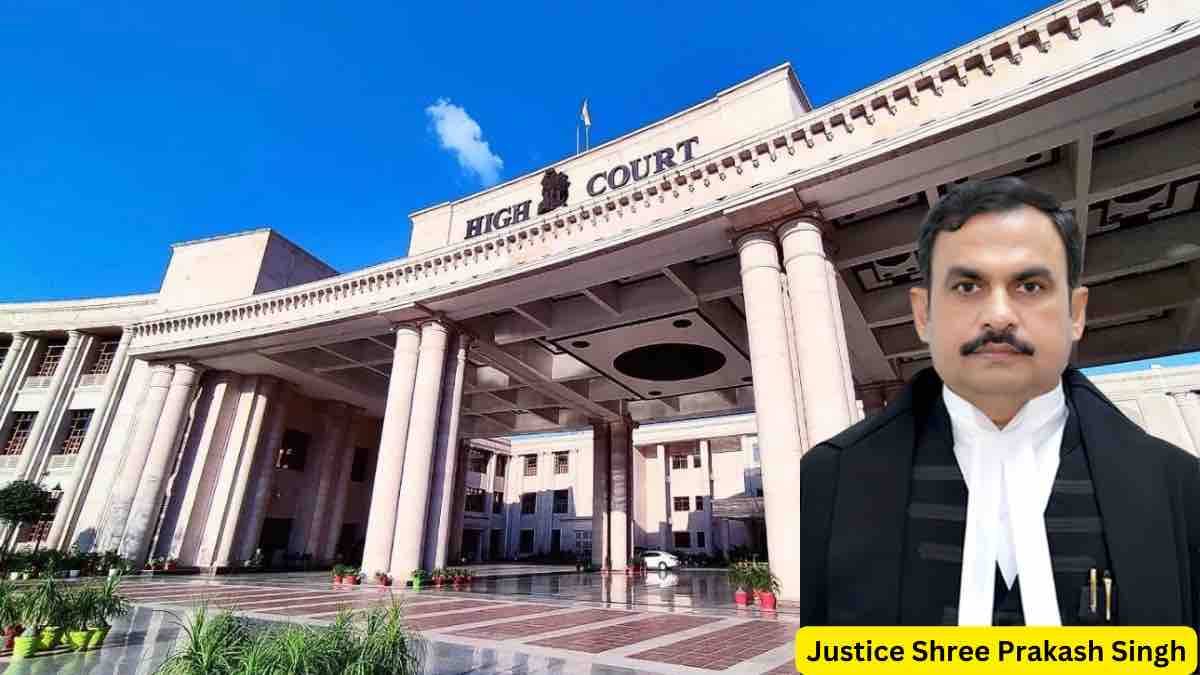
A single-judge bench of Justice Shree Prakash Singh examined the record and noted that the applicant was not named in the initial FIR and the subsequent investigation was conducted strictly under the administrative orders of the Superintendent of Police, Ambedkar Nagar.
The Court observed that the legal position regarding further investigation is well-settled:
“It is trite law that further investigation can be undertaken only when the prior permission is granted by the trial court concerned.”
The Court emphasized that when an application for further investigation is moved, the Magistrate or trial court must apply its discretion and record reasons. Reaffirming the law laid down in Pramod Kumar (supra), the Court observed that:
“…prior permission of the trial court is mandatory, while proceeding with the further investigation, and that permission must include the reasons recorded by the trial court, for direction of the further investigation.”
Addressing the issue of multiple cognizance orders, the Court noted that while the trial was already in motion and charges were being framed, a subsequent charge sheet was filed, and the Magistrate took cognizance again before committing the matter to the Sessions Court. The Court categorically held:
“This Court finds that for one case crime number, cognizance cannot be taken twice by Magistrate/trial court. So far as the present case is concerned, the cognizance is taken twice that too, during the motion of the trial, which goes contrary to the law.”
Reviewing the order passed on the discharge application, the High Court found that the trial court did not consider any of the legal questions or illegalities raised by the applicant, noting that there was “not a single whisper regarding the illegality committed and the grounds taken, in the application for discharge.” The Court concluded that the order on the discharge application was passed without the application of judicial mind.
Decision
The High Court found the supplementary charge sheet dated April 29, 2023, and the cognizance order dated February 3, 2026, to be unlawful and erroneous. Accordingly, the Court quashed the subsequent charge sheet and the second cognizance order.
The Court also set aside the trial court’s order dated February 13, 2026, which had rejected the applicant’s discharge application. The Section 482 application was allowed, though the Court clarified that it remains open for both the trial court and the Investigating Officer to proceed in accordance with the law.
Case Details
- Case Title: Sayed Mohammad Hamza Versus State Of U.P. Thru. Addl. Chief Secy./Prin. Secy. Depttt. Of Home Lko. And Another
- Case No.: APPLICATION U/S 482 No. 3474 of 2026 (Neutral Citation: 2026:AHC-LKO:35249)
- Bench: Justice Shree Prakash Singh
- Date: May 15, 2026