

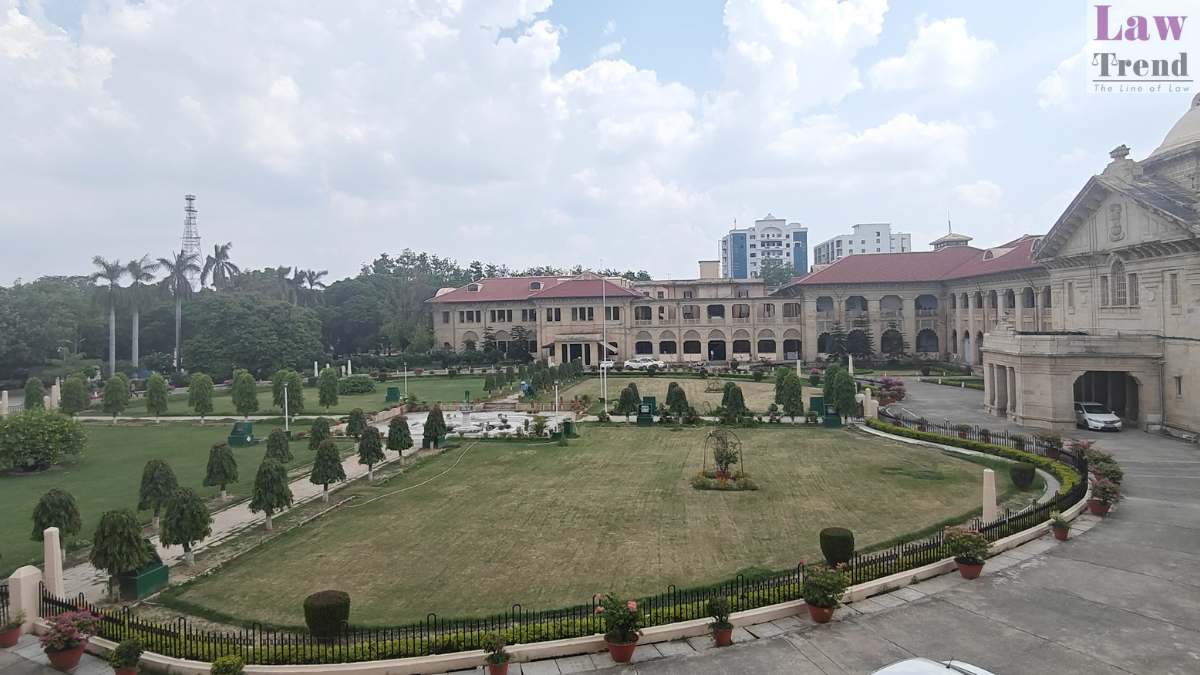
Terming the prolonged delay and disappearance of critical files as an “institutional failure,” the Allahabad High Court has directed the Central Bureau of Investigation (CBI) to trace and recover missing videographic and photographic evidence concerning the alleged custodial death of a physically challenged man in Mainpuri district seventeen years ago.
A division bench of the High Court has instructed the CBI’s Anti-Corruption Branch in Ghaziabad to secure the missing recordings within 60 days and submit them before the court.
The matter dates back to May 9, 2009, when Nahar Singh, a man suffering from 40 percent physical disability, was found hanging inside the urinal section of the lockup at the Dannahar police station in Mainpuri district.
Following the incident, the local police claimed that Singh had committed suicide by hanging himself with his belt.
In 2010, the Association for Advocacy and Legal Initiatives (AALI), a non-governmental organization working for the rights of women and marginalized communities, approached the High Court by filing a Public Interest Litigation (PIL) seeking an independent and fair inquiry into the incident, alleging custodial violence and murder.
During the proceedings, Advocate Ankur Sharma, representing the petitioner organization, argued that critical evidence was being deliberately withheld to shield the accused police personnel. He further highlighted the broader systemic issue of rising custodial death cases across the state of Uttar Pradesh, emphasizing the need for stringent judicial oversight and accountability.
On the other hand, despite the PIL pending for sixteen years, the state authorities had failed to produce vital evidence, including the postmortem videography and photos of the scene of occurrence, before the bench.
The bench, comprising Justice Atul Sreedharan and Justice Siddharth Nandan, expressed deep displeasure over the state’s inability to produce the primary evidence even after more than a decade and a half.
The court strongly questioned the plausibility of the police department’s suicide theory, noting that a lockup is not an unmonitored space. The bench observed:
“This case discloses institutional failures. This is a PIL filed in the year 2010 and is still pending. Sixteen years down the line, the videography and the photographs of the scene of occurrence and the postmortem are not being made available to this Court to enable it to proceed further.”
Addressing the police’s defense that the deceased hanged himself inside the cell, the court remarked that a police lockup remains under constant surveillance and is not an isolated space, casting serious doubts on how such an incident could occur unnoticed.
Taking serious note of the missing records, the High Court bypassed local investigation channels and handed the task of recovering the evidence to the central agency.
The court directed the CBI’s Anti-Corruption Branch, Ghaziabad, to locate and secure the missing videography and photographs of both the crime scene and the postmortem examination within a strict timeline of 60 days. The CBI must present the recovered material at the next hearing.
The High Court has scheduled the next hearing for August 10, 2026.




