

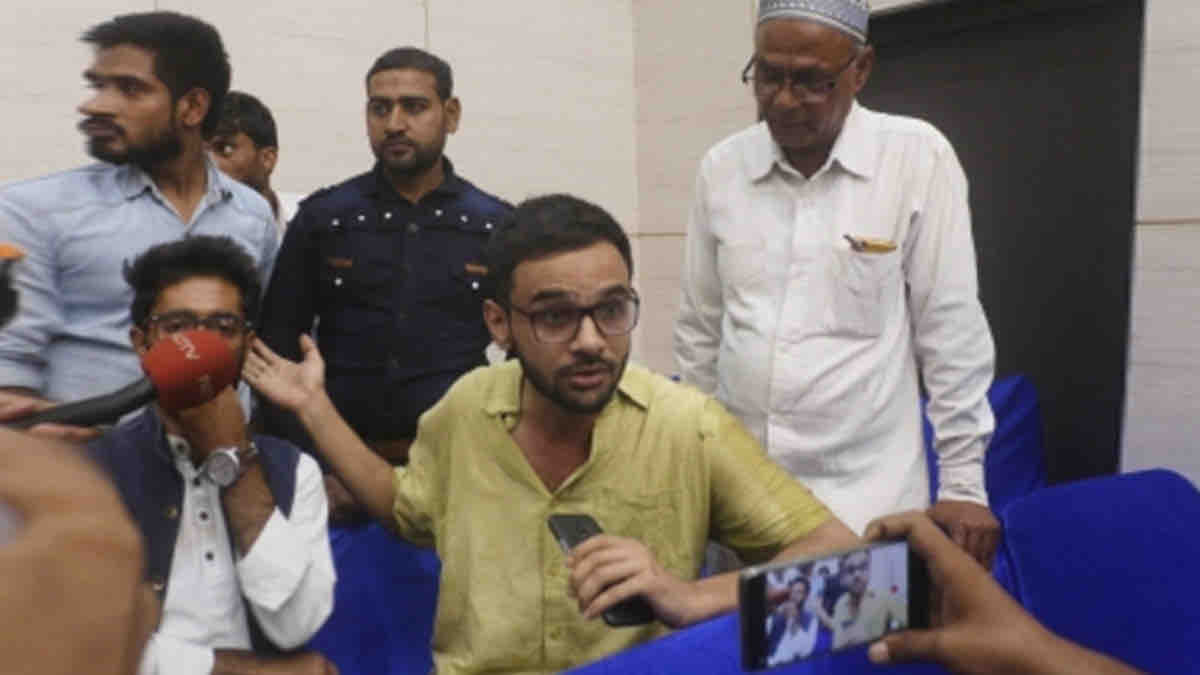
A Delhi court on Tuesday dismissed an application for a 15-day interim bail filed by activist and former JNU student Umar Khalid in connection with the February 2020 Northeast Delhi riots conspiracy case. Khalid had sought temporary release to attend the 40th-day ritual (chehlum) of his deceased uncle and to care for his mother, who is scheduled to undergo a surgical procedure.
Additional Sessions Judge Sameer Bajpai rejected the application, which was moved under Section 483 of the Bharatiya Nagarik Suraksha Sanhit (BNSS), read with Section 439 of the Criminal Procedure Code (CrPC). The court ruled that the grounds presented by the defense did not warrant temporary release.
Court Rules Family Rituals and ‘Simple’ Surgery Do Not Merit Release
In his application, Khalid’s counsel, Sahil Ghai, argued that the activist is the eldest and only son in his family. Ghai submitted that while Khalid has five sisters, four are married and live away from the parental home. He further argued that Khalid’s 71-year-old father is not in a position to adequately care for his wife, who has been ill for a long time and requires surgery for a lump excision.
However, the court found these arguments unconvincing. Addressing the scheduled medical procedure, Judge Bajpai noted in the four-page rejection order that the operation is relatively minor.
“As far as the surgery of the mother of the applicant is concerned… the surgery is very simple, i.e., just for the removal of lumps, and there seems to be no actual requirement or help from the side of the applicant,” the judge observed. The order added that Khalid’s sisters are “definitely expected to come for the help of their mother” and that his father is also available.
The court similarly dismissed the request to attend the chehlum of Khalid’s late uncle, stating that the ceremony was not for an “immediate relation.”
“If the relation was so immediate and thick, the applicant would have asked for the release at the time of the death of his uncle only, and not now, after such a long time,” Judge Bajpai stated, concluding that the reason was not “just.”
Prosecution Opposes ‘Misuse’ of Court’s Leniency
Special Public Prosecutor Ayodhya Prasad strongly opposed the interim bail application, arguing that Khalid was attempting to “misuse the leniency of the court.”
Prasad highlighted that while Khalid had been granted interim bail on previous occasions when reasonable grounds existed, the current reasons fell short. He argued that the uncle did not fall into the category of close relatives and that other family members could attend the ceremony. Regarding the mother’s surgery, the prosecution emphasized that it is a minor procedure conducted under local anesthesia, requiring no physical assistance from the accused.
While the defense argued that neither Khalid nor other co-accused had ever flouted bail conditions in the past, the court clarified that past compliance does not guarantee future approvals.
“The Court has to consider every fresh application on its own merits and should allow the same only when the grounds are reasonable,” the order maintained.
Background: The 2020 Delhi Riots Case
Umar Khalid was arrested in 2020 and faces criminal conspiracy charges under the Unlawful Activities (Prevention) Act (UAPA) for his alleged role in the Northeast Delhi riots, which resulted in 53 deaths and left hundreds injured.
The rejection of his interim bail follows a significant ruling in January, where the Supreme Court denied regular bail to both Khalid and co-accused Sharjeel Imam. In that decision, a bench of Justices Aravind Kumar and N V Anjaria identified them as the “principal accused” who played a “central and directive role in conceptualising, planning and coordinating the alleged terrorist act.”
In its January ruling, the Supreme Court emphasized that under special statutes like the UAPA, the gravity of individual culpability, community security, and the integrity of the trial process must be balanced against the personal liberties enshrined in Article 21 of the Constitution. The apex court noted that the evidence points to strategic planning and mobilization rather than localized acts, justifying continued pre-trial detention.




