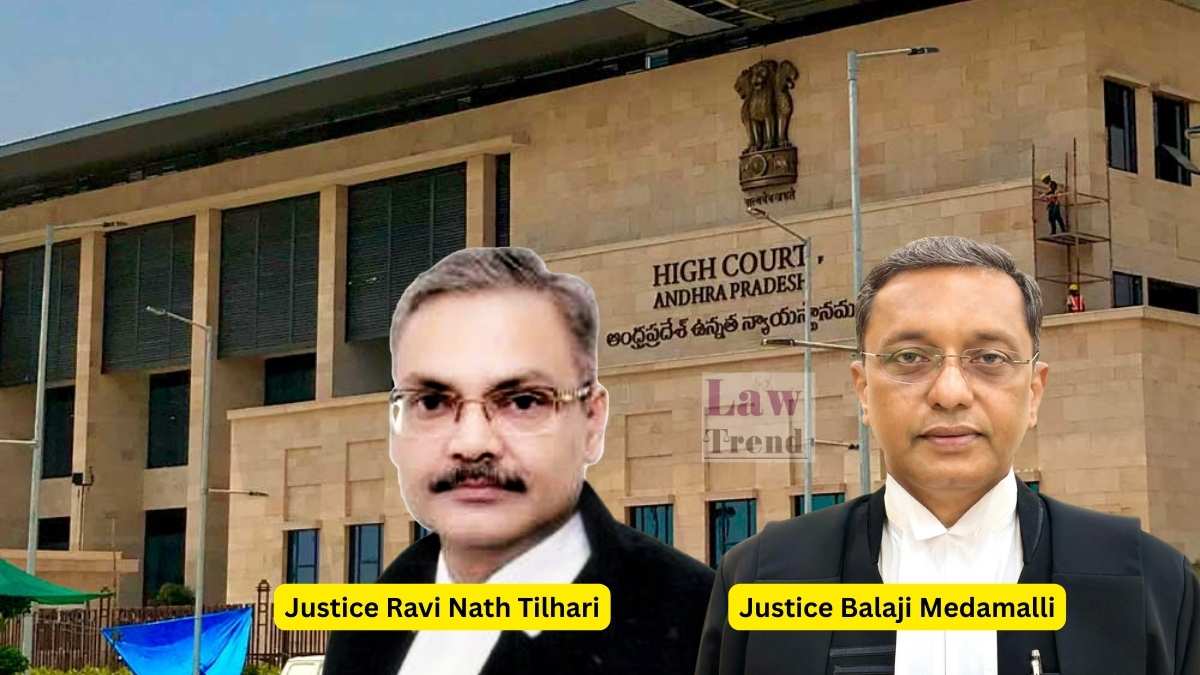
The High Court of Andhra Pradesh has held that parties to a civil or commercial suit are legally permitted to privately engage experts and submit their reports as evidence, subject to proving the report and offering the expert for cross-examination at trial. At the same time, the Court ruled that documents cannot be admitted on record through a simple memo where a specific statutory procedure for bringing documents on record has been prescribed under the Civil Procedure Code (CPC).
The Division Bench, comprising Justice Ravi Nath Tilhari and Justice Balaji Medamalli, delivered this common judgment while deciding two Civil Revision Petitions (C.R.P. Nos. 1209 and 1210 of 2025) filed under Article 227 of the Constitution of India.
Background of the Dispute
The revision petitioner, ISGEC Heavy Engineering Limited, is the defendant in a commercial suit (C.O.S. No. 3 of 2022) pending before the Special Court for Trial and Disposal of Commercial Disputes at Vijayawada. The suit was instituted by the respondent, M/S FE Engineering, seeking various monetary decrees totaling over Rs. 6.42 crores ($6,42,82,261$).
The claims raised by the respondent in the suit include:
- Rs. 57,34,825/- towards unpaid Approved R.A. Bills, along with 18% interest (amounting to Rs. 35,57,790/-);
- Rs. 25,82,397/- towards the non-release of retention money, along with 18% interest (amounting to Rs. 12,77,331/-);
- Rs. 32,00,000/- for partially completed work unpaid at the time of foreclosure, along with 18% interest (amounting to Rs. 19,85,227/-);
- Rs. 64,09,860/- towards claims for idling of men and machinery, along with 18% interest (amounting to Rs. 39,76,571/-);
- Rs. 84,70,980/- towards loss of overheads and profits;
- Rs. 1,00,00,000/- towards loss of business opportunity due to project completion delay; and
- Rs. 50,00,000/- towards damages for breach of agreement, alongside other claims for crane rent, reworks, and tools and tackle.
CRP No. 1209 of 2025: Bypassing Prescribed Document Admission Procedures
The Legal Issue
Whether a crucial document (specifically, a Certificate of Registration of Firm) can be taken on record by a Commercial Court when it is filed simply along with a memo at the stage of cross-examination of a witness, bypassing the procedures outlined under Order XI of the CPC.
Arguments
During the cross-examination of the plaintiff’s witness (P.W.1), the respondent filed a “Certificate of Registration of Firm” accompanied by a simple memo dated March 28, 2025. The Special Judge allowed the memo and took the document on record. ISGEC Heavy Engineering Limited challenged this order.
The petitioner argued that a document cannot be admitted via a memo because Order XI Rules 4 and 5 of the CPC (as amended for Commercial Courts) prescribe a specific procedure. They argued that in the absence of an appropriate application seeking the leave of the court, the document could not be legally admitted.
The respondent’s counsel conceded that the plaintiff was ready to file the document by following the appropriate procedure and submitting a proper application, requesting the High Court to grant liberty for the same.
The Court’s Analysis and Decision
The High Court held that once a specific statutory procedure is laid down, it must be strictly adhered to, and filing a simple memo is not an accepted substitute. The Bench observed:
“In view of the submissions made… we are of the view that once procedure has been prescribed, the applicant has to follow the procedure. There is no such procedure to bring on record the document by filing memo. Consequently, the impugned order passed on memo cannot be sustained.”
Accordingly, the High Court allowed C.R.P. No. 1209 of 2025 and set aside the lower court’s order. However, it granted liberty to the respondent/plaintiff to file a fresh, appropriate application following the prescribed legal procedure, directing the Special Court to decide such an application on its merits without being influenced by the setting aside of the previous order.
CRP No. 1210 of 2025: Engagement of Private Experts and Report Admissibility
The Legal Issue
Whether a report prepared by an expert privately engaged by a party, without the intervention or prior appointment of the Court, is permissible to be taken on record as evidence under the CPC and the Commercial Courts Act.
Background and Arguments
The respondent filed an interlocutory application (I.A. No. 157 of 2024) under Order XI Rule 1(5) of the CPC, seeking permission to introduce an expert report dated August 26, 2024. The report was finalized subsequent to the filing of the suit and was prepared by an expert engaged privately by the respondent.
The Special Judge allowed the application, noting that since the report was finalized after the suit’s institution, it was not within the plaintiff’s possession at the time of filing. The lower court admitted the document on record, subject to its relevancy and admissibility being determined during the trial.
ISGEC Heavy Engineering Limited challenged this order on multiple grounds:
- Exclusive Judicial Power: The petitioner argued that the power to appoint an expert is a judicial function of the court under Order XXVI Rules 9 and 10 of the CPC. Hence, a party cannot privately bypass the court to engage an expert and submit their report.
- Prior Possession: The petitioner pointed to Paragraph 101 of the plaint, which stated, “The plaintiff has engaged a claim’s expert for calculating the said overheads and profits and the same amounts to Rs.84,70,980/-.” They argued that this proved the report was already in the plaintiff’s custody at the time of filing the suit, and the subsequent date of August 26, 2024, was added later to make it appear as post-suit evidence.
- Precedents: The petitioner relied on the rulings in Sudhir Kumar alias S.Baliya v. Vinay Kumar G.B, Narayana Menoki Vs. Raan Nair, and Pada Sen and Anr. V. The State of U.P. to argue that expert appointment is strictly a judicial process.
The respondent defended the admissibility of the report, arguing:
- No Statutory Bar: There is no provision in the CPC or the Commercial Courts Act that bars a party from privately engaging an expert to assist in substantiating their claims.
- Clarification in Plaint: The respondent highlighted Paragraph 104 of the plaint, which pleaded: “The plaintiff is entitled to revise this figure after ascertaining the exact amount via an expert for quantification of the said claim.” This indicated that the final report was indeed obtained and compiled post-institution.
- Precedents: The respondent relied on Parappa and Ors. Vs. Bhimappa and Ors. (Karnataka High Court) and Santhosh K.S Vs. State of Kerala and Ors. (Kerala High Court).
The Court’s Analysis and Decision
The High Court rejected the petitioner’s contentions. Addressing the argument on Paragraph 101 of the plaint, the Court observed that a plea of fact cannot be raised for the first time in a revision petition under Article 227, and similarity in the claimed amount does not automatically prove the final report was in the plaintiff’s possession prior to the suit’s filing.
On the core legal question of whether a party can file a private expert report, the High Court held that the court’s power to appoint an expert does not preclude a party from obtaining their own expert evidence. The Bench observed:
“The appointment of Commissioner or expert may be the function of the Court, but that does not preclude to engage an expert and submit that report in evidence as also to produce such an expert to prove the report. In such a case the other side shall also have opportunity to file his evidence if so required as also to cross examine the expert, and produced as a witness in evidence. No doubt, the Court can pass order for appointment of the expert, but that does not mean that a party cannot engage a private expert and submit the report of his opinion.”
The High Court expressed its concurrence with the Karnataka and Kerala High Court rulings. It cited Paragraph 13 of the Kerala High Court’s judgment in Santhosh K.S., which observed:
“Though the court should be circumspect while appreciating the evidentiary value of a report obtained without the intervention of the court, there is no restriction in obtaining such a report.”
The Bench also cited Paragraph 15 of the Karnataka High Court’s judgment in Parappa, which clarified that a privately obtained expert report does not automatically become substantive evidence by mere production. Rather:
“…it is obligatory on the part of the party who relies on the said expert to examine him, produce the report through him, get it marked and then subject the said expert for cross-examination of the opposite party. It is only after the examination of such expert, his report would become admissible in evidence.”
Adopting these principles, the High Court concluded:
“An expert can be engaged privately without the intervention of the court as well and his report can be filed in the Court. However, the relevancy and the admissibility of that report shall be subject to the proof, to be determined or seen at the stage of trial.”
Finding no legal error or jurisdictional infirmity in the Special Judge’s order, the High Court dismissed C.R.P. No. 1210 of 2025.
Case Details
- Case Title: ISGEC Heavy Engineering Limited v. M/s FE Engineering
- Case No.: Civil Revision Petition Nos: 1209 and 1210 of 2025
- Bench: Justice Ravi Nath Tilhari, Justice Balaji Medamalli
- Date: 15.04.2026