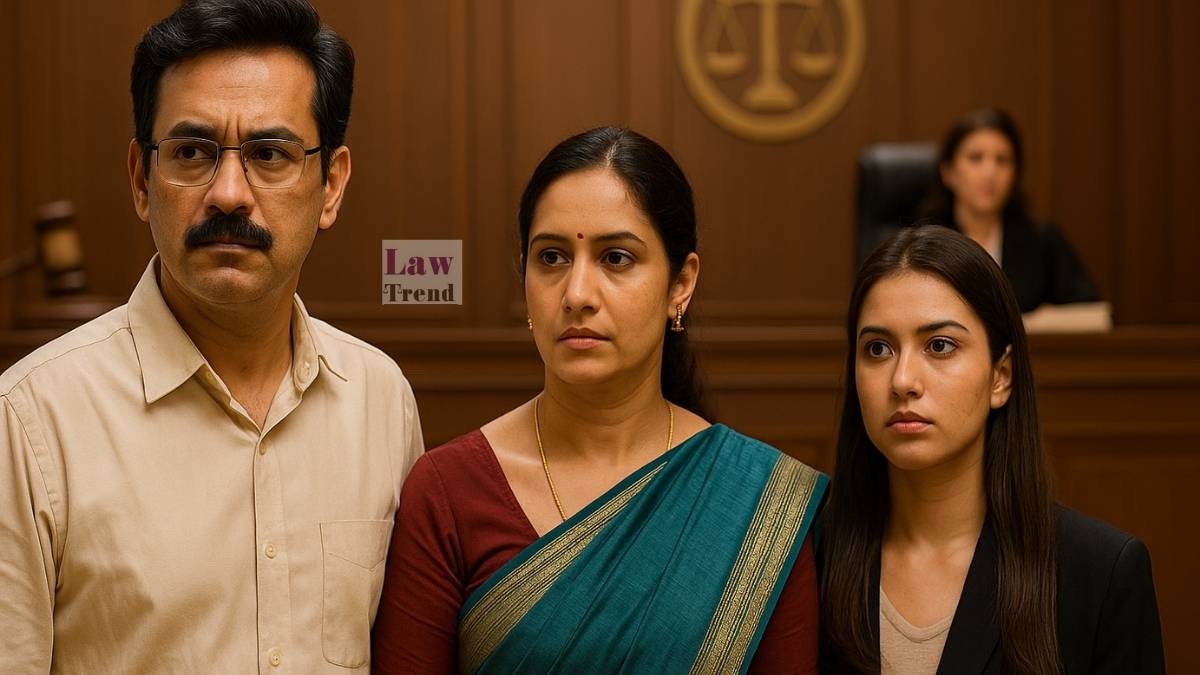
The Supreme Court of India today quashed criminal proceedings, including charges under the Protection of Children from Sexual Offences (POCSO) Act, initiated against a man and his family members by his estranged wife. A bench comprising Justice B.V. Nagarathna and Justice Ujjal Bhuyan set aside an order of the Allahabad High Court, concluding that the generic nature of the allegations, a lack of corroborative medical evidence, and a “verbatim reproduction of statements almost parrot-like” by the minor indicated witness tutoring amid a highly contentious matrimonial dispute.
Background of the Case
The dispute stems from a deeply fractured marriage that began in 2008. The complainant (estranged wife) and her sister married Appellant No. 1 (the husband) and his brother, respectively. Due to matrimonial discord, the complainant left her matrimonial home in 2011, leaving behind a son and a daughter (the prosecutrix, born in 2009). For over 14 years, the care and custody of the children remained with the appellants.
The parties have been embroiled in more than a dozen civil and criminal litigations, including cases under Section 498-A of the Indian Penal Code (IPC), the Domestic Violence Act, and the Hindu Marriage Act.
On September 10, 2024, the complainant filed a new complaint before the Special Judge (POCSO Act) in Meerut. She alleged that her daughter had been sexually abused and raped by the father and uncle (Appellant No. 4), and physically assaulted and criminally intimidated by the grandmother and aunt (Appellant Nos. 2 and 3). She alleged that the aunt had inserted a hammer handle into the minor’s private parts. The trial court took cognizance on February 7, 2025, and issued summons, which the Allahabad High Court later refused to quash.
Arguments of the Parties
The counsel for the appellants argued that the complaint was a calculated counterblast designed to pursue a personal vendetta amidst a string of prior FIRs. They contended that it was “highly inconceivable, improbable and rather unimaginable” for the father and uncle to commit such acts. Furthermore, the defence highlighted the vague, omnibus nature of the allegations, the complete absence of medical reports, and the likelihood that the minor prosecutrix had been tutored by the complainant.
Conversely, the State and the complainant’s counsel defended the High Court’s order, relying heavily on the statements recorded under Sections 223 and 225 of the Bharatiya Nagarik Suraksha Sanhita (BNSS). The complainant’s counsel submitted that since the child had been in the sole custody of the father, there was no opportunity for tutoring. They further argued that the lack of medical evidence was not fatal to a POCSO case and that a conviction could be based on the sole testimony of the prosecutrix.
The Court’s Analysis
The Supreme Court undertook a rigorous examination of the essential ingredients for offences under Sections 65, 74, 115, 351, and 352 of the Bharatiya Nyaya Sanhita (BNS) and Sections 3 and 4 of the POCSO Act.
The bench found the allegations of sexual assault against the father and uncle to be “generic” and devoid of specific factual details or dates. The Court observed, “A casual invocation of a grave charge of rape, that too, against the father of the prosecutrix, carries with it a greater social taboo and stigma that cannot be washed off easily.”
Upon comparing the complaint and the BNSS statements of the complainant and the prosecutrix, the Court noted a “verbatim reproduction of statements almost parrot-like, as a result of tutoring by the complainant and possibly her family.”
Crucially, the Court pointed out the absolute lack of medical evidence, despite the grave nature of the allegations—including the alleged insertion of a hammer rod. Referencing the Justice J.S. Verma Committee Report on the necessity of timely medical examinations, the Court held that the “absence of medical examination of the prosecutrix is fatal to the case of the prosecution as the allegations have not been supported, even remotely by any other corroborative material.”
The Court extensively discussed the rising trend of vexatious litigation in matrimonial disputes. Justice Nagarathna wrote: “One particular offshoot or a species of vexatious and frivolous litigation is in family disputes, particularly, a ‘matrimonial bouquet’ that is presented by the estranged wife against the husband and his family out of personal animosity and spite once the relationship turns sour…”
The bench lamented the increasing misuse of the POCSO Act where children are used “against their will and wishes, so as to make false and vexatious complaints against her father and other male members of her paternal family in order to exact revenge or as an arm-twisting tactic to obtain a higher monetary settlement or to simply harass.”
Relying on the precedent set in State of Haryana v. Bhajan Lal, the Court concluded that the allegations were inherently improbable and manifestly attended with mala fide intent. The bench also drew upon judgments in Dara Lakshmi Narayana v. State of Bihar and Geddam Jhansi v. State of Telangana to caution against generalized accusations involving all family members. Furthermore, citing Achin Gupta v. State of Haryana, the Court reminded legal practitioners of their social responsibility not to encourage frivolous criminal complaints that demolish the social fabric of family life.
The Decision
Holding that it would not serve the interests of justice to permit the prosecution to continue, the Supreme Court set aside the impugned order of the Allahabad High Court. The Court quashed the complaint, the cognizance order, and the summoning order pending before the Special Judge (POCSO Act) in Meerut against all the appellants.
The Court concluded by clarifying that these observations apply strictly to the facts of this case and should not impact genuine cases of abuse, where authorities must act “swiftly and vigorously to serve the interests of justice.”
Case title: Ishwar Chand Sharma & Others v. State of Uttar Pradesh & Another
Case no.: 2026 INSC 587 (Arising out of Special Leave Petition (Criminal) No. 18035 of 2025)
Bench: Justice B.V. Nagarathna and Justice Ujjal Bhuyan
Date: May 29, 2026