

Priority in E-Voting Does Not Override Lawful Authority; Supreme Court Clarifies Majority Rule for Society Trustees:
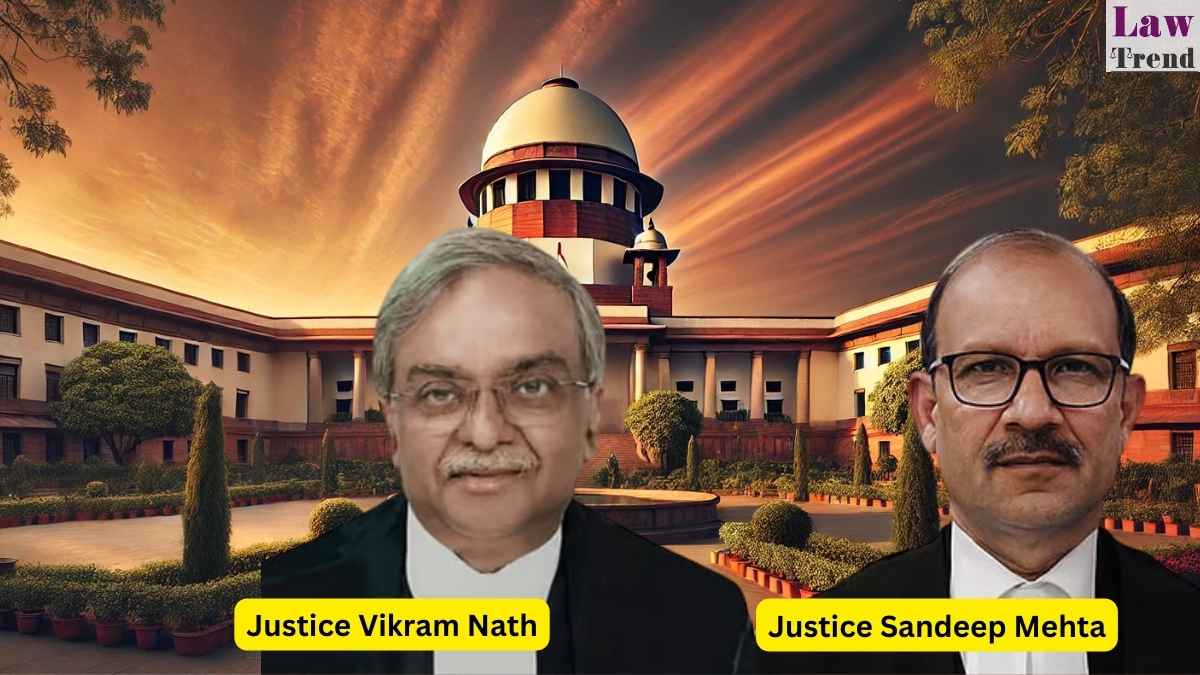

In a ruling clarifying the intersection of corporate voting procedures and trust administration, the Supreme Court of India has held that a vote cast first in point of time during a company’s remote e-voting process does not become valid simply by priority if it lacks lawful authority. The Division Bench comprising Justice Vikram Nath and Justice Sandeep Mehta also ruled that if a society’s by-laws expressly permit it, trustees can validly delegate authority by a majority decision without requiring absolute unanimity.

The judgment set aside a Calcutta High Court Division Bench order that had mandated counting the “first vote cast” by rival factions within three societies holding shares in Birla Corporation Limited (BCL), and erroneously required unanimous action by the trustees.

Background of the Case

The dispute stems from three societies registered under the West Bengal Societies Registration Act, 1961: Hindustan Medical Institution, Eastern India Educational Institution, and Belle Vue Clinic. These societies collectively hold significant shares in Birla Corporation Limited.

Following the demise of Priyamvada Devi Birla in 2004, disputes arose regarding the internal governance of these societies. Specifically, rival claims emerged concerning who had the lawful authority to issue authorizations and cast votes on behalf of the societies at BCL’s Annual General Meetings (AGMs).

During the 2021 AGM, the scrutiniser invalidated the votes cast on behalf of the societies due to claims and counterclaims by competing factions. Ahead of the 2022 AGM, the three societies filed suits before a Single Judge of the Calcutta High Court seeking to restrain BCL from preventing their nominated representatives from voting.

The Single Judge denied ad-interim relief, stating that resolving rival claims required adjudicating internal authority, which could not be done at the interim stage. On appeal, the Division Bench of the High Court affirmed the Single Judge’s order but added a specific caveat: the vote cast first in point of time—whether by the Managing Committee or the Board of Trustees—would be accepted, and no subsequent communication could invalidate it. The Division Bench further relied on Section 48 of the Indian Trusts Act, 1882, to conclude that trustees must act in consonance and a decision lacking unanimity was invalid.

Aggrieved, the societies and Ms. Anamika Lodha filed separate Civil Appeals before the Supreme Court.

READ ALSO  Split Multiplier is 'Foreign to Motor Vehicles Act', Cannot Be Used for Compensation: Supreme Court

Arguments of the Parties

The appellant societies argued that the High Court misread their governing by-laws and incorrectly applied Section 48 of the Trusts Act to enforce a requirement of unanimity among the trustees. They further challenged the High Court’s direction that the “vote cast first” must prevail, arguing that the validity of a corporate vote depends on lawful authorization under statutory frameworks, not on chronology.

Ms. Anamika Lodha, in her connected appeals, also challenged the “vote cast first” directive. She argued that neither the Companies Act, 2013, nor the Companies (Management and Administration) Rules, 2014, permitted the counting of a vote merely because it was cast first, without verifying if it was validly cast.

Court’s Analysis

The Supreme Court analyzed the dispute across three principal legal issues:

1. Requirement of Unanimity vs. Majority Among Trustees The Court examined Clause 24 of the societies’ by-laws, which explicitly allows the delegation of authority via a resolution “evidenced in writing under the hands of the majority of the trustees.” Applying the rule of interpretation from Reserve Bank of India v. Peerless General Finance and Investment Co. Ltd. and J.K. Cotton Spinning & Weaving Mills Co. Ltd. v. State of U.P., the Court held that a statutory provision must be read as a whole to avoid rendering any words redundant.

READ ALSO  At Notice Stage, Court Only Sees Prima Facie Case; Delhi HC Upholds Charge Under Sec 304 Part II Against Juvenile in Fatal Car Crash

While Section 48 of the Trusts Act states that all co-trustees must join in the execution of a trust, the Court emphasized that the provision explicitly includes the exception: “except where the instrument of trust otherwise provides.” The Court noted that the High Court erred in heavily relying on the precedent set in Janakirama Iyer v. Nilakanta Iyer without giving effect to this statutory exception.

The Court concluded: “…where the by-laws contemplate delegation or authorization by the trustees, the same may validly be accomplished through a resolution evidenced in writing under the hands of the majority of the trustees, and once so made, it cannot be disregarded merely because all trustees have not concurred in it.”

2. Authority of the Board of Trustees vs. Managing Committee The Court scrutinized the Memorandum of Association and Rules of the societies, noting that all movable and immovable properties (including the BCL shares) vest in the Trustees. The Managing Committee exercises only delegated powers.

The Supreme Court observed that the High Court had erroneously treated the Board of Trustees and the Managing Committee as interchangeable bodies for the purpose of voting. “The constitutive documents do not permit the Board of Trustees and the Managing Committee to be treated as interchangeable bodies for all purposes,” the Court observed, stating that authority to vote must first be traced to the trustees unless a valid delegation to the Managing Committee is established.

3. The “Vote Cast First” Rule Addressing the High Court’s directive that the vote cast first in remote e-voting prevails, the Supreme Court analyzed Section 108 of the Companies Act, 2013, and Rule 20 of the 2014 Rules. The Court noted that the statutory framework specifically requires non-individual shareholders to submit a Board Resolution or authority letter for the scrutiniser to verify.

Relying on the principle established in Babu Verghese v. Bar Council of Kerala—that where a statute prescribes a manner for doing a thing, it must be done in that manner—the Court held that authority is foundational to the act of voting. The High Court’s caveat, the Supreme Court ruled, effectively “substitutes chronology for authority.”

READ ALSO  Can Pending FIR Bar Advocate Enrollment? Madras HC Refers Issue to Larger Bench

“A vote cast first but without lawful authority cannot become valid merely by reason of priority in time. The law protects the first valid vote of the member against duplication or change. It does not validate the first unauthorised act of a rival claimant,” the Court observed.

Decision

The Supreme Court allowed the appeals filed by the societies and the limited appeals filed by Ms. Anamika Lodha. The Court set aside the Calcutta High Court Division Bench’s common judgment and order, including the Single Judge’s order.

The Court directed that the suits and interlocutory applications be restored to the file of the High Court for fresh consideration by the Single Judge in accordance with the law. The Supreme Court explicitly clarified that it was not adjudicating upon the factual validity of any specific resolution, including the disputed resolutions dated 04.03.2021, leaving those matters to be decided by the competent forum on their merits.

Case Details

Case Title: Hindustan Medical Institution v. Birla Corporation Limited & Ors. (and connected matters)
Case No.: Civil Appeal Arising out of SLP (C) No. 1182 of 2023 (With SLP (C) Nos. 1183/2023, 23145/2022, 1185/2023, 1187/2023, 22799/2022)
Bench: Justice Vikram Nath and Justice Sandeep Mehta
Date: May 26, 2026

Law Trend
Law Trendhttps://lawtrend.in/
Legal News Website Providing Latest Judgments of Supreme Court and High Court

Related Articles

Latest Articles

