

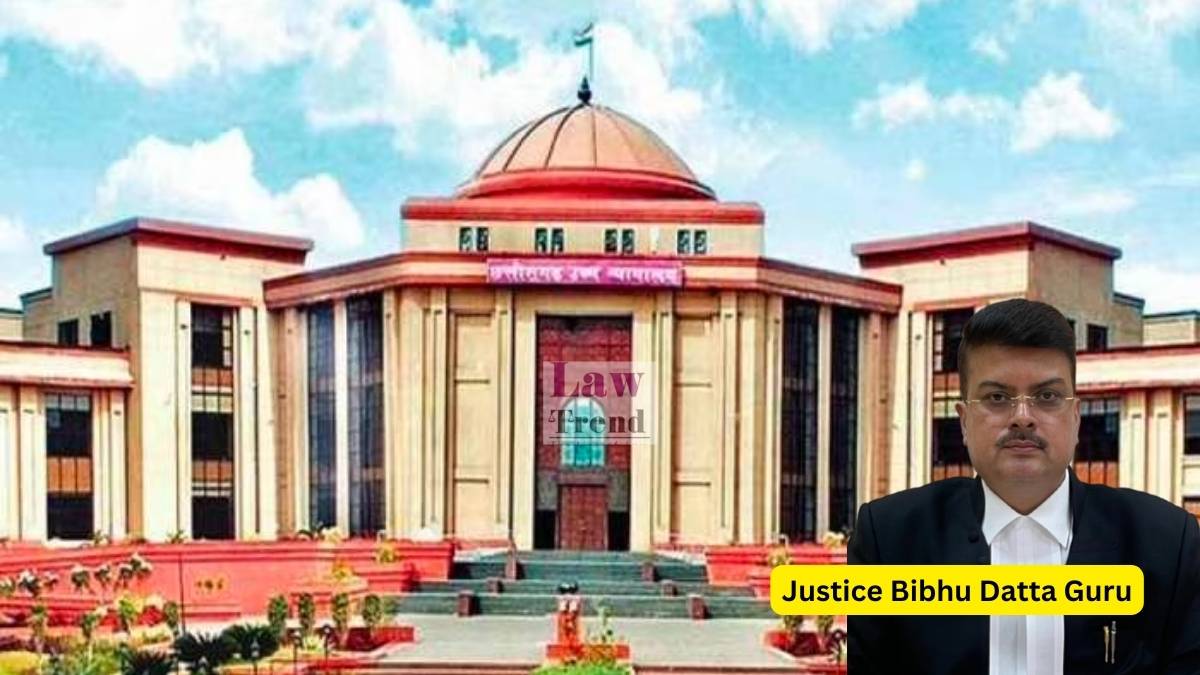
Reiterating the settled canon of statutory interpretation that an order passed today is presumed not to operate retrospectively, the High Court of Chhattisgarh has held that a subsequent government order enhancing the ceiling of study leave cannot be applied retrospectively to reopen or enlarge leave periods already sanctioned and availed under an earlier legal regime. A single-judge bench of Justice Bibhu Datta Guru dismissed a batch of writ petitions filed by in-service government doctors seeking an extension of their 24-month study leave to 36 months, ruling that subordinate executive relaxations look forward, not backward, in the absence of explicit legislative mandate.
Background of the Case
The petitioners were serving Dental Surgeons under the Department of Health and Family Welfare, Government of Chhattisgarh. Having secured No Objection Certificates (NOC) and departmental permissions to pursue postgraduate medical education, they were sanctioned study leave under the prevailing framework of Rule 44 of the Chhattisgarh Civil Services (Leave) Rules, 2010.
In the leading petition (Dr. Bhumika Dewangan v. State of Chhattisgarh), the petitioner was granted 24 months of study leave by an order dated August 18, 2023, for the period between December 2, 2022, and December 1, 2024. For the subsequent third year of her postgraduate course, she was granted 12 months of extraordinary leave from December 2, 2024, to December 1, 2025. The original study leave entitlement was thus fully sanctioned and availed prior to March 2025.
On March 3, 2025, the State Government issued an order in the name of the Governor of Chhattisgarh relaxing the provisions of Rule 44 of the 2010 Rules. The order enhanced the maximum permissible study leave ceiling for in-service doctors pursuing MD/MS courses up to 36 months, subject to specific conditions, including a mandatory five-year service bond and financial recovery with 8% compound interest in case of breach. Subsequently, through an administrative communication dated April 6, 2026, the Department clarified that the benefit of the March 3, 2025 order would be available to doctors who proceed for higher studies after obtaining permission/NOC after that date.
Aggrieved by the State’s refusal to convert their 12-month extraordinary leave into sanctioned study leave, the doctors approached the High Court seeking a writ of mandamus to modify and sanction their study leave from 24 months to 36 months.
Arguments of the Parties
Appearing for the petitioners, senior counsel Mr. S.C. Verma, assisted by advocate Mr. Sajal Kumar Gupta, submitted that the order dated March 3, 2025, was a beneficial measure issued after obtaining proper concurrence from the Finance Department. Counsel argued that because the petitioners had pursued their courses transparently with due permissions and sanctions, they could not be placed in a disadvantageous position merely because their original sanctions preceded the March 3, 2025 order.
The petitioners further challenged the departmental communication dated April 6, 2026, contending that an administrative instruction not issued in the name of the Governor could not curtail benefits conferred under the parent order of March 3, 2025, relying on the Supreme Court ruling in P.D. Aggarwal v. State of U.P. (1987). Invoking Articles 14 and 16 of the Constitution, they also alleged hostile discrimination by pointing to an order dated June 13, 2025, in the case of Dr. Meenakshi Sood, where an initial grant of two years’ study leave and one year of extraordinary leave had been amended to a full three-year study leave under the March 2025 relaxation.
Opposing the petitions, Additional Advocate General Mr. Y.S. Thakur, appearing with panel lawyer Ms. Apurva Nigam for the State, contended that the petitioners had already availed their sanctioned 24 months under the regime prevailing at the relevant time. The State argued that the relaxation order dated March 3, 2025, operated prospectively and contained no language directing the automatic reopening of concluded leave sanctions.
Addressing Dr. Meenakshi Sood’s case, the State submitted that the Finance Department had dissented vide communication dated February 13, 2026, resulting in the cancellation of the June 13, 2025 order with immediate effect on July 31, 2026. The State maintained that an administrative order that had been cancelled could not serve as a legal foundation to claim parity.
The Court’s Analysis
Examining the chronological record, Justice Bibhu Datta Guru observed that the petitioners’ 24-month study leave had been sanctioned and availed under the regime applicable at that time, anterior to the order of March 3, 2025. The Court noted that enhancing a permissible ceiling does not automatically confer an enforceable right to retrospective enlargement.
Anchoring its analysis in established canons of statutory construction, the High Court cited the Supreme Court’s decision in Assistant Excise Commissioner, Kottayam & Others v. Esthappan Cherian and Another (2021), which quoted the Constitution Bench ruling in CIT v. Vatika Township (P) Ltd.:
“Of the various rules guiding how a legislation has to be interpreted, one established rule is that unless a contrary intention appears, a legislation is presumed not to be intended to have a retrospective operation. The idea behind the rule is that a current law should govern current activities. Law passed today cannot apply to the events of the past. If we do something today, we do it keeping in view the law of today and in force and not tomorrow’s backward adjustment of it. Our belief in the nature of the law is founded on the bedrock that every human being is entitled to arrange his affairs by relying on the existing law and should not find that his plans have been retrospectively upset. This principle of law is known as lex prospicit non respicit: law looks forward not backward.”
The Court also highlighted the limitation governing subordinate authorities as articulated in CIT v. M.C. Ponnoose:
“The courts will not, therefore, ascribe retrospectivity to new laws affecting rights unless by express words or necessary implication it appears that such was the intention of the legislature. Parliament can delegate its legislative power within the recognised limits. Where any rule or regulation is made by any person or authority to whom such powers have been delegated by the legislature it may or may not be possible to make the same so as to give retrospective operation. It will depend on the language employed in the statutory provision which may in express terms or by necessary implication empower the authority concerned to make a rule or regulation with retrospective effect. But where no such language is to be found it has been held by the courts that the persons or authority exercising subordinate legislative functions cannot make a rule, regulation or bye-law which can operate with retrospective effect.”
Applying these principles, the bench held that the order dated March 3, 2025, contained no express retrospective mandate, nor did any necessary implication arise from its text. Distinguishing P.D. Aggarwal, the Court observed that the clarificatory communication of April 6, 2026, did not amend or override the parent order, but merely clarified its prospective field of operation.
Turning to the plea of discrimination and legitimate expectation, the bench held that legitimate expectation cannot override statutory rules to create substantive rights retrospectively. Rejecting the parity argument premised on the recalled order in Dr. Sood’s matter, the Court held:
“A benefit granted under an order which has ceased to operate cannot, merely on the ground of parity, be directed to be extended to others, unless the underlying entitlement is otherwise found to flow from the governing statutory provision or the order dated 03.03.2025 itself.”
Decision of the Court
The High Court concluded that the relaxation could not be claimed by candidates who had already concluded their sanctioned study leave prior to the issuance of the policy:
“The Government order dated 03.03.2025 operates as a subsequent relaxation to the candidates who applied for study leave on or after 03.03.2025. The said order was not for all the candidates like the petitioners who had already availed the study leave much prior to passing of the said order. It cannot be invoked with retrospectively enlarge the period of study leave already sanctioned and availed by the petitioners prior to its issuance.”
Finding no arbitrariness or violation of Articles 14 and 16, the Court dismissed all the writ petitions with no order as to costs.
Case Title: Dr. Bhumika Dewangan v. State of Chhattisgarh and Others (and connected matters)
Case No.: WPS No. 5391 of 2026
Bench: Justice Bibhu Datta Guru
Date: October 1, 2026




