

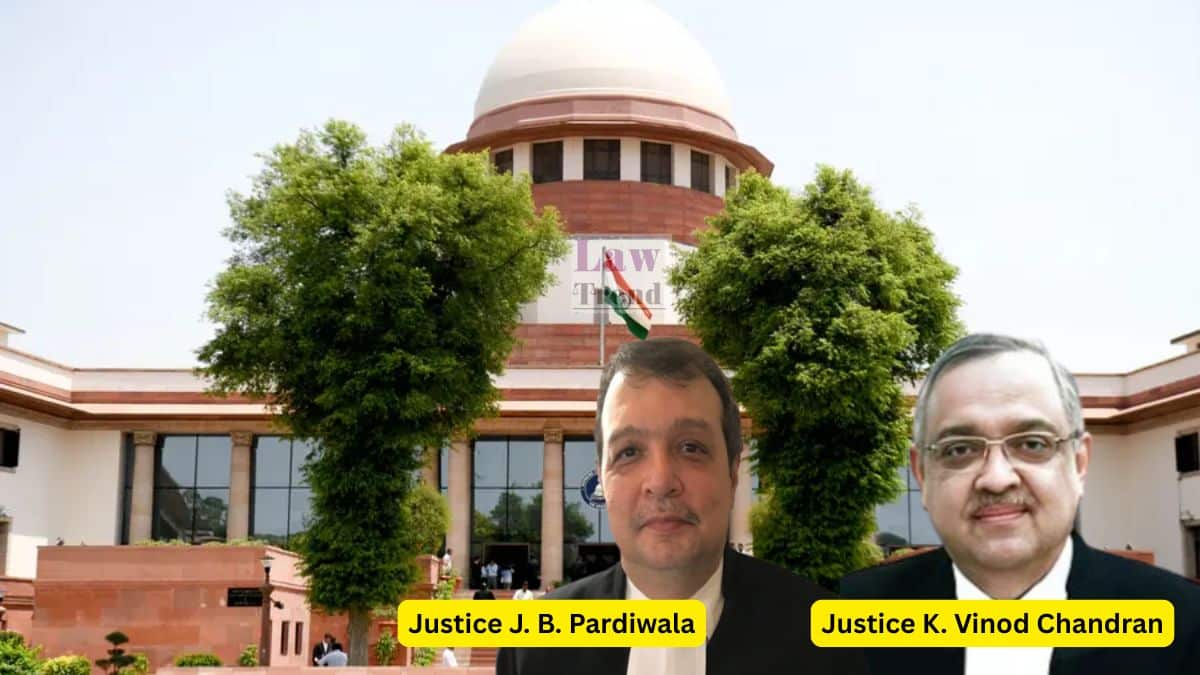
The Supreme Court of India has held that a subsequent suit for specific performance is barred under Order II Rule 2 of the Code of Civil Procedure, 1908 (CPC) if the plaintiff, despite having an accrued cause of action to seek specific performance, limited their prior suit to permanent injunction without obtaining the leave of the court at the time of institution. A Bench comprising Justice J.B. Pardiwala and Justice K. Vinod Chandran set aside concurrent decrees passed by the Trial Court and the High Court granting specific performance on an alleged oral contract, holding that liberty sought at the time of withdrawing a prior suit cannot cure the failure to seek statutory leave at the inception of the litigation.
The Court also reiterated the strict standard of proof required to establish an oral agreement for the sale of immovable property, observing that evasive answers or recalcitrant conduct by defense witnesses cannot substitute for the plaintiff’s primary burden of establishing a concluded contract.
Background of the Case
The dispute arose from an alleged oral agreement for the sale of immovable property owned by Bombay Garage Ahmedabad Limited (the first appellant/first defendant). According to the plaintiff, JP Iscon Private Limited, negotiations took place to purchase the property initially for a total consideration of Rs. 18.51 crore, against which a token advance of Rs. 11,000 was paid. The plaintiff claimed that during subsequent meetings, the price was enhanced to Rs. 20.50 crore, whereupon an additional cash payment of Rs. 5,00,000 was made, and a cheque for Rs. 5 crore dated January 11, 2007, was handed over to the defendants.
On May 8, 2007, the defendants allegedly refused to execute the sale deed and challenged the plaintiff to contest the matter. Consequently, the plaintiff instituted a suit at Mirzapur seeking a decree of permanent injunction simpliciter to restrain the defendants from alienating or creating third-party rights in the property. At that stage, no relief of specific performance was claimed, nor was any leave obtained under Order II Rule 2(3) CPC to sue for it subsequently.
The plaintiff later filed a pursis seeking withdrawal of the injunction suit with liberty to file a fresh suit on the ground that amicable settlement talks were underway. Although no express leave was recorded in the formal withdrawal order, the suit was dismissed as withdrawn. Thereafter, the plaintiff instituted a fresh suit claiming specific performance of the alleged oral agreement.
Both the Trial Court and the High Court concurrently decreed the suit in favor of the plaintiff, holding that an adverse inference could be drawn against the defendants due to evasive responses during cross-examination, and held the second suit maintainable. Aggrieved by these concurrent findings, the appellants approached the Supreme Court.
Arguments of the Parties
Appearing for the appellants, Senior Counsel Mihir Thakore contended that the subsequent suit for specific performance was squarely barred under Order II Rule 2 CPC. He submitted that the cause of action for specific performance had fully arisen when the earlier injunction suit was instituted, as the alleged refusal occurred prior to that filing. Since the plaintiff omitted the relief of specific performance without obtaining the court’s leave at the time of filing the first suit, the right to claim that relief stood relinquished. He further argued that there was no concluded contract; the negotiations were carried out with the son-in-law of the person-in-charge who had no corporate authorization to bind the company under Section 46 of the Companies Act, 1956, and the Rs. 5 crore cheque was never presented or encashed.
Opposing the appeal, Senior Counsel Deven Parikh, representing the respondent-plaintiff, submitted that Order II Rule 2 had no application because the plaintiff had expressly filed a pursis seeking liberty to file a fresh suit. He argued that the applicable provision was Order XXIII Rule 1(3) CPC, under which liberty must be inferred from the order permitting withdrawal. He maintained that the second suit was filed within the period of limitation, and because an amendment could have been sought in the first suit, a fresh suit was not barred. On the merits, he argued that payment of Rs. 5.11 lakh in cash and delivery of the Rs. 5 crore cheque established the transaction, and the evasive testimonies of the defense witnesses justified drawing an adverse inference against them.
Legal Principles on Oral Contracts for Immovable Property
Addressing the validity of specific performance claims founded solely on oral agreements, the Supreme Court referred to the settled law laid down in Brij Mohan and Ors. v. Smt. Sugra Begum and Ors., reiterated in K. Nanjappa (Dead) by LRs v. R.A. Hameed @ Ameersab (Dead) by LRs, quoting verbatim:
“We agree with the contention of the learned counsel for the appellants to the extent that there is no requirement of law that an agreement or contract of sale of immovable property should only be in writing. However, in a case where the plaintiffs come forward to seek a decree for specific performance of contract of sale of immovable property on the basis of an oral agreement alone, heavy burden lies on the plaintiffs to prove that there was consensus ad idem between the parties for a concluded oral agreement for sale of immovable property. Whether there was such a concluded oral contract or not would be a question of fact to be determined in the facts and circumstances of each individual case. It has to be established by the plaintiffs that vital and fundamental terms for sale of immovable property were concluded between the parties orally and a written agreement if any to be executed subsequently would only be a formal agreement incorporating such terms which had already been settled and concluded in the oral agreement.”
The Bench emphasized that while an oral contract can be legally enforced, strict proof is the norm and mere inference is wholly impermissible.
Court’s Analysis on Maintainability under Order II Rule 2 CPC
The Supreme Court examined the maintainability of the second suit against the benchmark laid down by the Constitution Bench in Gurbux Singh v. Bhooralal, which established three mandatory ingredients to invoke the bar under Order II Rule 2(3) CPC: identity of the cause of action, entitlement to more than one relief on that cause of action, and omission to sue for all reliefs without obtaining leave from the court.
The Bench distinguished decisions where the bar was held inapplicable, such as Inbasagaran v. S. Natarajan and Rathnavati v. Kavita Ganashamdas, where the cause of action for specific performance arose only after disclosures made in written statements filed in earlier injunction suits. It also distinguished Sucha Singh Sodhi (Dead) through LRs v. Baldev Raj Walia, wherein the need for specific performance arose subsequent to an attempted dispossession and disclosure of third-party sale.
Contrasting these with Virgo Industries (Eng.) Private Limited v. Venturetech Solutions Private Limited and Vurimi Pullarao v. Vemari Vyankata Radharani, the Court highlighted that when the complete cause of action to seek specific performance is already available at the time of filing the first suit, omitting to sue for it without prior leave is fatal.
Addressing the three-judge bench decision in Gurinderpal v. Jagmittar Singh—where it was inferred that a withdrawal statement necessarily implied an intention to file a fresh suit for specific performance—the Bench observed that such an inference runs contrary to the Constitution Bench in Gurbux Singh. The Court noted that Vimlesh Kumari Kulshrestha v. Sambhajirao had no application to the present controversy.
The Bench placed reliance on Cuddalore Powergen Corporation Ltd. v. M/s. Chemplast Cuddalore Vinyls Limited and Anr., reiterating:
“Therefore, the phrase ’cause of action’ for the purposes of Order II Rule 2 would mean the cause of action which gives an occasion for and forms the foundation of the suit. If that cause enables a person to ask for a larger and wider relief than that to which he limits his claim, he cannot be permitted to recover the balance reliefs through independent proceedings afterwards, especially when the leave of the court has not been obtained.”
Applying these principles, the Bench observed that the plaintiff’s own pleadings in the first suit demonstrated that the cause of action—including the alleged refusal of May 8, 2007—had fully accrued. The Court held:
- Sub-rule (3) of Order II Rule 2 enables a person entitled to multiple reliefs on the same cause of action to reserve a relief only if leave of the court is obtained at the time of institution of the suit.
- Liberty sought at the time of withdrawal under Order XXIII Rule 1(3) CPC cannot cure the initial negligence of not seeking leave at institution.
- Order XXIII Rule 1(3) CPC enables the filing of a fresh suit for the subject matter or part of the claim originally instituted (the injunction), not for an entirely omitted relief (specific performance) that stood relinquished under Order II Rule 2.
Court’s Analysis on the Evidence of an Oral Contract
On the factual matrix, the Supreme Court found glaring contradictions and an absence of proof regarding any concluded oral contract:
- Inconsistent Pleadings: The plaints contained material contradictions regarding the number of meetings, their dates, and who attended them. Crucial averments—such as meetings allegedly held at the official residence of an independent witness—were entirely missing from the plaints.
- Unpresented Cheque: Although the plaintiff alleged handing over a cheque for Rs. 5 crore dated January 5, 2007, the cheque was never presented to the bank for encashment. The Court held that an unencashed advance cheque directly negated the plea of a concluded contract.
- Witness Status and Hearsay: The plaintiff examined PW2, Vajubhai Vala, claiming the agreement was concluded in his presence during his tenure as a State Minister (and later Governor). Rejecting the argument regarding the “evidentiary significance” of the witness’s political status, the Court held that there is no legal presumption that a person holding high political office speaks only the truth, especially when their presence was never pleaded. Furthermore, PW2’s testimony that the sixth defendant spoke to the ninth defendant on the phone was inadmissible hearsay, as PW2 had no means of verifying who was on the line.
- Lack of Corporate Authority: The sixth defendant, the son-in-law of the person-in-charge of the company, held no official post or board authorization to alienate company assets. If the plaintiff relied on him merely due to his matrimonial ties, they did so at their own peril.
- Burden of Proof: The Trial Court erred by relying on the evasive answers of the defense witnesses (DW1 and DW2). The Bench clarified that the weakness or evasiveness of the defense cannot relieve the plaintiff of the obligation to establish their case unequivocally.
Decision of the Court
Holding the concurrent findings of the Trial Court and the High Court to be perverse and unsustainable in law, the Supreme Court allowed the appeal.
The Court set aside the judgments and decrees of both lower courts, dismissed the suit for specific performance, and directed the parties to bear their respective costs.
Case Details:
Case Title: Bombay Garage Ahmedabad Limited & Ors. v. JP Iscon Private Ltd. & Anr.
Case No.: Civil Appeal No. of 2026 (@Special Leave Petition (C) No. 25909 of 2024)
Bench: Justice J.B. Pardiwala and Justice K. Vinod Chandran
Date: September 29, 2026




