

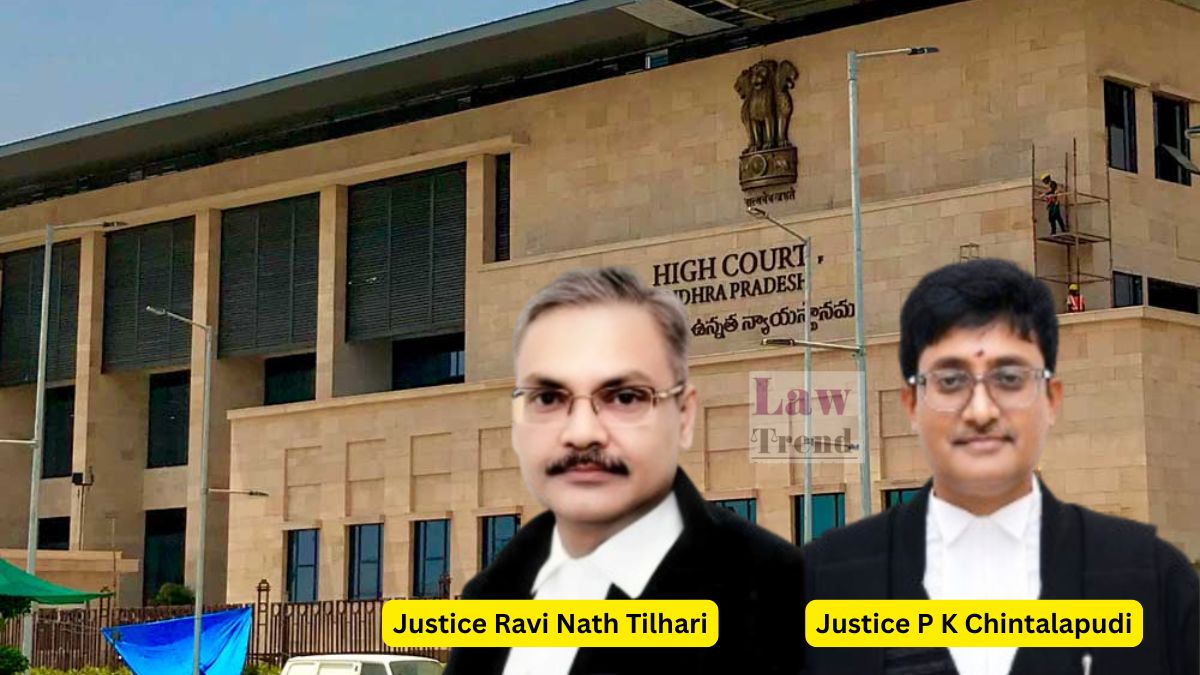
The High Court of Andhra Pradesh, comprising Justice Ravi Nath Tilhari and Justice Purushottam Kumar Chintalapudi, has held that the issuance of a notice of appearance under Section 41A of the Code of Criminal Procedure (CrPC) or Section 35 of the Bharatiya Nagarik Suraksha Sanhita (BNSS) by an investigating police officer does not disable or bar the detaining authority from passing a preventive detention order based on that very same criminal case. Clarifying the interplay between statutory arrest provisions and preventive detention laws, the Division Bench ruled that an investigating officer’s decision to dispense with arrest operates in an entirely different domain from the subjective satisfaction arrived at by a District Collector to preserve public order. However, the Court quashed the detention order against the detenu on other grounds, holding that the detaining authority failed to consider conditional bail orders and an acquittal, and that the proximate “live link” between the past incidents and the detention order had snapped.
Background of the Case
The petitioner, Chintala Hymavathi, filed a writ of Habeas Corpus under Article 226 of the Constitution of India challenging the preventive detention order dated December 11, 2025, passed against the detenu, Chintala Bhupathi. The detenu was classified as a “Goonda” under Section 2(g) of the Andhra Pradesh Prevention of Dangerous Activities of Bootleggers, Dacoits, Drug Offenders, Goondas, Immoral Traffic Offenders and Land Grabbers Act, 1986. The detention order was subsequently confirmed by the Chief Secretary to the Government on February 4, 2026.
The detention was founded on three criminal cases registered against the detenu:
- Crime No. 350/2018 of Nawabpet Police Station, registered under Sections 302, 120(B), 143, 147, 148 read with 149 of the Indian Penal Code (IPC) and Sections 3(2)(va) and 3(2)(v) of the Scheduled Castes and the Scheduled Tribes (Prevention of Atrocities) Act.
- Crime No. 134/2024 of Kodavalur Police Station, registered under Sections 191(2), 191(3), 103(1), 61(2), 351(3), 126(2), 324(4), 49 read with 190 of the Bharatiya Nyaya Sanhita (BNS), Sections 25 and 27(1) of the Arms Act, 1959, and Section 3(2)(v) of the SC/ST (POA) Act.
- Crime No. 197/2025 of Muttukur Police Station, registered under Sections 126(2), 115(2), 351(2) read with 3(5) of the BNS.
Submissions of the Parties
Appearing for the petitioner, learned Senior Counsel placed substantial reliance on the fact that in Ground No. 3 (the 2025 case), a notice had been issued to the detenu under Section 35(3) of the BNSS (corresponding to Section 41A CrPC). Counsel argued that under Section 35(1)(b)(ii)(a) BNSS / Section 41(1)(b)(ii)(a) CrPC, issuing a notice of appearance instead of effecting an arrest indicates that the police officer was satisfied that arrest was unnecessary to prevent the accused from committing any further offence. Citing Arnesh Kumar v. State of Bihar, counsel contended that because the object of preventive detention is also to prevent further offences, the detaining authority could not reach a contrary subjective satisfaction on the basis of that very same case.
Counsel further argued that in Ground No. 1, the detenu had secured bail and was subsequently acquitted on December 2, 2025, by the Special Judge for SC/ST offences-cum-V Additional District Sessions Judge, Nellore, in Sessions Case No. 72 of 2020. However, the detaining authority erroneously recorded that the trial was still pending, omitting to consider the bail conditions or the acquittal. In Ground No. 2, the detenu had been granted conditional bail on January 2, 2025, but the authority merely noted the grant of bail without assessing the efficacy of its conditions. Lastly, counsel contended that the time lag between the 2018 and 2024 crimes and the detention order snapped the live link, and that supplying relied-upon material in English to a detenu who only knew Telugu infringed Article 22(5) of the Constitution.
Opposing the petition, the learned Government Pleader argued that issuing a notice under Section 35 BNSS was simply statutory compliance under Arnesh Kumar to regulate arrest during investigation, which could not curtail the detaining authority’s jurisdiction to order preventive detention for the maintenance of public order. Relying on Pesala Nookaraju v. Government of A.P., he maintained that detention orders can be passed even after discharge or acquittal. He further submitted that mentioning the bail orders in the detention order implied that due consideration had been given, that the acts were prejudicial to public order, and that material papers had been supplied in Telugu.
High Court’s Analysis: Section 41A CrPC / Section 35 BNSS Does Not Bar Preventive Detention
The High Court rejected the petitioner’s contention that the issuance of a notice under Section 41A CrPC or Section 35 BNSS precludes a detaining authority from ordering preventive detention based on the same case.
The Bench observed that the statutory powers under the criminal procedure codes and the preventive detention law are vested in distinct authorities and pursue fundamentally different objectives:
“The police officer under Cr.P.C or BNSS taking the decision, on his satisfaction that, the arrest was not necessary, is different from the subjective satisfaction of the detaining authority under the Act, 1986. The authorities under both the Acts are different. Under Cr.P.C/BNSS it is police officer and under the Act, 1986 for preventive detention it is the District Collector. It is not necessary under law that the satisfaction of one authority be also the same as of the other authority under different Acts.”
Addressing the differing scopes of inquiry, the Court held:
“The subjective satisfaction being based on different material, being of different authorities and with different objective on different consideration, it cannot be said that the satisfaction arrived at by the police officer under Section 35 for not arresting the accused and issuing only notice, must also be the subjective satisfaction of the detaining authority or the detaining authority cannot arrive at its independent subjective satisfied.”
The Court further explained that while Section 41A CrPC / Section 35 BNSS is designed to regulate custodial investigation by police officers for individual crimes, preventive detention addresses wider concerns regarding the disturbance of public order:
“Section 41A Cr.P.C/35 BNSS is to be resorted to by the investigation officer before arresting an individual and that provision regulates the power of the investigation officer to arrest an individual. The main object is for carrying out the investigation into a crime by resorting to custodial investigation if the investigating officer is satisfied on the considerations under Section 35(3) BNSS/Section 41A Cr.P.C., otherwise not. The arrest would be for a limited purpose to facilitate the investigation, whereas under the Preventive Detention Act, 1986, the preventive detention is aimed at maintenance of public order.”
Pointing out that preventive detention orders can be passed notwithstanding the grant of bail, or even following an acquittal or discharge, the Bench ruled:
“…when under preventive detention, order can be passed inspite of the bail orders or even after discharge or acquittal on the statutory satisfaction of the detaining authority arrived at in accordance with law, it cannot be held that a criminal case in which Sections 41 & 41A Cr.P.C/Section 35 BNSS have been resorted to by giving notice and by not making arrest of the accused, such a criminal case cannot be taken into account for passing the order of preventive detention.”
High Court’s Analysis: Non-Consideration of Bail Conditions and Acquittal
Despite rejecting the petitioner’s argument on Section 41A CrPC / Section 35 BNSS, the High Court held that the detention order was unsustainable on Grounds 1 and 2 due to the detaining authority’s failure to actively evaluate the bail conditions and the subsequent acquittal.
The Bench emphasized that a mechanical recital that bail was granted does not satisfy the requirements of law:
“Mention of the grant of bail is only as a fact mentioned. It must be clearly reflected from the order of preventive detention that the detaining authority considered those bail conditions and then reached the satisfaction on the material before it that inspite of bail conditions it was necessary to detain the detenu for the reasons recorded in the order.”
The Court cited Rushikesh Tanaji Bhoite v. State of Maharashtra and Rekha v. State of T.N. to affirm that bail orders are vital material that must be placed before and considered by the detaining authority. Relying on Joyi Kitty Joseph v. Union of India, the Bench noted that where a jurisdictional court grants conditional bail, the detaining authority must examine whether those conditions were sufficient to restrain the detenu from further prejudicial acts. The Court also referred to its own ruling in Buddiga Dhana Lakshmi v. State of Andhra Pradesh, reaffirming that failure to evaluate bail orders impairs the subjective satisfaction.
Examining the State’s reliance on Pesala Nookaraju, the Bench clarified that while preventive detention may conceptually be ordered after an acquittal, it cannot be done without taking that acquittal into account:
“However, we are of the view that even if after acquittal, preventive detention order may be passed but certainly it cannot be passed without taking into account the factum of acquittal. In the present case the detaining authority was not aware of the acquittal of the detenu in criminal case in ground No.1. The satisfaction recorded is without consideration of material fact of acquittal in a criminal case in ground No.1 which has also been made the basis of preventive detention order.”
Absence of Live Link and Proximate Nexus
The Bench further held that the causal link between the earlier offenses and the detention order had snapped.
Referring to Mohd. Sahabuddin v. Distt. Magistrate, 24 Parganas, Rajinder Arora v. Union of India, and T.A. Abdul Rahman v. State of Kerala, the Court noted that unexplained delay between prejudicial acts and a detention order breaks the rational nexus. The detaining authority had relied on cases from 2018 and 2024 without showing how any live connection persisted up to December 2025. Applying Shiv Parsad Bhatnagar v. State of M.P., the Bench reiterated that “the single vicious ground is sufficient to vitiate an order of detention.” The Court also cited Pramod Singla v. Union of India, emphasizing that under Articles 21 and 22(5) of the Constitution, every procedural irregularity must accrue to the detenu’s benefit.
Decision of the Court
Holding that the subjective satisfaction was vitiated by the non-consideration of vital materials and the absence of a proximate live link, the High Court allowed the writ petition. The Bench quashed the detention order dated December 11, 2025, and the confirmation order dated February 4, 2026, directing that the detenu be released immediately if not required in any other pending case.
The Court granted liberty to the detaining authority to pass a fresh order in accordance with law, provided that the total detention period does not exceed the statutory limit.
Case Title: Chintala Hymavathi v. The State of Andhra Pradesh and 3 others
Case No.: Writ Petition No: 36444 of 2025
Bench: Justice Ravi Nath Tilhari and Justice Purushottam Kumar Chintalapudi
Date: .09.2026




