

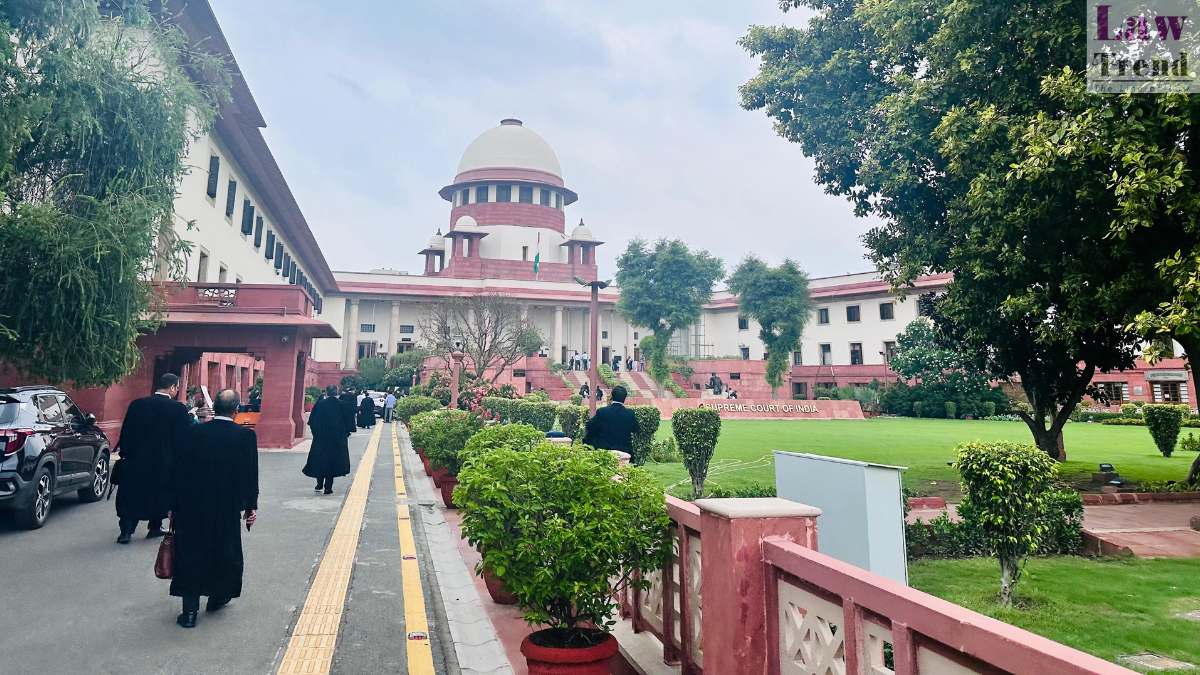
The Supreme Court of India has set aside the conviction and life imprisonment of a man accused of raping and murdering his minor niece, holding that the prosecution failed to establish an unbroken chain of circumstantial evidence pointing conclusively to his guilt. A Division Bench comprising Justice Ujjal Bhuyan and Justice Atul S. Chandurkar ruled that criminal conviction cannot rest on conjecture or suspicion, noting critical discrepancies in the prosecution’s case—including a DNA report revealing that recovered bone fragments were of male origin, while the victim was female. Setting aside the concurrent findings of the trial court and the High Court of Sikkim, the apex court extended the benefit of doubt to the appellant and directed his immediate release.
Background of the Case
According to the prosecution, on November 6, 2013, at around 9:00 a.m., the appellant, Santosh Gurung, was asked by his mother (the complainant) to purchase vegetables. The appellant requested his minor maternal niece to accompany him, but the complainant refused permission. Despite the refusal, the appellant allegedly took the child along. When neither returned, the complainant searched the area and informed the victim’s mother. On November 12, 2013, a missing person report was lodged at Rongli Police Station.
The appellant was traced months later in Siliguri. According to the First Information Report (FIR) registered on May 13, 2014, the appellant, while being brought back from Siliguri to Rongli, allegedly confessed that he had raped the victim and throttled her to death on November 6, 2013. The child’s corpus was never recovered, though certain bones, teeth, and clothing were allegedly discovered on May 15, 2014, pursuant to a disclosure statement made by the appellant.
Following an investigation, the appellant was charged under Sections 376(2)(i), 302, and 201 of the Indian Penal Code, 1860, read with Sections 4 and 6 of the Protection of Children from Sexual Offences (POCSO) Act, 2012. The Sessions Court convicted him on April 20, 2016, sentencing him to life imprisonment. The High Court of Sikkim subsequently affirmed the conviction and sentence on appeal, prompting the appellant to approach the Supreme Court.
Arguments Before the Supreme Court
Appearing for the appellant, learned counsel Ms. Sangeeta Kumar contended that both courts erred in convicting him purely on incomplete circumstantial evidence. She argued that the “last seen” theory was uncorroborated, as prosecution witnesses contradicted each other on whether the appellant was seen leaving with the victim. Counsel highlighted an unexplained delay of six months between the missing report and the FIR.
She further argued that the alleged recovery under Section 27 of the Indian Evidence Act, 1872, took place from an open area frequented by cattle herders and visible to passersby, citing the decision in Kattavellai @ Devakar v. State of Tamil Nadu. Finally, she underscored that forensic and DNA test reports failed to connect the appellant to the alleged crime, with the DNA test establishing that the recovered bones did not belong to the victim.
Opposing the appeal, learned counsel for the State of Sikkim, Mr. Sameer Abhyankar, supported the concurrent judgments. He argued that in the absence of eyewitnesses, the prosecution had established clinching circumstances that pointed solely to the appellant’s guilt. Counsel contended that under Section 313 of the Code of Criminal Procedure, 1973 (CrPC), the appellant failed to offer a plausible explanation for incriminating circumstances, which reinforced the chain of guilt. In support of his submissions, he relied on Naib Singh v. State of Punjab, State of Rajasthan v. Kashi Ram, and Manik & Ors. v. The State of Maharashtra.
The Court’s Analysis
Delivering the judgment, Justice Atul S. Chandurkar observed that the conviction based entirely on circumstantial evidence could not be sustained because the chain of circumstances was broken at multiple points. Reiterating the foundational test laid down by a three-judge Bench in Hanumant v. The State of Madhya Pradesh, the Court recalled the cautionary principle originally voiced in Reg v. Hodge:
“The mind was apt to take a pleasure in adapting circumstances to one another, and even in straining them a little, if need be, to force them to from parts of one connected whole; and the more ingenious the mind of the individual, the more likely was it, considering such matters to overreach and mislead itself, to supply some little link that is wanting, to take for granted some fact consistent with its previous theories and necessary to render them complete.”
The Court emphasized that in cases of circumstantial evidence:
“…the circumstances from which the conclusion of guilt is to be drawn should in the first instance be fully established, and all the facts so established should be consistent only with the hypothesis of the guilt of the accused. Again, the circumstances should be of a conclusive nature and pendency and they should be such as to exclude every hypothesis but the one proposed to be proved.”
The Bench systematically evaluated each circumstance relied upon by the prosecution:
- “Last Seen” Theory: The Court examined the deposition of the victim’s grandmother (PW2), who admitted that two other villagers had visited the house at the relevant time and that she did not notice whether the appellant and the child left together or separately. The Head Constable (PW1) and the Investigating Officer (PW16) both conceded that no witness saw the appellant taking the victim away. Addressing the six-month time gap between the date the victim went missing and the discovery of skeletal remains, the Bench cited State of U.P. v. Satish:
“The last seen theory comes into play where the time-gap between the point of time when the accused and the deceased were seen last alive and when the deceased is found dead is so small that possibility of any person other than the accused being the author of the crime becomes impossible. It would be difficult in some cases to positively establish that the deceased was last seen with the accused when there is a long gap and possibility of other persons coming in between exists. In the absence of any other positive evidence to conclude that the accused and the deceased were last seen together, it would be hazardous to come to a conclusion of guilt in those cases.”
- Recovery under Section 27 of the Evidence Act: Witnesses to the recovery (PW5 and PW8) admitted that the recovery site was situated near an old road and footpath used by villagers to collect fodder and graze cattle, and that the spot was clearly visible. Referring to State of Himachal Pradesh v. Jeet Singh, the Court observed that:
“Hence the crucial question is not whether the place was accessible to others or not but whether it was ordinarily visible to others. If it is not, then it is immaterial that the concealed place is accessible to others.”
Given that the location was ordinarily visible to the public, the Court held that the recovery had to be viewed with caution.
- DNA and Forensic Reports: The Court noted that the DNA report by the Assistant Chemical Examiner to the Government of Tripura revealed that the recovered bone fragments were of “human male origin” and had no biological relationship with the blood samples of the victim’s mother or sister. Furthermore, the Medico-legal specialist (PW13) could not verify whether the recovered specimens were human or animal remains, while the Regional Forensic Science Laboratory (RFSL) report failed to determine whether blood stains on the recovered shawl were human or animal.
- Ownership of the Brown Shawl: While the prosecution claimed the appellant took a brown shawl from his mother’s home to wrap the victim, the complainant failed to identify the shawl in court and denied ownership. The Investigating Officer also admitted that no witness saw the accused take the shawl.
- Section 313 CrPC Statement: Rejecting the State’s argument that the appellant’s answers or silence under Section 313 CrPC could bridge prosecution deficiencies, the Court cited Raj Kumar Singh @ Raju @ Batya v. State of Rajasthan:
“His answers to the questions put to him under Section 313 Cr.P.C. cannot be used to fill up the gaps left by the prosecution witnesses in their depositions. Thus, the statement of the accused is not a substantive piece of evidence and therefore, it can be used only for appreciating the evidence led by the prosecution, though it cannot be a substitute for the evidence of the prosecution.”
The Bench clarified that an adverse inference under Section 313 can arise only when incriminating circumstances are already established by independent evidence, which the prosecution had failed to achieve in this case.
Final Decision
Concluding that the prosecution evidence fell “woefully short” of establishing guilt beyond reasonable doubt, the Supreme Court held that the trial court and the High Court erred in sustaining the conviction on frail circumstantial links. While acknowledging that the minor met an unfortunate end, the Bench held that the appellant was entitled to the benefit of doubt.
The Supreme Court allowed Criminal Appeal No. 107 of 2018, quashed the judgments of the Sessions Court and the High Court of Sikkim, acquitted Santosh Gurung of all charges, and ordered his immediate release.
Case Title: Santosh Gurung v. State of Sikkim
Case No.: Criminal Appeal No. 107 of 2018
Bench: Justice Ujjal Bhuyan and Justice Atul S. Chandurkar
Date: October 1, 2026




