

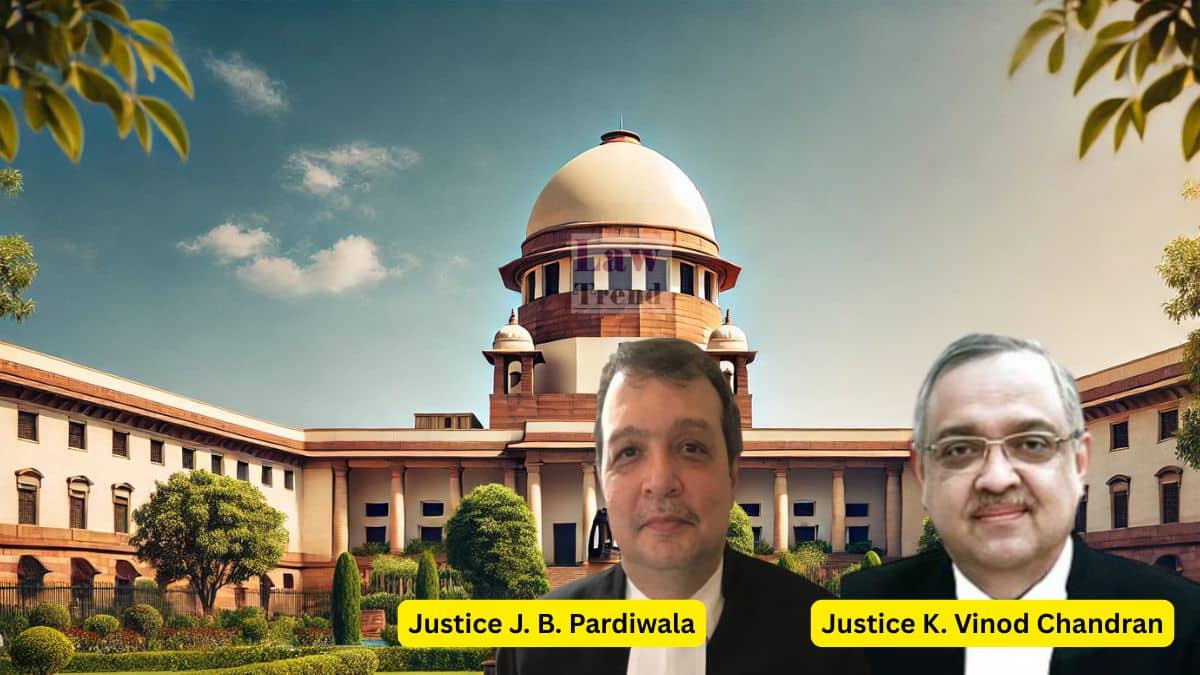
The Supreme Court of India, comprising a Bench of Justice J. B. Pardiwala and Justice K. Vinod Chandran, has held that the forfeiture of Earnest Money Deposit (EMD) and subsequent deposits made by a successful auction bidder is an automatic and inevitable consequence of non-payment of the balance consideration within the stipulated timeline, provided such a condition is expressly contained in the e-auction notice. Resolving the dispute over whether the absence of an express forfeiture clause in Schedule I of the Insolvency and Bankruptcy Board of India (Liquidation Process) Regulations, 2016 bars forfeiture, the Court upheld the order of the National Company Law Appellate Tribunal (NCLAT) and dismissed the appeal filed by the defaulting auction purchaser.
Background of the Dispute
The corporate insolvency resolution process of the Corporate Debtor commenced after an Operational Creditor approached the National Company Law Tribunal (NCLT) under Section 9 of the Insolvency and Bankruptcy Code, 2016 (IBC). An Interim Resolution Professional (IRP) was appointed, followed by the appointment of Vikram Bajaj as the Resolution Professional (RP). With no Resolution Plan forthcoming within the extended period, the NCLT approved liquidation of the Corporate Debtor, an order later affirmed by the NCLAT upon a challenge by a suspended Director.
Under the liquidation process, an e-auction notice for sale dated 25.10.2021 was issued for various assets. The subject property, designated as Lot No. 5 (measuring 68K, 17M situated at Village Nangal Khurd Tehsil, Sonepat, Haryana), carried a reserve price of Rs. 25.56 crores. The auction notice specifically contained a note disclosing that a civil suit was pending regarding the sale deed of 6M of land and that the Liquidator was applying for custody of the same. The sale was carried out on an “as is where is” basis.
The appellant, M/s ASJ Finsolutions Pvt. Ltd., emerged as the successful bidder on 15.11.2021 at the reserve price. Against the total bid of Rs. 25,56,00,000, the appellant deposited 25% of the bid amount (Rs. 6,39,00,000), comprising Rs. 2.55 crores as EMD (10% of reserve price) and Rs. 3.84 crores towards balance sale consideration, without demur.
Under the auction conditions, the balance was payable within 30 days (by 14.12.2021), or within 90 days (by 14.02.2022) with 12% per annum interest. On 15.12.2021, the appellant emailed the RP indicating its intention to pay the remaining Rs. 19.17 crores with interest within the 90-day window. However, the appellant failed to remit the balance. Instead, citing writ proceedings initiated by an entity named M/s Agarwal Trading Company before the Punjab & Haryana High Court and an application filed by them before the NCLT, the appellant filed Company Application No. 85 of 2022 before the NCLT on 11.02.2022 demanding prior title deeds.
The NCLT rejected this application on 31.03.2023, and the NCLAT dismissed the appeal on 21.04.2023, holding that the appellant had committed a wilful default. A subsequent writ petition before the Punjab & Haryana High Court was also dismissed, reserving liberty to pursue available remedies. In the interim, the property was put to fresh auction and fetched Rs. 31.10 crores—Rs. 5.54 crores above the appellant’s bid.
Relying on the liberty granted, the appellant initiated a second round before the NCLT, seeking annulment of the forfeiture and refund of the deposited amount. The NCLT ruled in the appellant’s favour by applying the “Triple Test,” but the NCLAT reversed this ruling on appeal. Aggrieved, the appellant approached the Supreme Court.
Arguments of the Parties
Senior Counsel Meenakshi Arora, appearing for the appellant, argued that Schedule I of the Liquidation Process Regulations, 2016 does not stipulate any forfeiture of EMD and restricts the demand of EMD to a maximum of 10% of the estimated value. Relying on Authorised Officer, Central Bank of India v. Shanmugavelu (2024) 6 SCC 641, she contended that unlike the SARFAESI Act, the liquidation regulations carry no statutory imprimatur for forfeiture. She further argued that the NCLT had rightly found the “Triple Test” in the appellant’s favour, that other bidders had been granted extensions, and that in any event, forfeiture could not extend beyond 10% of the reserve price.
Counsel Abhishek Anand, appearing for the respondent Liquidator/RP, countered that the appellant bid with open eyes despite an express disclosure regarding the pending civil suit over a portion of the land. He highlighted that the e-auction notice contained a specific, binding clause mandating forfeiture of the EMD and all deposited amounts in the event of default. The respondent further cited the decisions in Westcoast Infraprojects Private Limited v. Mr. Ram Chandra Dallaram Choudhary and Potens Transmission & Power Pvt Ltd v. Apex Buildsys Ltd (In Liquidation) (both affirmed by the Supreme Court in Civil Appeal No. 4087 of 2023 and Civil Appeal No. 4116 of 2022, respectively) to establish that forfeiture clauses in auction notices have been judicially upheld.
Court’s Analysis and Observations
Examining the regulatory framework and the auction terms, the Bench noted that although Schedule I of the Liquidation Process Regulations does not expressly provide for forfeiture and limits EMD to 10%, the binding terms of the tender notice clearly outlined the consequences. Justice K. Vinod Chandran observed:
“Having deposited 10% of the reserve price, along with a portion of the balance sale consideration, which itself is an undertaking to pay the balance amounts within a period of 30 days or 90 days with interest, brings in the consequences of forfeiture, on failure; which is automatic.”
Addressing the appellant’s eleventh-hour demand for title deeds, the Court stressed:
“A request was made for prior deeds, which, in any event, was not permissible at that distance of time, since the auction notice was issued on an ‘as is where is’ basis and it specifically indicated the non-availability of sale deeds with respect to a portion of the property. The appellant having not sought for verification of title deeds before the bid was made or the EMD was deposited, cannot project it as a requirement to resile from payment of the balance sale consideration. The argument of absence of stipulation of forfeiture, in the regulations also falls flat in the wake of the specific condition in the auction notice, which made forfeiture an inevitable consequence on failure to deposit the balance sale consideration.”
The Court firmly rejected the NCLT’s application of the “Triple Test”—which examines whether a bidder harboured a hidden agenda to rig the auction, lacked financial capacity, or was prevented by extraneous circumstances:
“Looking at the specific clause threatening forfeiture on failure of payment of balance sale consideration, on cancellation, forfeiture is a necessary consequence and there is no application of the Triple Test, on facts herein, to absolve the appellant from such forfeiture. The mere failure to make the balance sale consideration was to rig the auction proceedings, in which circumstance, admittedly, there was a fresh auction proposed and there was a higher value received on such auction.”
The Court held that the higher price obtained in the subsequent re-auction was due to the inherent value of the property and could not be claimed as a set-off by the defaulting bidder. The Bench also noted that financial capacity must be substantiated with tangible proof rather than empty assertions or repeated communications. The intervention by M/s Agarwal Trading Company was dismissed as “just an afterthought” and “merely projected as an excuse to scuttle the process of auction and to absolve the appellant from the liability to pay the balance sale consideration.”
Addressing the extent of forfeiture, the Court extracted Clause III of the e-auction notice, which stipulated that the entire amount paid by the bidder including EMD can be forfeited upon failure to pay the balance sale consideration.
The Decision
Holding that the appellant had voluntarily remitted Rs. 6.39 crores without demur under known tender terms, the Supreme Court concluded:
“The appellant having paid the money voluntarily and the terms and conditions stipulated in the e-auction notice having provided for the entire amount paid by a successful bidder, including EMD to be forfeited, if he fails to pay the balance sale consideration as per the terms of the sale, there is no reason to order refund. We find no reason to interfere with the impugned order.”
Accordingly, the Supreme Court dismissed the appeal and rejected all pending applications.
Case Details
Case Title: M/S ASJ Finsolutions Pvt. Ltd. v. Vikram Bajaj
Case No.: Civil Appeal No. 13023 of 2025
Bench: Justice J. B. Pardiwala and Justice K. Vinod Chandran
Date: September 28, 2026




