

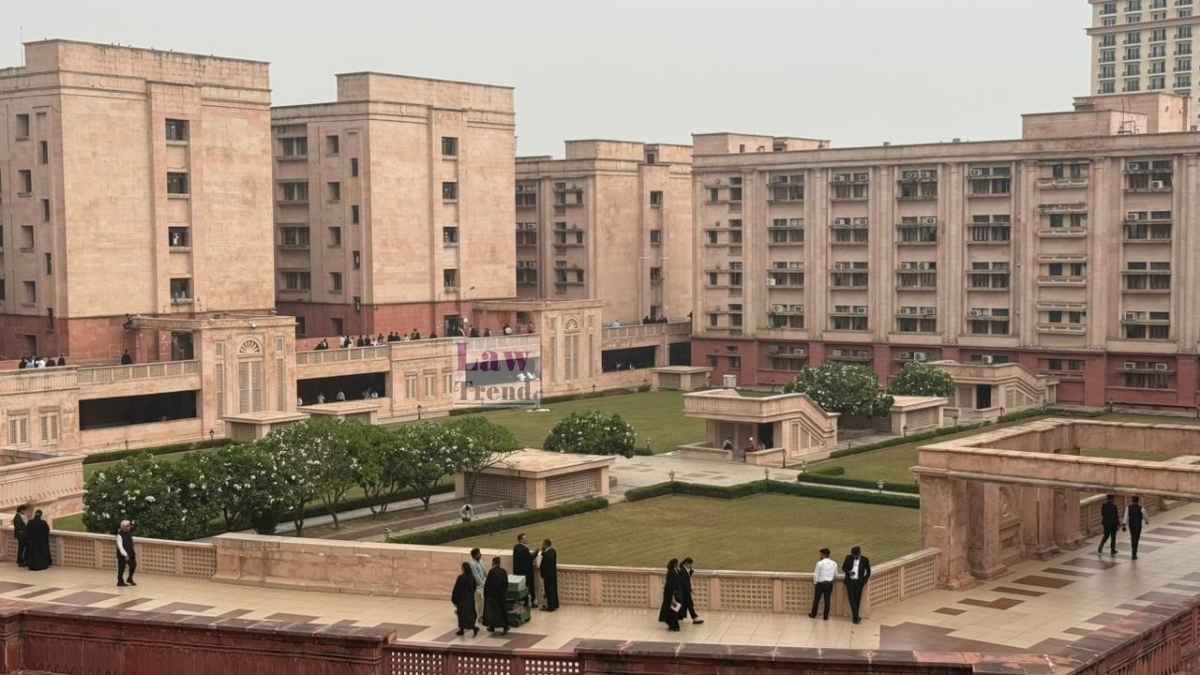
Taking strong exception to an unexplained 31-year delay by State authorities in filing their counter affidavit, the High Court of Judicature at Allahabad, Lucknow Bench, presided over by Justice Garima Prashad, has slapped costs of ₹1,00,000 on the State. While dismissing a writ petition on merits and holding that a temporary engagement expressly limited to 89 days confers no substantive right to regularisation, salary, or pensionary benefits merely because litigation remained pending, the Court ruled that the State cannot evade accountability for keeping the question of compliance with an interim order in limbo for more than three decades.
Background of the Case
The petitioner, Uma Kant Tripathi, filed the writ petition in 1994 assailing orders dated March 16, 1994, and March 23, 1994, by which his appointment as a Class IV employee on the post of “Sahyogi” in the Bahraich District Cooperative Bank Limited was annulled and he was relieved from service. Tripathi also prayed for continuance in service along with salary and arrears. While he had initially challenged Rule 7 of the Co-operative Banks Centralised Service Rules, 1976, and Regulation 17(d) of the Uttar Pradesh Co-operative Societies Employees’ Service Regulations, 1975, that challenge was deleted as not pressed in December 2024.
Tripathi was initially engaged as a Sahyogi under an order dated September 7, 1993, followed by a second order on December 22, 1993. Both appointment orders expressly stipulated that the engagement was wholly temporary, for a period not exceeding 89 days, terminable without prior notice, and subject to the post being filled through regular selection. The petitioner contended that he was duly selected by the Committee of Management and joined duties pursuant to its resolution until his termination in March 1994.
The respondents disputed the validity of his engagement. They stated that following the demise of the then Secretary/General Manager on December 22, 1993, the Chairman merely authorised Radha Mohan Singh, a Junior Branch Manager, to look after the office’s work. Singh had neither been a member of the centralised service nor possessed the statutory competence to make appointments. Consequently, the Deputy Registrar, Co-operative Societies, exercised powers under Section 128 of the Uttar Pradesh Co-operative Societies Act, 1965, to annul the authorisation as well as the appointment orders issued pursuant to it, prompting the Bank to relieve Tripathi.
On May 2, 1994, the High Court passed an interim order directing the respondents to keep the cancellation order in abeyance, permit Tripathi to work, and pay him his salary. However, in a supplementary affidavit filed in November 2017, the petitioner submitted that this interim order was never complied with and that he was neither permitted to work nor paid any salary after March 1994.
Submissions of the Parties
Counsel for the petitioner submitted that the Committee of Management was the competent appointing authority and had selected Tripathi, with Radha Mohan Singh merely executing the formal order. It was further contended that before annulling the appointment under Section 128 of the 1965 Act, the Deputy Registrar neither required the Committee of Management to reconsider its decision—as mandated by the statutory proviso—nor afforded Tripathi an opportunity of hearing.
Opposing the plea, counsel for the respondents argued that the appointment was made without an open selection process by an officer devoid of authority. It was further asserted that since the tenure was strictly limited to 89 days, it conferred no legal right to seek continuation or regularisation. Counsel maintained that an appointment void from inception could be cancelled without undertaking an empty formality and could not generate an entitlement to salary or service benefits.
Court’s Analysis and Observations
Evaluating the terms of the engagement, the Court observed that the appointment orders never appointed Tripathi on a substantive basis. Justice Prashad held:
“The assertion that no regularly selected candidate subsequently joined the post, even if accepted, would not convert a time-bound temporary appointment into a permanent one. The petitioner, therefore, acquired no enforceable right to continue after the expiry of the stipulated period.”
Examining the procedural ground under Section 128 of the Uttar Pradesh Co-operative Societies Act, 1965, the Court observed that nothing on record showed that the Committee of Management had been required to reconsider the decision in accordance with the proviso. However, the Court ruled that this procedural lapse did not entitle Tripathi to substantive relief. Relying on the Supreme Court’s ruling in Bhartiya Seva Samaj Trust v. Yogeshbhai Ambalal Patel (2012), the Court observed:
“The jurisdiction to issue a writ of certiorari is discretionary. Such a writ need not be issued where setting aside the impugned action would merely revive an appointment that could not otherwise be sustained or had already come to an end by efflux of time.”
The Court also referred to the Supreme Court ruling in Union of India v. Raghuwar Pal Singh (2018), which established that an appointment made without authority or essential approval is a nullity and the absence of a prior hearing does not necessitate its restoration. The Court, however, refrained from deciding whether the appointment was void ab initio, resting its decision on the narrower ground that the temporary 89-day term had fully lapsed.
Turning to the interim order dated May 2, 1994, the Court observed that although the respondents’ failure to allow Tripathi to work was unsatisfactory, an interim order cannot confer rights outside the original terms of employment:
“Nevertheless, an interim order is intended to preserve the subject matter of the proceedings pending final adjudication. It cannot create or enlarge a substantive right that the petitioner did not otherwise possess.”
The Court highlighted that Tripathi had not performed any duties after March 1994 and had placed no material on record showing any legal steps taken between 1994 and 2017 to enforce the interim order. Furthermore, based on his recorded date of birth (April 21, 1966), he had already crossed his superannuation date on April 20, 2026. Rejecting the monetary claims, the Court observed:
“An appointment limited to 89 days cannot form the basis of a claim for salary, pension or other service benefits until the date of superannuation merely because the writ petition remained pending.”
Decision and Imposition of Costs
While the Court dismissed the writ petition on merits and discharged the interim order, it held the State accountable for gross institutional delay. Although notice was accepted on behalf of opposite party nos. 3 to 5 on May 2, 1994, with a six-week timeline to file counter affidavits, the responsible authorities filed their counter affidavit only after further orders were passed in 2025.
Noting that no explanation had been offered for this delay of more than three decades, and that the Court was kept uninformed about the non-implementation of its interim direction, Justice Prashad held:
“The State cannot avoid responsibility for this lapse merely because the petitioner has failed to establish his substantive claim. The prolonged delay deprived the Court of timely assistance from the authorities concerned and allowed the issue of compliance with the interim order to remain unresolved until the petitioner had crossed the age of superannuation. The petitioner is, therefore, entitled to be compensated by way of costs, though not by the grant of service benefits to which he has established no legal right.”
Consequently, the Court imposed costs of ₹1,00,000 on the State, directing opposite party nos. 3 and 4 to ensure the amount is paid to the petitioner within six weeks.
Case Title: Uma Kant Tripathi Versus C/M Bahraich Coop Bank Ltd.
Case No.: WRIT-A No. 2291 of 1994
Bench: Justice Garima Prashad
Date: September 23, 2026




