

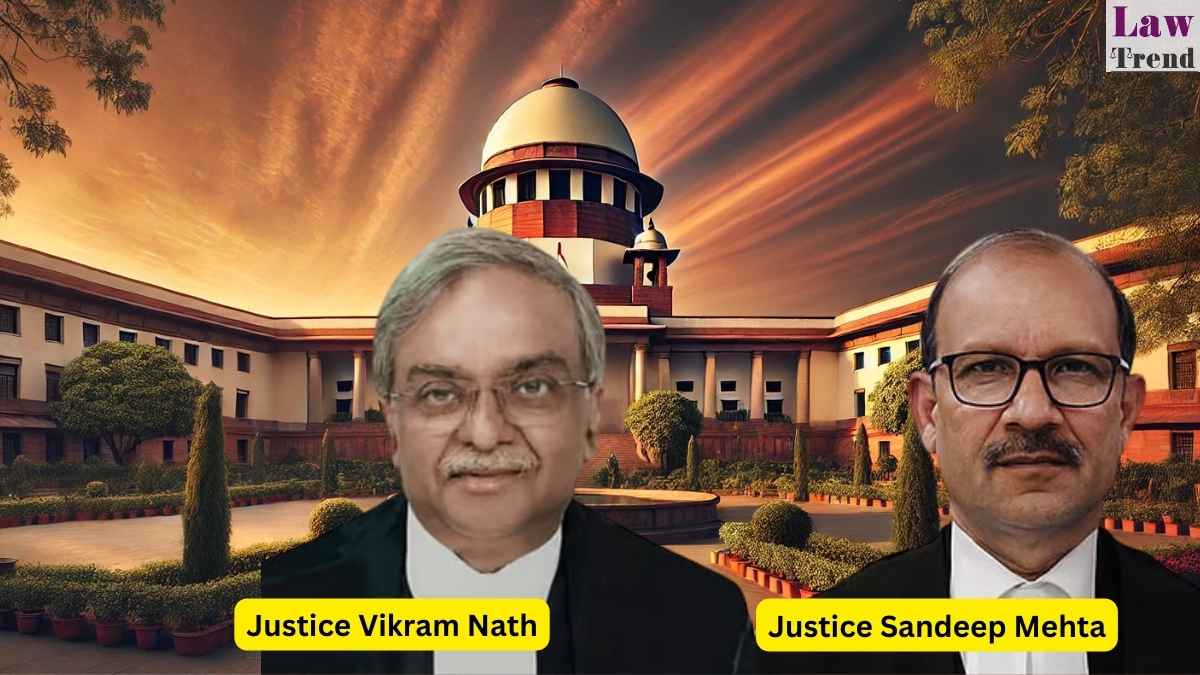
The Supreme Court of India, comprising a Bench of Justice Vikram Nath and Justice Sandeep Mehta, has held that delayed Employees’ Provident Fund (EPF) dues payable to employees of defunct state-owned corporations carry mandatory statutory simple interest at 12% per annum under Section 7-Q of the Employees’ Provident Funds and Miscellaneous Provisions Act, 1952, while delayed salaries and other monetary arrears attract simple interest at 6% per annum from the date they fell due until actual payment. Disposing of the longstanding dispute arising from the bifurcation of the erstwhile State of Bihar, the Court also awarded an additional one-time compensation of Rs. 1,00,000 to each eligible daily-wage worker, closed residual identification proceedings while preserving claimants’ rights for 12 months, and directed both Bihar and Jharkhand to publish complete details of all disbursements and pending claims online within four weeks.
Background of the Case
The dispute originated from the territorial reorganization of the erstwhile State of Bihar under the Bihar Reorganisation Act, 2000, which led to the creation of the State of Jharkhand. Following the reorganization, questions arose concerning the apportionment and discharge of liabilities, unpaid salaries, retiral benefits, and service claims of employees and workmen across five state-owned inter-state corporations:
- Bihar State Construction Corporation Ltd. (BSCCL)
- Bihar State Industrial Development Corporation Ltd. (BSIDC)
- Bihar State Electronic Development Corporation Ltd. (BSEDC)
- Bihar State Forest Development Corporation Ltd. (BSFDC)
- Bihar State Panchayati Raj Financial Corporation Ltd. (BPRFC)
The litigation, which traces its lineage to the landmark proceedings in Kapila Hingorani v. State of Bihar, previously saw the Supreme Court constitute a high-level committee chaired by Justice Dinesh Maheshwari, retired Judge of the Supreme Court. On May 29, 2026, the Court accepted the committee’s final report to bring finality to settled issues, while leaving three specific unresolved questions open for adjudication:
- The identification and verification of remaining employees, workmen, or legal heirs whose claims had not attained finality;
- The entitlement of daily-wage workmen and legal heirs of deceased workers to lump-sum compensation or welfare support; and
- The entitlement to and determination of interest on delayed salaries, wages, retiral dues, and provident fund amounts.
Compliance affidavits submitted by Bihar and Jharkhand in August 2026 showed that out of a verified baseline workforce of 2,274 employees, dues had been disbursed to 2,074 individuals, leaving approximately 200 cases pending on account of claimants being untraceable or lacking documentation.
Arguments on Behalf of the Petitioners
Appearing for the petitioner union, Senior Counsel Ms. Priya Hingorani contended that the mere inability to trace certain employees or the lack of formal documentation could not extinguish crystallized entitlements. She urged the Court to order the remaining amounts to be placed in an escrow or designated corpus so that claimants or legal heirs could claim them upon completing verification formalities without re-litigating entitlement.
Regarding daily-wage employees, the petitioners contested the applicability of the “no work, no pay” doctrine. Counsel submitted that BSCCL continued to treat them as workmen without formal termination until October 2015, and the absence of work was solely due to the corporation’s collapse and administrative failure. Furthermore, counsel argued that computing dues on a historical flat rate of Rs. 42.50 per day spanning several decades was arbitrary and failed to account for revisions in statutory minimum wages and the cost of living. She invoked Article 21 of the Constitution of India, seeking quantified monetary compensation under public-law remedies for prolonged deprivation of livelihood.
On the issue of interest, the petitioners argued that interest must run from the exact date when the respective salaries, retiral dues, and provident fund contributions fell due. For EPF arrears, counsel asserted that statutory interest under Section 7-Q of the Employees’ Provident Funds and Miscellaneous Provisions Act, 1952 was mandatory.
Arguments on Behalf of the Respondent-States
Opposing the petition, Senior Counsel Shri Ranjit Kumar, representing the State of Bihar, and Senior Counsel Shri Arunabh Chowdhury, representing the State of Jharkhand, submitted that substantial compliance had already been achieved by paying 2,074 verified workmen. They detailed administrative efforts to trace the remaining 200 claimants—including sending special messengers to permanent addresses, issuing speed posts, coordinating with unions, and publishing public notices in national and regional newspapers. The States requested that residual cases be closed administratively.
On daily-wage claims, the States maintained that daily wagers were engaged exclusively by BSCCL under daily-wage terms and held no vested right to subsequent revisions of minimum wages. They noted that Rs. 14.21 crore had already been paid to 467 of the 598 identified daily wagers at the rate of Rs. 42.50 per day up to their superannuation, death, or cessation of service. Both States vehemently opposed lump-sum death or starvation compensation, arguing that applicable service rules contained no such provisions, and that ascertaining whether past deaths were attributable to starvation or natural causes was practically impossible.
On the question of interest, the States argued that fastening 7.5% interest on salary arrears and 12% on EPF would impose a crippling financial burden on public exchequers. They highlighted that the corporations were independent juristic entities whose liabilities could not automatically fall upon the States. Furthermore, they contended that payments were made on humanitarian grounds, and because the units had been defunct for decades prior to Jharkhand’s creation, the workers had not rendered actual services during that period and had not proven that they were not gainfully employed elsewhere.
The Court’s Analysis
1. Identification and Verification of Untraced Employees
The Court observed that both States had taken all reasonable steps expected of them to trace untraceable employees and legal heirs through extensive public notices and outreach. It held that the States could not be required to continue the verification exercise indefinitely. However, the Court ruled that administrative closure cannot extinguish underlying lawful entitlements, granting claimants a 12-month window to approach designated Nodal Officers.
2. Daily-Wagers’ Entitlements and Compensation
The Bench acknowledged that daily-wage employment differs in legal character from regular employment, but emphasized that engagement as a daily wager cannot justify arbitrary treatment or disregard for services rendered. Addressing the wage computation, the Court held:
A fixed daily wage of Rs. 42.50, adopted as a uniform basis for computing the dues of workmen over a prolonged period extending from 1992 onwards, cannot constitute a fair and reasonable measure of their monetary entitlement, as it erroneously presumes that the value of labour and wages remained static over decades despite changes in the cost of living.
However, recognizing that remitting the matter for fresh wage refixation would trigger another protracted round of litigation after decades of delay, the Court balanced equities by awarding a one-time additional sum of Rs. 1,00,000 to each daily wager. The claim for death and starvation compensation was declined due to the absence of enabling service rules.
3. Interest on Delayed EPF Dues
The Court held that provident fund contributions represent a statutory social security measure that cannot be treated as an ordinary monetary claim. Analyzing Section 7-Q of the Employees’ Provident Funds and Miscellaneous Provisions Act, 1952, the Court cited its earlier ruling in Arcot Textile Mills Ltd. v. Regl. Provident Fund Commissioner & Ors., reiterating:
Section 7-Q which provides for interest for belated payment is basically a compensation for payment of interest to the affected employees. This provision has been made to secure just and humane conditions of work as has been opined in Regl. Provident Fund Commr. v. Hooghly Mills Co. Ltd. [(2012) 2 SCC 489: (2012) 1 SCC (L&S) 449] The language employed in Section 7-Q provides for levy of interest on delayed payment and the rates have been stipulated.
The Bench ruled that liability under Section 7-Q arises by operation of law and cannot be defeated merely because principal dues were belatedly discharged.
4. Interest on Delayed Salaries and Wages
Distinguishing salary arrears from statutory EPF claims, the Court noted the absence of a uniform statutory interest provision for salaries. Relying on the Constitution Bench judgment in Central Bank of India v. Ravindra & Ors., the Court observed that interest represents recompense for being deprived of the use of money lawfully due:
In Secy., Irrigation Deptt., Govt. of Orissa v. G.C. Roy [(1992) 1 SCC 508] the Constitution Bench opined that a person deprived of the use of money to which he is legitimately entitled has a right to be compensated for the deprivation, call it by any name. It may be called interest, compensation or damages … this is the principle of Section 34 of the Civil Procedure Code.
Rejecting the defense of separate corporate personality, the Bench held that as welfare States under whose exclusive domain the corporations functioned, Bihar and Jharkhand cannot permit legitimate entitlements to be rendered illusory by the collapse of state instrumentalities. To ensure the interest award remains compensatory rather than punitive, the Court fixed simple interest at 6% per annum.
Final Decision and Directives
Disposing of Writ Petition (Civil) No. 932 of 2022, the Supreme Court issued the following directions:
- Closure of Verification with Safeguard: The verification exercise stands closed administratively, but untraced/unverified employees or their legal heirs may approach the concerned Nodal Officer within 12 months with supporting documents for payment.
- Mandatory Web Publication: Within four weeks, both States must publish on their Information and Public Relations Department websites and parent Administrative Department websites full details of all employees/workmen, distinguishing between disbursed claims (with payment details) and pending claims (with pendency reasons, required documents, and Nodal Officer contact details), updated periodically.
- One-Time Ex-Gratia to Daily Wagers: Both States shall pay an additional one-time amount of Rs. 1,00,000 to each daily-wage worker engaged during the relevant period.
- Interest Rates: Both States shall pay simple interest at the rate of 12% per annum on delayed EPF dues under Section 7-Q of the Act, and simple interest at the rate of 6% per annum on delayed salaries, wages, and other non-EPF arrears, calculated from the date dues became payable until actual payment.
- Timeline: The computed interest and principal amounts must be disbursed within three months.
- Precedential Scope: The Court clarified that these directions are grounded in the peculiar facts and extraordinary delays of this case and do not constitute a general binding precedent for other matters.
Case Details
Case Title: Bihar State Ardh Sarkari Arajpatit Karamchari Maha Sangh and Others v. State of Bihar and Others
Case No.: Writ Petition (Civil) No(s). 932 of 2022
Bench: Justice Vikram Nath and Justice Sandeep Mehta
Date: September 28, 2026




