

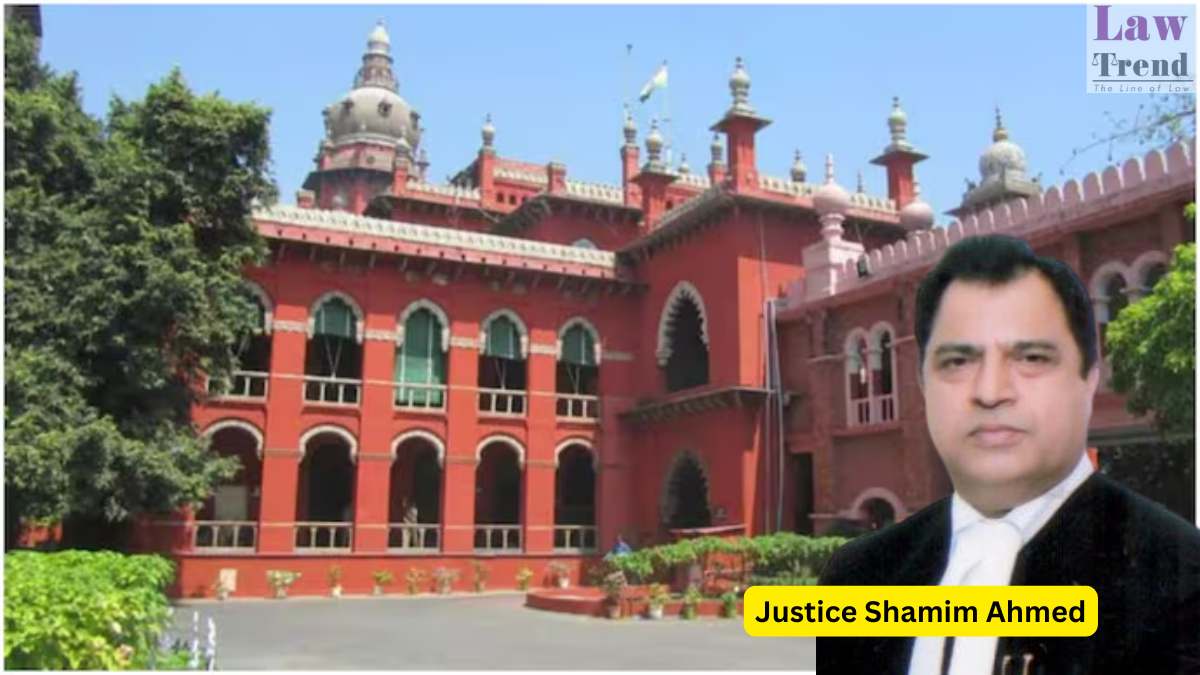
The Madras High Court has ruled that the death of a bona fide train passenger caused by heavy crowd rush and stampede on the steps of a railway foot overbridge amounts to an “untoward incident” under the Railways Act, 1989, making the Railway Administration strictly liable to pay compensation. Dismissing an appeal filed by Southern Railway, a single-judge bench comprising Justice Shamim Ahmed held that railway authorities are entirely accountable for passenger safety and crowd management across the precincts of a railway station.
Background of the Case
The case stems from an incident that occurred on November 11, 2023. The deceased, Raguraman, was travelling on a suburban train from Kancheepuram to Guindy. After alighting at the Guindy Railway Station around 9:35 AM, he attempted to exit by climbing the steps of the station’s foot overbridge. Owing to an intense crowd and rush of commuters, he was pushed by passengers rushing to cross, fell down the steps, and sustained severe head injuries. He fainted at the scene, was taken to the Government Hospital in Saidapet, and succumbed to his injuries during treatment.
The deceased’s wife and two minor children subsequently approached the Railway Claims Tribunal, Chennai Bench, under Section 16 of the Railway Claims Tribunal Act, 1987, read with Sections 123, 124A, and 125 of the Railways Act, 1989, claiming compensation of Rs. 10,00,000.
By an order dated March 20, 2025, the Tribunal awarded Rs. 8,00,000 as compensation to the dependants, along with 9% interest per annum from the date of the incident. The compensation was apportioned as Rs. 6,00,000 to the wife and Rs. 1,00,000 each to the two minor children. Challenging this award, the Union of India, represented by the General Manager of Southern Railway, preferred an appeal before the High Court.
Arguments of the Parties
Counsel appearing for the Southern Railway argued that the incident did not fall under the statutory definition of an “untoward incident” under Section 123(c)(2) of the Railways Act, as that provision specifically pertains to the accidental falling of a passenger from a train carrying passengers. It was contended that the Tribunal erred in describing the incident as an accidental fall from a train.
The Railway further argued that the passenger had died after falling on the steps of the foot overbridge, claiming that the occurrence fell under the proviso to Section 124A, specifically clause (e) relating to natural death, thereby absolving the Railway Administration of any liability to pay compensation.
The Court’s Analysis
Examining the evidence on record, the Court observed that the deceased held a valid Monthly Season Ticket (Ex.A6) and was unquestionably a bona fide passenger under Section 2(29) read with Section 124A of the Railways Act. The inquest report and post-mortem report (Ex.A5) conclusively established that the cause of death was head trauma resulting from the fall on the foot overbridge steps, decisively rejecting the Railway’s claim of “natural death.”
Addressing the Tribunal’s mention of an accidental fall from a train, the Court set aside that specific factual finding as a clerical error, while affirming the underlying finding that the death occurred due to a fall on the foot overbridge inside station precincts. The Court noted that the Railway failed to provide any evidence to establish that the death fell within any of the exclusionary clauses ((a) to (e)) of the proviso to Section 124A.
Justice Ahmed noted that a valid suburban ticket is inclusive of travel fare and covers the use of amenities across the station premises, including platforms, waiting areas, escalators, and foot overbridges. The Court highlighted the persistent overcrowding, debris, and ongoing construction at Guindy station, observing that crowd management is a primary institutional duty:
“The Railway Authorities are completely responsible and accountable for effective control of the crowd and also for smooth and safety movement of the passengers within the precincts of the Railway Stations or Railway Premises. The complex nature of scenarios and situations prevailing in the Railway Stations throughout the country cannot be neglected by the Courts and the Courts cannot shut its eyes with reference to the truth as well as the circumstances. In case of any “untoward incident”, blaming the passengers on the ground of negligence, can never be accepted by the Courts. In such circumstances, the Courts are bound to adopt the Doctrine of Liberal Interpretation, so as to ensure that the concept of social justice prevails and the livelihood of the dependants, who lost their dear and dear and the breadwinner, are safe guarded.”
The Court also observed that under Section 123(c)(1)(ii) of the Act, being pushed down by rushed passengers on a crowded overbridge effectively constituted a violent impact occurring within the station’s precincts.
Invoking Article 38(1) of the Constitution of India and the principle of strict liability under Section 124A, the bench relied on established judicial precedents interpreting the beneficial character of the Railways Act:
- The Supreme Court judgment in Union of India v. Prabhakaran Vijayakumar (2008), which held that beneficial and welfare statutes must be given a purposive, liberal interpretation rather than a narrow, technical one, so as not to deprive accident victims of compensation.
- The Calcutta High Court ruling in Shyamal Baran Saha v. State of West Bengal (1998), which affirmed that failure to make adequate safety arrangements for managing queues and crowds amounts to actionable breach of lawful duty.
- The Delhi High Court ruling in Union of India v. Krishan Kumar Goel (2010), which upheld that: “Hence in view of the decision of the Tribunal rendered in OA 13/2005 on 22.8.2006 and for the very same reasons, it is to be held that the death of the deceased, which has occurred in a stampede, amounts to an “untoward incident” and as such the railway administration is liable to pay compensation for the same.”
Decision of the Court
The High Court concluded that a fatal fall caused by an unprecedented rush or stampede on a station foot overbridge within railway premises squarely constitutes an “untoward incident.” Consequently, the Court dismissed the appeal filed by Southern Railway and confirmed the compensation award of Rs. 8,00,000 along with accrued interest.
The Railway Administration was directed to comply with the order and deposit the compensation within six weeks.
Case Title: Union of India v. Asha.K and Others
Case No.: CMA No. 3280 of 2026 (Neutral Citation: 2026:MHC:3998)
Bench: Justice Shamim Ahmed
Date: 21-09-2026




