

Denying Refund Of Premium For Unutilized Additional FSI On Residential Projects Is Arbitrary: Supreme Court
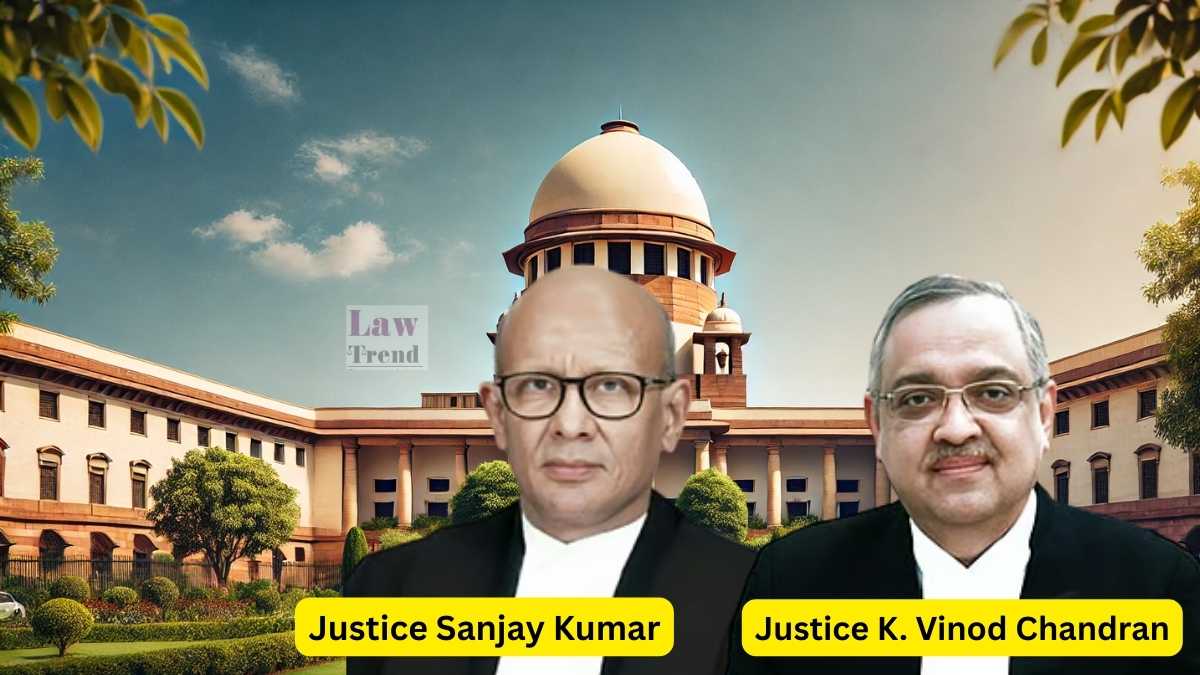

The Supreme Court of India has held that denying a refund of premium paid for unutilized additional Floor Space Index (FSI) for residential constructions is arbitrary, discriminatory, and violative of Article 14 of the Constitution. Setting aside a Bombay High Court judgment, a division bench comprising Justice Sanjay Kumar and Justice K. Vinod Chandran ruled that if the government allows such refunds for commercial and institutional projects, the same logic must apply to residential housing projects. The Court emphasized that withholding public money when no tangible benefit has been derived by the project proponent violates the basic tenets of state fairness.

Background of the Case

The appellants, Prasad Pandurang Tapkir and Shakuntala Pandurang Tapkir, owned agricultural land in Alandi Taluka, Pune District. Under a Maharashtra government scheme for homogenous development in areas adjoining municipal corporation limits, they sought to convert their land use to undertake a group housing construction project.

On August 30, 2012, they paid a premium of Rs. 30,46,290 to the authorities to obtain extra FSI, and permission was granted on October 8, 2012. However, the appellants subsequently abandoned their group housing plan, opting instead to develop the land as plotted plots. Their application for plotting was approved on April 19, 2014, with the condition that the terms of the original 2012 order would remain in force.

As they had not utilized the extra FSI, the appellants applied for a refund of the premium on August 13, 2015. Despite a recommendation in their favor by the Sub-Divisional Officer, Khed, the Assistant Director of Town Planning, Pune Branch, rejected their application on February 15, 2020, citing a lack of provisions in the Development Control Regulations (DCR) for such a refund. The appellants challenged this rejection in the Bombay High Court, which dismissed their writ petition on November 17, 2022, on grounds of delay and because the statutory scheme did not explicitly provide for a refund of FSI premium for residential projects.

Arguments of the Parties

The appellants argued that because they had abandoned the group housing project and proceeded with plotting, they never utilized the additional FSI. Consequently, retaining their premium was unjust and unfair, especially since government directives and notifications permitted refunds (minus 10% administration charges) for unutilized FSI in other categories, such as educational and medical institutions, and star category hotels.

READ ALSO  In Case of Minors, Birth Date Can be Changed in Passport After Attaining Majority: J&K&L HC

Conversely, the state authorities defended the denial of the refund. The Assistant Director of Town Planning filed a counter-affidavit claiming a distinction between premium paid for “exemption of certain components from FSI computation” (which they termed a non-refundable charge) and premium paid to purchase “additional FSI” (which is refundable). The respondent also argued that the Government Resolutions (GRs) permitting refunds applied exclusively to the Municipal Corporation of Greater Mumbai area and had no application to Pune District. They further contended that the premium was already credited to the consolidated fund of the State, and could not be returned without express regulatory provisions.

The Court’s Analysis and Findings

The Supreme Court rejected the state’s contentions, describing the technical distinctions raised in their counter-affidavit as “ludicrous” verbal jugglery, noting that both terms achieve the exact same effect of securing extra FSI.

The Court held that distinguishing between Mumbai and other areas of the state when refunding premiums was arbitrary, as the state government collects and shares these premiums across various districts. Furthermore, the Court found no rationale for treating unutilized FSI for institutional or commercial buildings differently from residential housing.

The Bench observed: The authorities’ decision in this regard does not manifest any reason as to why such benefit should be limited only to those identified buildings and to no other. Their action, therefore, suffers from sheer arbitrariness.

The Court remarked that logic and fairness dictate that residential projects, which directly affect individual homebuyers, should actually stand on a higher footing than commercial or semi-commercial developments.

To reinforce the mandate of state fairness, the Court cited several landmark precedents on Article 14 of the Constitution. Referring to the Constitution Bench ruling in E.P. Royappa vs. State of Tamil Nadu and another, the Court noted: equality is antithetical to arbitrariness as equality and arbitrariness are sworn enemies; one belonging to the rule of law in a republic, while the other, to the whims and caprice of an absolute monarch.

The Bench also cited Kumari Shrilekha Vidyarthi and others vs. State of U.P. and others, stating that the requirement of Article 14 to act fairly and reasonably applies even to the state’s contractual and administrative activities.

Highlighting the pervasive nature of non-arbitrariness, the Court referenced Ajay Hasia and others vs. Khalid Mujib Sehravardi and others, where it was observed: the concept of reasonableness and non-arbitrariness pervades the entire constitutional scheme and is a golden thread which runs through the whole of the fabric of the Constitution.

Other rulings including Dwarkadas Marfatia and Sons vs. Board of Trustees of the Port of Bombay and Securities and Exchange Board of India vs. Sunil Krishna Khaitan and others were also relied upon to establish that all state actions must pass the test of reason and fairness.

The Court also cleared the appellants of any delay, noting they had filed their initial refund request within three years of making the payment, and subsequent litigation arose due to the authorities’ long inaction.

READ ALSO  डीए मामले को सीबीआई को ट्रांसफर करने की छत्तीसगढ़ के पूर्व नौकरशाह की याचिका खारिज

The Decision

The Supreme Court allowed the appeal and set aside the November 17, 2022 judgment of the Bombay High Court and the February 15, 2020 rejection order of the Assistant Director of Town Planning.

The Court ruled that the appellants are entitled to a refund of their premium, subject to a 10% deduction toward administrative charges as applied to other categories. Accordingly, the Court directed the respondents to refund the sum of Rs. 27,41,661 with 7% simple interest per annum from the date of deposit until actual payment, to be executed within two months. The parties were directed to bear their own costs.

READ ALSO  Courts can condone delay u/s 5 of limitation Act even in the absence of a formal affidavit/application: SC

Case Details:

Case Title: Prasad Pandurang Tapkir and another versus The Assistant Director of Town Planning, Pune District, Pune and others
Case No.: Civil Appeal No. of 2026 (Arising out of SLP (Civil) No. 9666 of 2023)
Bench: Justice Sanjay Kumar and Justice K. Vinod Chandran
Date: July 13, 2026

Law Trend
Law Trendhttps://lawtrend.in/
Legal News Website Providing Latest Judgments of Supreme Court and High Court

Related Articles

Latest Articles

