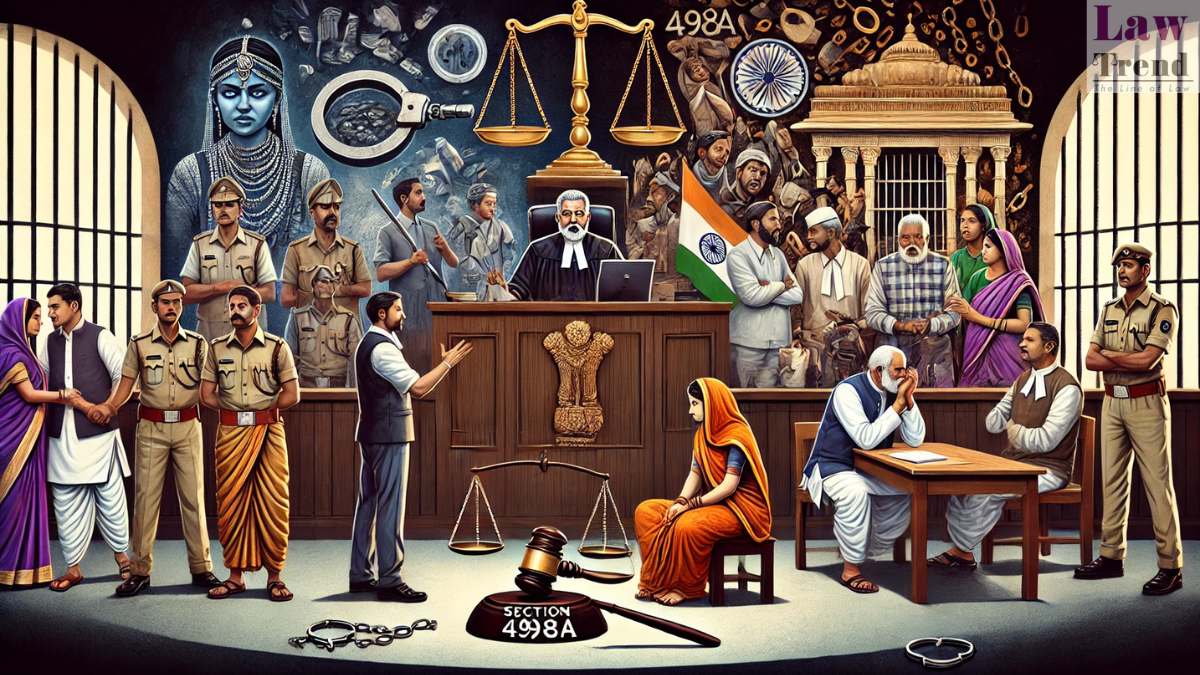
The Calcutta High Court has quashed a domestic cruelty case pending against five in-laws, ruling that the prosecution was launched as a retaliatory “counter-blast” to a divorce petition. Justice Shampa Dutt (Paul) allowed the criminal revisional application, holding that continuing the proceedings under Sections 498A, 323, and 34 of the Indian Penal Code, 1860, against the relatives of the husband would constitute a clear abuse of the judicial process due to the absence of specific, substantiated allegations.
Background of the Case
The petitioners in this case—Krishna Lal Paul, Bhakti Rani Paul, Sanjay Paul, Rinku Paul, and Swapna Paul—are the parents and close relatives of Rajib Paul. Rajib married the de facto complainant on January 28, 2014. Shortly after their marriage, Rajib secured a tatkal visa for his wife, and the couple moved to the United States in February 2014.
According to the petitioners, the complainant began inflicting cruelty upon her husband within a few days of their arrival in the US and demanded to return to her parental residence in India. She subsequently returned to India on April 18, 2014, and has since been residing with her parents.
In contrast, the complainant filed a written complaint alleging that after she returned to India and stayed at her matrimonial home, her in-laws subjected her to physical and mental torture over unmet dowry demands.
Chronology of Litigations and Arguments
During the proceedings, the court took note of the timeline of the disputes. On June 23, 2015, the husband filed a matrimonial suit (Matrimonial Suit No. 39 of 2015) seeking a dissolution of marriage before the Additional District and Session Judge at Raiganj.
After receiving the summons for the divorce suit in 2017, the complainant prayed for the transfer of the matrimonial suit from Alipore to Raiganj. Immediately thereafter, on February 8, 2017, she lodged a criminal complaint at the Kaliayaganj police station. Following an investigation, the police filed a charge-sheet against the in-laws under Sections 498A (cruelty by husband or relatives), 323 (voluntarily causing hurt), and 34 (common intention) of the IPC. The investigation did not find any ingredients to support the complainant’s allegation under Section 307 (attempt to murder).
The Court’s Analysis and Reliance on Precedents
In evaluating the case diary and records, the High Court analyzed the nature of Section 498A prosecutions and the rising trend of matrimonial conflicts. Justice Shampa Dutt (Paul) referred extensively to the landmark Supreme Court decision in Dara Lakshmi Narayana & Ors. vs State of Telangana & Anr. (2024), which analyzed the elements of cruelty and dowry harassment.
Citing the Supreme Court’s observations on the tendency to implicate entire families, the High Court highlighted:
“A mere reference to the names of family members in a criminal case arising out of a matrimonial dispute, without specific allegations indicating their active involvement should be nipped in the bud. It is a well-recognised fact, borne out of judicial experience, that there is often a tendency to implicate all the members of the husband’s family when domestic disputes arise out of a matrimonial discord. Such generalised and sweeping accusations unsupported by concrete evidence or particularised allegations cannot form the basis for criminal prosecution.”
The Court further noted the Supreme Court’s warning against using the provision as an instrument of retaliation, quoting:
“there has been a notable rise in matrimonial disputes across the country, accompanied by growing discord and tension within the institution of marriage, consequently, there has been a growing tendency to misuse provisions like Section 498A of the IPC as a tool for unleashing personal vendetta against the husband and his family by a wife.”
The High Court also cited the Supreme Court’s rulings in G.V. Rao vs. L.H.V. Prasad (2000), which cautioned against the rapid escalation of matrimonial litigation:
“There has been an outburst of matrimonial disputes in recent times. Marriage is a sacred ceremony, the main purpose of which is to enable the young couple to settle down in life and live peacefully. But little matrimonial skirmishes suddenly erupt which often assume serious proportions resulting in commission of heinous crimes in which elders of the family are also involved with the result that those who could have counselled and brought about rapprochement are rendered helpless on their being arrayed as accused in the criminal case.”
Additionally, the Court relied on Preeti Gupta vs. State of Jharkhand (2010), which mandated that courts must scrutinize allegations against close relatives with extreme care and circumspection.
The Decision
Applying these legal standards to the facts, the High Court observed that the criminal case was initiated in 2017, specifically after the complainant received the summons for the divorce suit filed in 2015. Consequently, the court found the prosecution to be a direct reaction to the husband’s legal action.
Reviewing the evidence gathered by the police, the Court concluded:
“The materials in the case diary in the present case shows that the allegations are general in nature.”
“The allegations made by the de facto complainant has also not been substantiated.”
“As such permitting the case to proceed against the petitioners herein, will clearly be an abuse of the process of law, considering that none of the ingredients required to constitute the offences alleged are present against the petitioners herein.”
Accordingly, the High Court allowed the revisional application and quashed the pending proceedings in G.R. Case No. 219 of 2017 against all five petitioners.
Case Details
Case Title: Krishna Lal Paul & Ors. vs. State of West Bengal & Anr.
Case No.: CRR 5025 of 2024
Bench: Justice Shampa Dutt (Paul)
Date: 07.07.2026