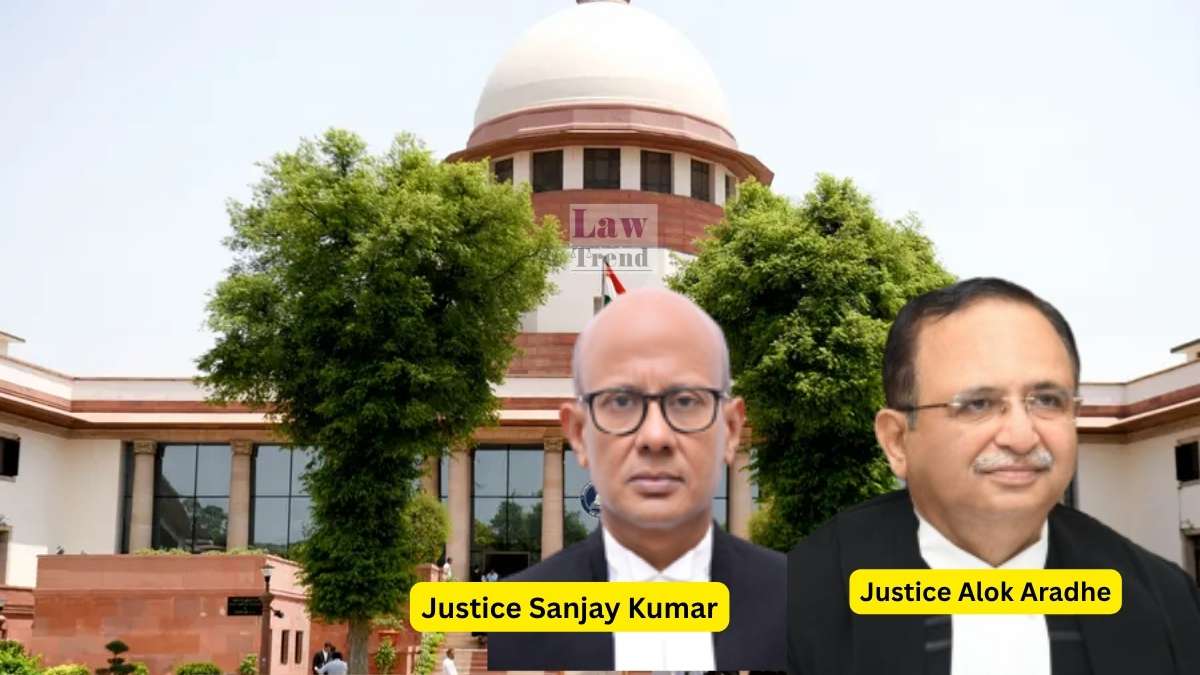
The Supreme Court of India has set aside a judgment of the National Company Law Appellate Tribunal (NCLAT) and restored the resolution plans for stalled real estate projects of Earth Infrastructures Limited (EIL). In a significant ruling, the Court applied the doctrine of “piercing the corporate veil” to hold that the assets of subsidiary companies could be dealt with in the insolvency proceedings of the holding company when they are “inextricably connected.”
The Division Bench, comprising Justice Sanjay Kumar and Justice Alok Aradhe, also directed the Greater Noida Industrial Development Authority (GNIDA) to waive penal interest, penal charges, and time-extension penalties, citing GNIDA’s “persistent inaction and ineptitude” in monitoring the projects.
Background of the Case
The litigation originated from the Corporate Insolvency Resolution Process (CIRP) initiated against Earth Infrastructures Limited (EIL) in 2018. Long prior thereto, GNIDA had allotted lands to various consortiums and subsidiaries of EIL, including Earth Towne Infrastructures Private Limited (ETIPL), Neo Multimedia Limited, and Nishtha Software Private Limited.
Lease deeds were executed for projects namely ‘Earth Towne,’ ‘Earth TechOne,’ and ‘Earth Sapphire Court.’ Although the leases were in the names of the subsidiaries, EIL was the lead member and developer. When EIL went into insolvency, the Resolution Professional (RP) invited resolution plans for these projects. The NCLT subsequently approved plans by Roma Unicon Designex Consortium (Roma) for ‘Earth Towne’ and Alpha Corp Development Private Limited (Alpha) for other projects.
However, GNIDA challenged these approvals before the NCLAT, arguing that the land belonged to the subsidiaries (separate legal entities) and not the Corporate Debtor (EIL), and therefore could not be part of the resolution plan without GNIDA’s prior permission. The NCLAT agreed with GNIDA, setting aside the resolution plans and directing a fresh process.
Arguments of the Parties
GNIDA’s Contentions: GNIDA argued that as per the “Explanation” to Section 18 of the Insolvency and Bankruptcy Code (IBC), the assets of a subsidiary cannot be treated as assets of the corporate debtor. They further contended that the resolution plans sought to transfer leasehold rights to third parties without GNIDA’s mandatory consent, violating the terms of the lease deeds.
Resolution Applicants and Homebuyers: Alpha and Roma, along with various homebuyers’ associations, argued that the subsidiaries were mere “alter egos” of EIL. They pointed out that GNIDA was fully aware that EIL was the actual developer. They also highlighted that GNIDA had remained silent throughout the CIRP and only filed belated claims after the plans were approved.
The Court’s Analysis
The Supreme Court addressed several critical legal issues:
1. Piercing the Corporate Veil While acknowledging the general rule that holding and subsidiary companies are distinct legal entities, the Court held that this was a fit case to lift the corporate veil. Referring to Life Insurance Corporation of India vs. Escorts Ltd., the Bench observed:
“Generally and broadly speaking, we may say that the corporate veil may be lifted… where associated companies are inextricably connected as to be, in reality, part of one concern.”
The Court found that the subsidiaries were controlled by EIL (holding up to 98% share), shared common directors, and were created specifically to hold the leases for projects developed by EIL. The Court noted that in such cases, the corporate veil should be lifted to protect public interest.
2. GNIDA’s Conduct and Penal Interest The Court scathingly critiqued GNIDA’s failure to monitor the projects, noting that payments had stopped as early as 2010-2013, yet GNIDA took no coercive action for years. The Court remarked:
“GNIDA contributed greatly to the present imbroglio by its persistent inaction and ineptitude all through… Turning a blind eye to all that was going on and also not going on, GNIDA did not even choose to be vigilant after initiation of the CIRP proceedings.”
Consequently, the Court upheld the NCLAT’s finding that GNIDA was not entitled to penal interest or time-extension penalties, stating that the Authority’s power should be viewed as a “trust coupled with duty.”
3. Project-Specific Resolution The Court reiterated that CIRP in real estate cases should proceed on a project-specific basis to protect solvent projects and homebuyers, citing Indiabulls Asset Reconstruction Company Limited vs. Ram Kishore Arora.
The Decision
The Supreme Court allowed the appeals filed by Alpha, Roma, and the homebuyers’ associations, with the following directions:
- Restoration of Plans: The resolution plans of Alpha and Roma are restored.
- Recalculation of Dues: GNIDA must recalculate its dues within two weeks, excluding all penal interest, penal charges, and time-extension penalties.
- Payment Schedule: The successful resolution applicants (Alpha and Roma) must clear the principal dues in equated monthly instalments over 24 months, starting July 7, 2026.
- No Burden on Buyers: The Court noted the commitment of Alpha and Roma that these dues would not be passed on to the homebuyers.
- Completion of Projects: The resolution applicants must endeavour to complete the projects within the timelines specified in their plans, commencing June 1, 2026.
- Status of Buyers: Registration of units in favour of allottees shall be undertaken only after total payment of GNIDA’s dues, conferring the status of sub-lessees upon the buyers.
The Court dismissed the appeals filed by GNIDA and certain individual intervenors whose interests were already represented by associations.
Case Details:
- Case Title: Alpha Corp Development Private Limited vs. Greater Noida Industrial Development Authority (GNIDA) and others
- Case No.: Civil Appeal No. 1526 of 2023 (and batch)
- Bench: Justice Sanjay Kumar and Justice Alok Aradhe
- Date: May 05, 2026