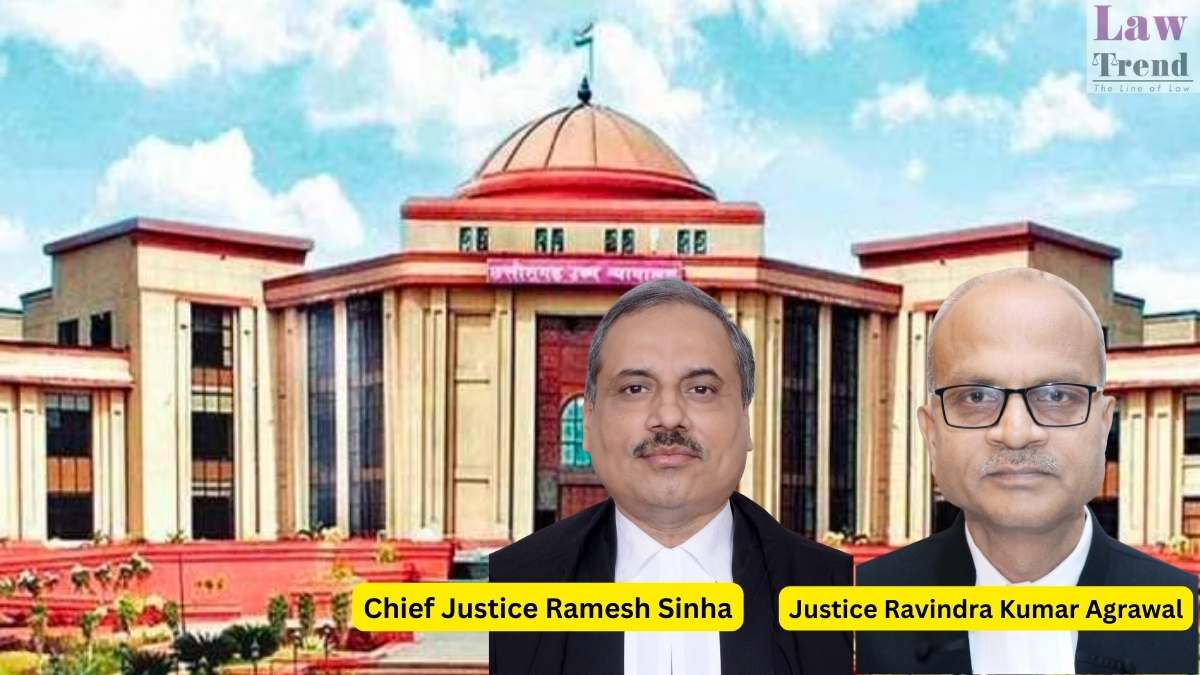
The High Court of Chhattisgarh at Bilaspur has ruled that the quashing of an FIR, charge-sheet, or criminal proceeding is permissible only when the defence material is of an unimpeachable quality, completely rules out the prosecution’s case, remains unrefuted, and showing that the continuation of the trial would amount to an abuse of the court’s process. A division bench comprising Chief Justice Ramesh Sinha and Justice Ravindra Kumar Agrawal dismissed a petition filed by an entrepreneur seeking to quash a commercial tax fraud case, holding that all these conditions must be cumulatively satisfied for a court to exercise its inherent power to quash a case; otherwise, the matter must proceed to trial.
Background of the Case
The petitioner, Nishant Sahu, was the proprietor of M/s Sai Nath Enterprises, a firm registered on October 2, 2013, under the Chhattisgarh Value Added Tax (VAT) Act, 2005, for purchasing and selling coal and coke. The criminal case against him originated from a written complaint lodged on June 27, 2014, by the Commercial Tax Officer, Bilaspur.
According to the prosecution, a discrepancy was detected during a scrutiny of data generated from departmental software and online returns filed by registered dealers. While Sahu had disclosed sales of approximately Rs 47.37 lakh in his VAT returns, the departmental portal and online purchaser lists reflected transactions amounting to approximately Rs 356.25 lakh. The prosecution alleged that Sahu generated bogus sales invoices to facilitate the wrongful availment of input tax credit by other traders, resulting in a tax evasion of Rs 17.81 lakh and causing a corresponding loss to the State revenue.
Following the complaint, First Information Report (FIR) No. 361/2014 was registered at Police Station Civil Lines, Bilaspur, under Sections 420 (cheating) and 467 (forgery) of the Indian Penal Code (IPC). Following an investigation, the police submitted Charge-sheet No. 617/2025 on July 16, 2025, before the Chief Judicial Magistrate, Bilaspur, adding Section 34 (common intention) of the IPC. The Magistrate took cognizance of the offences on July 23, 2025, and framed charges on November 6, 2025. Sahu subsequently moved the High Court under Section 528 of the Bharatiya Nagarik Suraksha Sanhita, 2023 (BNSS), seeking to quash the FIR, charge-sheet, and all subsequent proceedings.
Arguments of the Parties
The counsel for the petitioner argued that the entire dispute arose from alleged violations under the Chhattisgarh VAT Act, which is a special fiscal statute. He contended that the Act provides a complete, self-contained mechanism for tax assessment, adjudication, and penal action, and since offences under it are bailable, invoking harsher IPC provisions was an abuse of the process of law. It was further argued that no reassessment proceedings had been initiated under Section 22 of the VAT Act to determine actual liability, and no prior statutory sanction was obtained before registering the FIR.
Additionally, Sahu’s counsel highlighted an inordinate delay of eleven years in completing the investigation, which he argued violated the petitioner’s right to a speedy trial under Article 21 of the Constitution. He also pointed out that the charge-sheet lacked any recovery of forged documents and pointed to statements of witnesses indicating another individual, Sonu alias Piyush Singh, was the actual mastermind who ran the firm under Sahu’s name.
Opposing the petition, the State counsel submitted that the investigation revealed Sahu and co-accused Sonu alias Piyush Singh acted in a criminal conspiracy to cause wrongful loss to the government exchequer. Responding to the allegation of delay, the State explained that Sahu had absconded after the registration of the crime and moved outside Chhattisgarh. He was ultimately tracked down via mobile location and apprehended in Pune, Maharashtra, on May 29, 2025, while the co-accused remained absconding. The State asserted that because a prima facie case of cognizable offences was established, disputed questions of fact must be resolved in a trial.
The Court’s Analysis
The High Court analyzed the scope of its inherent powers under Section 528 of the BNSS (formerly Section 482 of the Code of Criminal Procedure). Referring to the landmark judgment of the Supreme Court in Neeharika Infrastructure Pvt. Ltd. v. State of Maharashtra (2021), the court emphasized that the power to quash criminal proceedings must be exercised sparingly and with circumspection.
The court focused on the legal threshold for quashing criminal proceedings on the basis of defense arguments. Drawing from the Supreme Court’s ruling in Pradeep Kumar Kesharwani v. State of Uttar Pradesh (2025), which relied on Rajiv Thapar v. Madan Lal Kapoor (2013), the bench emphasized a strict four-step cumulative test to determine the veracity of a prayer for quashing:
- Whether the material relied upon by the accused is sound, reasonable, and indubitable (i.e., of sterling and impeccable quality).
- Whether this material would rule out the assertions contained in the charges, persuading a reasonable person to dismiss the factual basis of the accusations as false.
- Whether the material relied upon by the accused has not been refuted by the prosecution or complainant.
- Whether proceeding with the trial would result in an abuse of the process of the court, and would not serve the ends of justice.
The bench stressed that all these conditions must be met cumulatively. Tested against these principles, the court found that the petitioner’s arguments did not meet this high threshold.
Addressing the petitioner’s argument that fiscal disputes must be restricted to special statutes, the court held:
“merely because a transaction has civil, commercial or fiscal ramifications, criminal proceedings do not become untenable if the allegations prima facie disclose the ingredients of a criminal offence.”
The court further observed:
“The existence of remedies under a special statute does not, by itself, operate as a bar against prosecution under the penal law where the allegations disclose commission of cognizable offences.”
Regarding the eleven-year delay in completing the investigation, the bench found the State’s explanation regarding the petitioner’s absconding status to be relevant, noting:
“Mere delay in investigation, by itself, cannot be a ground for quashing criminal proceedings when the materials collected during investigation prima facie disclose commission of cognizable offences.”
The court also declined to evaluate witness statements or delve into Sahu’s defence that he was a victim of another individual’s actions. The bench noted that a High Court cannot conduct a “mini-trial” or weigh evidence at this preliminary stage:
“The law is well settled that the High Court, while exercising its inherent jurisdiction, does not function as a trial Court and cannot undertake a roving enquiry into the truthfulness, reliability or admissibility of the material collected during investigation.”
Decision of the Court
The High Court concluded that the allegations and material collected during the investigation disclosed a prima facie case against the petitioner. Because the petitioner’s defence failed to satisfy the cumulative requirements of being unimpeachable and completely refuting the prosecution’s case at this preliminary stage, the court dismissed the petition.
The court clarified that its observations were confined solely to the disposal of the petition and should not be construed as an expression of opinion on the merits of the case during the trial.
Case Details:
Case Title: Nishant Sahu S/o Ramesh Sahu v. State of Chhattisgarh
Case No.: CRMP No. 1451 of 2026
Bench: Justice Ramesh Sinha, Justice Ravindra Kumar Agrawal
Date: 16.06.2026