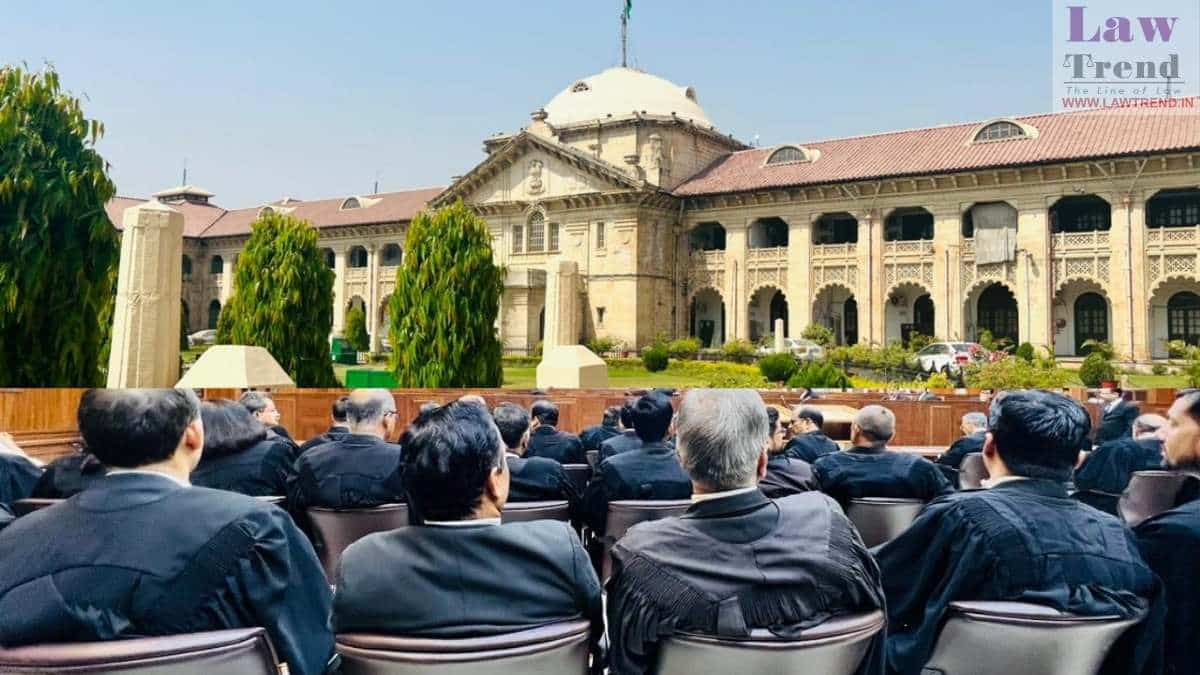
In a significant ruling aimed at streamlining the election processes of various Bar Associations across Uttar Pradesh, a Division Bench of the High Court of Judicature at Allahabad has held that while internal seniority disputes regarding the constitution of an ‘Elders Committee’ must be decided by the Bar Council of Uttar Pradesh under Section 21 of the Advocates Act, 1961, the Bar Council has no authority to directly interfere in the internal elections of these independent societies.
The Division Bench, comprising Justice Atul Sreedharan and Justice Siddharth Nandan, quashed the controversial election resolutions of the Mau and Bijnor District Bar Associations for violating the mandated Model Bye-Laws. Recognizing a regulatory gap in the existing framework, the Court invoked its extraordinary jurisdiction under Article 226 of the Constitution of India to lay down comprehensive “interregnum” directions governing the powers, composition, and functions of Elders Committees across all affiliated Bar Associations in the State of Uttar Pradesh until the Model Bye-Laws are formally amended.
Background of the Cases
The Court was flooded with multiple writ petitions filed by various district Bar Associations seeking redressal of disputes concerning their elections and the constitution of their Elders Committees. The Bench decided to address these common legal questions through a joint judgment in two primary petitions:
- WRIT-C No. 6613 of 2026 (Chandrashekhar Upadhyay, Advocate v. State of U.P. and 8 others): The petitioner, a member of the District Bar Association, Mau, challenged a resolution dated February 4, 2026, passed by the outgoing President. The resolution nominated specific members (respondents 5 to 9) to the Elders Committee and authorized them to conduct the 2026 office-bearer elections, while simultaneously resolving not to hold elections for the Elders Committee itself.
- WRIT-C No. 9562 of 2026 (Ankit Kumar v. State of U.P. and 2 others): The petitioner, a practicing advocate and member of the District Bar Association and Library, Bijnor, sought the quashing of a joint order dated February 19, 2026, issued by the Association’s President and Secretary. The order had constituted a 20-member committee to hold elections dehors the mandated Elders Committee.
Historical Context and the “Elders Committee”
The Court traced the origin of the “Elders Committee” and the “Model Bye-Laws” to the landmark Division Bench decision in Shiv Kumar Akela and others v. Registrar, Societies, Firms and Chits and others (2007). In that case, regular practitioners had approached the Court highlighting the influx of “non-resident” or “non-practicing” members who influenced elections through unethical means, thereby defeating the true purposes of the Bar Associations.
This issue was also highlighted in Sunita Sharma v. Deputy Registrar, Chits, Funds Society and others (2014) and P.K. Dash and others v. Bar Council of Delhi and others (2010), where courts noted that the control of Bar Associations was being hijacked by non-practicing and non-resident lawyers, thereby disrupting the dispensation of justice through frequent strikes. To combat this, State Bar Councils and the Bar Council of India (BCI) introduced the “One Bar One Vote” principle and formulated “Model Bye-Laws” for uniform adoption. These bye-laws created the “Elders Committee”—comprising the senior-most members of the Bar—to take over administration and hold timely elections if the outgoing governing body failed to do so within its one-year term plus a one-month grace period.
Arguments of the Parties
Contentions of the Bar Council of Uttar Pradesh
Shri Ashok Kumar Tiwari, appearing for the Bar Council of U.P., submitted that all affiliated Bar Associations must strictly adhere to:
- The Bar Council of U.P. (Advocate Association Affiliation) Rules, 2005;
- The U.P. Advocates Welfare Fund Act, 1974;
- The Model Bye-Laws for Bar Associations, U.P.; and
- The Bar Council of India Certificate and Place of Practice (Verification) Rules, 2015.
He argued that under Rule 8 of the Affiliation Rules, 2005, associations are duty-bound to conduct elections every year and forward the list of registered members to the Bar Council. Rule 10 provides that failure to hold timely elections can result in the disaffiliation of the Bar Association.
Furthermore, he outlined the substantial welfare benefits funded by the State Bar Council and State Government (such as Rs. 5 lakh death assistance up to the age of 70, Rs. 3 lakh under the Old Age Death Grant Scheme, and medical assistance of up to Rs. 50,000 for serious illnesses), pointing out that these benefits are exclusively available to advocates who are members of an affiliated Bar Association. He relied on Rule 54 of the Model Bye-Laws to assert that the Bar Association elections must be held under the “supervision and control” of the Bar Council of U.P., and that violating these bye-laws could subject the election officers and office bearers to professional misconduct proceedings under Section 35 of the Advocates Act.
Contentions of the Petitioners and the High Court Bar Association (HCBA)
Shri Rakesh Pande, learned Senior Advocate appearing on behalf of the High Court Bar Association, Allahabad (intervenor), and counsels for the petitioners countered the Bar Council’s assertions.
They argued that Rule 54 of the Model Bye-Laws, to the extent that it gives the Bar Council supervision and control over elections, directly conflicts with the High Court’s ruling in Elders Committee Central Bar Association, Azamgarh v. State of Uttar Pradesh (2013). They contended that a statutory body like the Bar Council cannot intervene in the internal elections of an independent registered society under the guise of maintaining discipline.
Shri Pande further argued that:
- The State-sponsored welfare schemes are meant for all enrolled “Advocates” as defined under the Advocates Act, 1961, and their benefits cannot be restricted or taken away from an advocate simply because they are not members of an affiliated association.
- It is “preposterous” to suggest that the President and Secretary of a Bar Association could be tried for professional misconduct under Section 35 of the Act for election disputes, as this would infringe upon the fundamental right to form associations under Article 19(1)(c).
- While the HCBA approved certain amendments to its bye-laws on December 1, 2022 (which were accepted by the Bar Council), any minor deviations from the Model Bye-Laws cannot automatically result in punitive actions.
The Court’s Analysis
The Court emphasized the high moral and ethical standards expected of the legal fraternity, quoting Lord Denning’s prologue in Rondel v. Worsley (1966) regarding an advocate’s paramount duty to the court. The Bench noted that a registered Advocates Association stands on a “higher pedestal” than other ordinary societies because it performs a public utility service crucial to the justice delivery system.
Addressing the restricted right to vote, the Court referenced Supreme Court Bar Association v. B.D. Kaushik (2012) and In Re v. Zila Adhivakta Sangh, Allahabad (2015), stating:
“Though an advocate can be member of several associations, the right to form an association or be a member of an association does not necessarily include the right to vote. ‘One Bar One Vote’ is a prescription which is in furtherance of the right to form an association and be able to manage the affairs of the association by those who regularly practice in the courts…”
On Issue Nos. 1 & 2: Power of the Bar Council in Seniority and Election Disputes
The Court resolved the first two issues by drawing a clear boundary between statutory powers of seniority determination and election interference:
- Seniority Disputes: If a dispute arises regarding the seniority of members to constitute the 5-member Elders Committee, the remedy is to approach the Bar Council of U.P. under Section 21 of the Advocates Act, 1961, which holds the statutory power to decide such disputes.
- No Interference in Elections: The Court held that even while a seniority dispute is pending, the Bar Council has no authority to interfere with the election process. Referencing Rajesh Kumar Shukla v. Assistant Registrar, Firms, Societies and Chits and Another (2015), the Bench declared:
“…under no circumstances, either pending the dispute or otherwise, issue any directions to the ‘Advocates Association’ regarding the postponement of the elections of the ‘Advocates Association’ or directives otherwise, interfering in the process of elections…” - Inapplicability of the Societies Registration Act: The Court reaffirmed that Section 25(2) of the Societies Registration Act, 1860 (which allows the Registrar of Societies to hold elections after the expiry of a term) is not applicable to Bar Associations. Referencing Satish Chandra Pandey v. Registrar, Firms and Societies, U.P. (2008) and Bar Association & Anr. v. State of U.P. (2013), the Court noted that Bar elections must strictly be conducted by the Elders Committee in accordance with the Model Bye-Laws.
- High Court Bar Association Seniority: For the High Court Bar Association, the Elders Committee must strictly comprise the five designated senior-most Advocates actively practicing in the High Court based on the official seniority list maintained by the Allahabad High Court.
On Issue Nos. 3 & 4: Powers of the Elders Committee and Regulatory Gaps
The Court observed that while the Model Bye-Laws vest the administration of the Association in the Elders Committee after the expiry of the elected body’s term (1 year + 1 month), they fail to provide the consequences if the Elders Committee itself fails to conduct the elections within its mandated 1-month period.
To resolve this and bring “quietus to the numerous litigations,” the Court formulated the following Interregnum Directions:
- Financial and Property Limitations: The Elders Committee shall not take any policy or financial decisions, nor make decisions regarding the movable and immovable properties of the Association. It shall only exercise such financial powers necessary for day-to-day work and the conduct of the elections.
- Permanence and Composition: The Committee must be permanent, consisting of 5 senior-most active practitioners. In District Courts, seniority is determined by the date of enrollment with the Bar Council, provided the member has at least 10 years of regular practice in that court.
- Timeline for Takeover: If the outgoing committee fails to hold elections within 13 months, the Elders Committee must take charge and hold elections within 1 month. If it fails, an Extraordinary General Meeting (EGM) must be called, and the elections must be held on the date fixed by the General Assembly.
- Rotation and Retirement: Upon the declaration of election results, the senior-most member (the Chairman) of the Elders Committee shall retire. The remaining members will induct the next senior-most eligible practitioner. The retiring Chairman shall be eligible for re-induction only after the subsequent election.
- Resolution of Deviations: If an association’s bye-laws deviate from the Model Bye-Laws, the State Bar Council must provide them 30 days’ notice to amend and bring them into conformity, failing which the association faces disaffiliation.
- Objections and Dispute Resolution: Any post-election disputes referred to the Elders Committee must be decided on the principles laid down under Section 25(1) of the Societies Registration Act, 1860.
The Court’s Decision
Applying these principles to the facts of the two writ petitions, the Court ruled as follows:
- Mau Bar Association Case (WRIT-C No. 6613 of 2026): The Court quashed the resolution dated February 4, 2026, passed by the outgoing President, ruling that the nomination of respondents 5 to 9 as members of the Elders Committee was dehors the mandate of the Model Bye-Laws and Clause 7 of the Association’s bye-laws.
- Bijnor Bar Association Case (WRIT-C No. 9562 of 2026): The Court quashed the order dated February 19, 2026, which had bypasses the Elders Committee to set up a separate 20-member election committee.
- Directions to the Bar Council of U.P.: The Court directed the Bar Council of U.P. to circulate a copy of the judgment to all affiliated Bar Associations in the State and ensure strict compliance with the Model Bye-Laws. Non-compliant associations must be given a reasonable opportunity to amend their bye-laws, failing which they shall be disaffiliated.
- Timeline for Implementation: The entire compliance exercise must be completed within one year to ensure that the Bar Association elections for the year 2027 are held in absolute conformity with the Model Bye-Laws.
The Court concluded by expressing its appreciation for the valuable legal research and assistance provided by the Senior Advocates, the President of the HCBA Shri Rakesh Pande, and the Amici Curiae Ms. Naina Sharma and Mr. Achintya Rai Sharma, noting their commendable gesture of refusing any financial remuneration for their services.
Both writ petitions were disposed of accordingly.
Case Details
- Case Title: Chandrashekhar Upadhyay, Advocate v. State of UP and 8 others (with WRIT-C No. 9562 of 2026: Ankit Kumar v. State of U.P. and 2 others)
- Case No.: WRIT-C No. 6613 of 2026
- Bench: Justice Atul Sreedharan and Justice Siddharth Nandan
- Date: May 20, 2026