The Supreme Court of India has set aside the conviction and life sentences of two men accused in a 2012 murder case, ruling that the prosecution failed to establish a complete chain of circumstantial evidence.
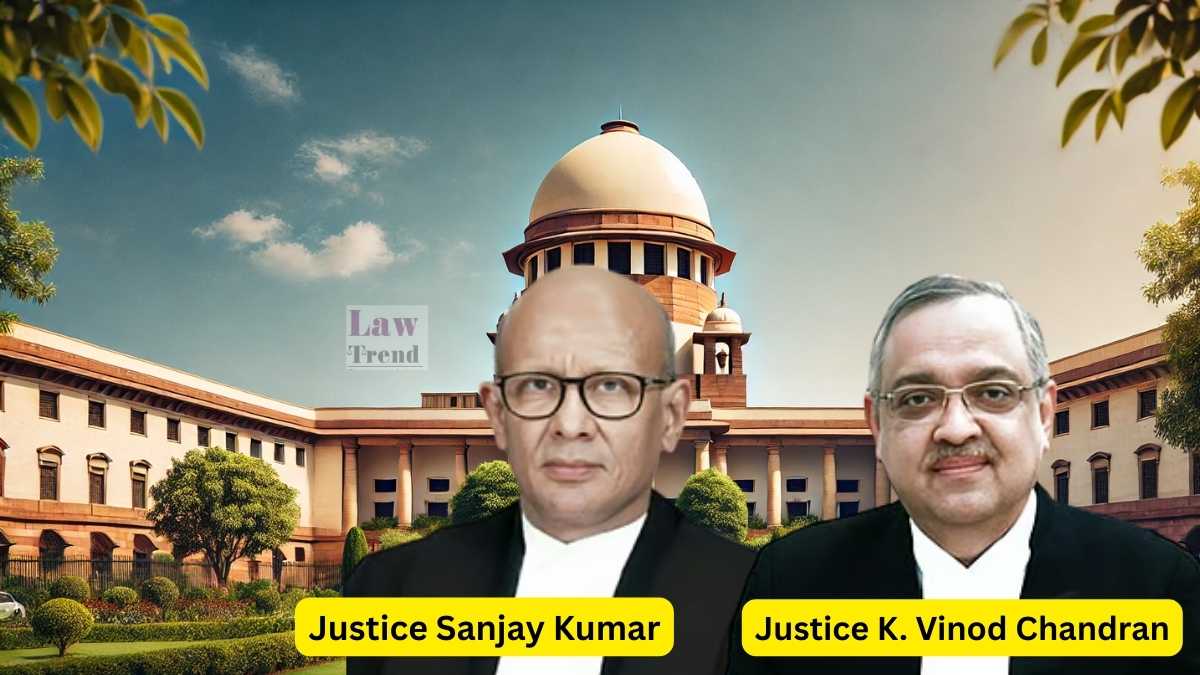
A Division Bench comprising Justice Sanjay Kumar and Justice K. Vinod Chandran observed that the “last seen together” theory could not be sustained due to an elastic time gap between when the deceased was last seen with the accused and the estimated time of death. The Court also held that exculpatory statements by an accused shifting blame onto co-accused cannot be treated as reliable extra-judicial confessions, and rejected the alleged weapon recoveries for failing to meet the strict statutory standards of Section 27 of the Indian Evidence Act.
Notably, while allowing the appeals of the first two accused, the Supreme Court took active steps to assist the third accused, who remains imprisoned and had not filed an appeal, by directing the National Legal Services Authority (NALSA) to facilitate his legal representation.
Background of the Case
The case originates from an incident on October 30, 2012, in West Bengal. According to the prosecution, the son of the de-facto complainant (PW1) left his house at around 4:00 PM on a motorbike accompanied by three companions—Papan Sarkar @ Pranab (Accused 1), Accused 2, and Accused 3—who arrived on another motorbike.
When the victim did not return by 8:00 PM, his father, along with others (PW3 and PW8), initiated a search. The following morning, the victim’s body was recovered from a ditch in a field, positioned head down with his legs sticking up. The body bore brutal injuries, including massive facial lacerations, a lost left eye, skull fractures, and burns on the right side of the face and shoulder.
Following the discovery, local villagers detained Accused 1 (A1) and Accused 2 (A2). The prosecution built its case entirely on circumstantial evidence, including:
- The “last seen together” theory.
- Alleged extra-judicial confessions made by the detained accused to the villagers.
- The recovery of weapons (a stone and a glass piece) and the victim’s motorbike.
- Oral testimonies of various witnesses, including an acquaintance (PW11) who claimed to have seen the group drinking together.
The trial court convicted all three accused, a decision subsequently affirmed by the High Court. Two of the three convicted individuals, A1 and A2, appealed their conviction before the Supreme Court, while Accused 3 did not file an appeal.
Arguments of the Parties
For the Appellants: Learned Counsel Ms. Ashima Mandla argued that the circumstantial chain was severely fractured. It was contended that the time gap between when the deceased was last seen with the accused and the estimated time of death was too wide to draw any adverse inference. Counsel pointed out contradictions in the testimonies regarding the extra-judicial confessions and raised serious doubts about the validity of the recoveries, noting that the seized weapons were never produced in court or shown to the medical officer who conducted the post-mortem.
For the Respondent (State of West Bengal): Learned Counsel Ms. Shraddha Chirania defended the concurrent findings of the lower courts. She submitted that the last seen theory was sufficiently corroborated by the post-mortem report, which detected alcohol in the victim’s stomach, matching the testimony of PW11 who saw them drinking. She further argued that even though the recovery site (a paddy field) was an open area, the thick growth of stalks allowed for effective concealment of the weapons, making the recoveries under Section 27 of the Evidence Act legally sound.
The Court’s Analysis and Observations
The Supreme Court systematically evaluated each circumstantial link relied upon by the trial and high courts:
1. The “Last Seen Together” Theory and Proximity of Death
The prosecution relied on testimonies from PW1 and PW14, who stated they saw the four individuals together between 4:00 PM and 5:00 PM on October 30, 2012. The body was discovered at approximately 10:00 AM the next day, and the autopsy was conducted at 2:10 PM.
The post-mortem report proved by the doctor (PW10) indicated the time of death broadly as “24 hours not passed during examination after death of deceased.”
The Bench noted that such an elastic time frame meant death could have occurred at any point during the intervening night or morning. Citing the settled precedent in State of Goa v. Sanjay Thakran and Another (2007) 3 SCC 755, the Court observed:
“The proximity of the death having occurred within a short time after the accused and the deceased were seen together is most relevant, for the said fact to be taken as an incriminating circumstance against the accused. When the time gap is large then there could be intervening circumstances, which snaps the link and prevents an adverse inference against the accused…”
Consequently, the Court held that “the time frame being quite large to term death as proximate, there can be no conviction based on the last seen together theory in the present case.”
The Court also discredited PW11’s testimony about seeing the men drinking behind a BDO office, pointing out that she could not name her employer, specify where she worked, or explain how a public drinking session went unnoticed in a thickly populated area.
2. Rejection of the “Extra-Judicial Confession”
The prosecution claimed A1 confessed to PW8 in the presence of other villagers. However, the Court found stark contradictions in the testimonies. While PW8 claimed A1 admitted that all three accused killed the victim, other key witnesses (PW3, PW12, and PW14) testified that A1 made an exculpatory statement blaming only A2 and A3.
Rejecting this evidence, the Court observed:
“The exculpatory statement made absolving himself and accusing the co-accused, by its very nature is unreliable. It cannot be put against the other accused, for no cross examination being provided to them, of the one who made that statement. It cannot also incriminate the person who made the statement since there is no element of confession in the recital as spoken of by three witnesses, as against one.”
The Court further noted that the alleged statements were made while A1 and A2 were being detained by an aggressive mob, and subsequent medical records showed physical injuries on the accused, indicating “undue duress or under threat of violence” which “cuts at the root of credibility of the statement made.”
3. Flaws in the Weapon Recoveries (Section 27, Evidence Act)
The prosecution claimed that a stone weighing 1–1.5 kg and a glass piece used in the murder were recovered on the joint information of A1 and A2. The Court observed multiple fatal infirmities in these recoveries:
- The seizure list lacked specific details of the place of concealment.
- There was no recorded statement of the accused revealing knowledge of concealment.
- The independent search witness, the Pradhan (PW5), did not depose that the accused pointed out the objects or were even present at the time.
- Crucially, the stone and glass piece were never produced in court, nor were they shown to the doctor to confirm if they could cause the fatal injuries.
The Bench emphasized the statutory requirements of Section 27:
“Concealment and its knowledge, revealed from the statement of the accused, is the crucial ingredient of Section 27 which can lead to that being used in a criminal trial, any other confession to a police officer being excluded as self-incriminating.”
Similarly, the recovery of the victim’s motorcycle was discarded as the homeowner (PW9) where it was allegedly parked failed to identify the accused, and the vehicle’s registration details were never produced in court.
4. Absence of Motive
Lastly, the Court noted that the prosecution failed to project any motive for the brutal crime. While motive is not imperative when a circumstantial chain is complete, its absence in this case raised reasonable doubt.
The Decision
Concluding that none of the circumstances projected by the prosecution qualified as incriminating or linked the appellants to the murder, the Supreme Court reversed the concurrent findings of the lower courts.
The Court allowed the appeals, acquitting Papan Sarkar @ Pranab and the co-appellant, and ordered their immediate release.
Court Intervention for Non-Appealing Accused (A3)
Observing that the third accused (A3) had been languishing in jail along with A1 and A2 but had not filed an appeal, the Bench directed:
“In the circumstance of having acquitted the two accused, it is only proper that A3 also be provided assistance to file an appeal. We direct the Member Secretary, National Legal Services Authority to get in touch with the Member Secretary of the West Bengal State Legal Services Authority, who shall… provide sufficient assistance to A3 and ensure that an appeal is filed before this Court from the impugned judgment.”
The compliance of this directive is to be reported to the Supreme Court by July 20, 2026.
Case Details
- Case Title: Papan Sarkar @ Pranab v. State of West Bengal
- Case No.: Criminal Appeal No. 2507 of 2026 with Criminal Appeal No. 2508 of 2026
- Bench: Justice Sanjay Kumar, Justice K. Vinod Chandran
- Date: May 22, 2026