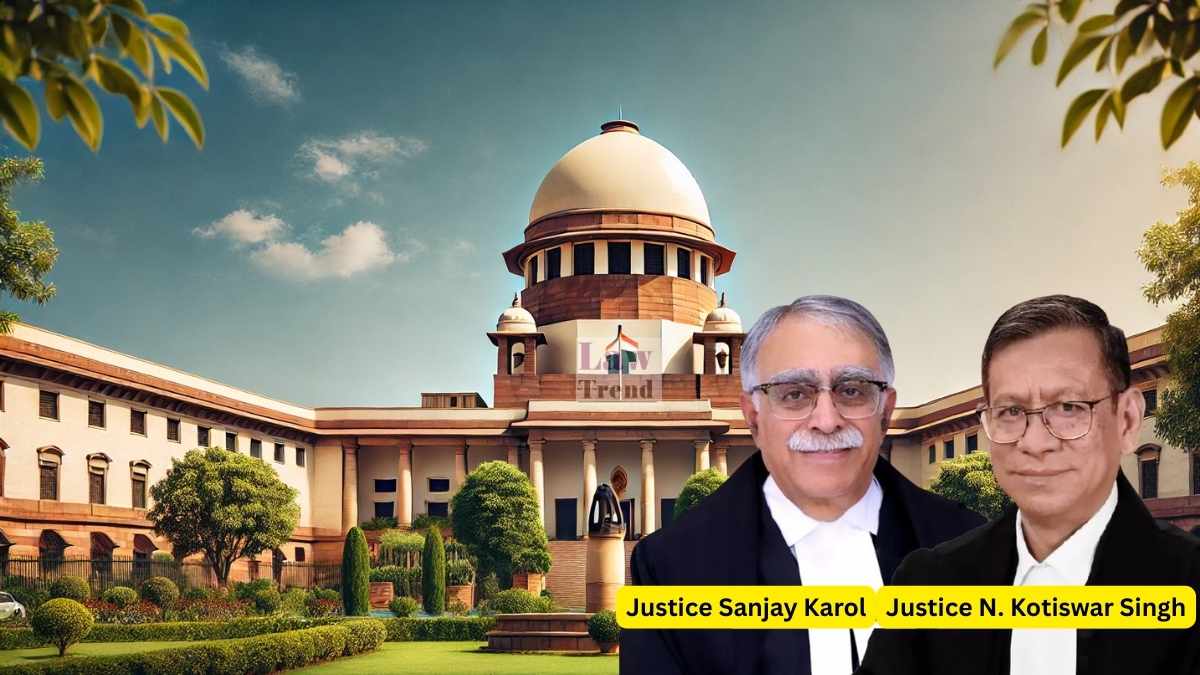
In a significant ruling on the scope of inquest proceedings, the Supreme Court of India has set aside an order of the Allahabad High Court that had granted regular bail to a murder accused. The division bench, comprising Justice Sanjay Karol and Justice Nongmeikapam Kotiswar Singh, ruled that the absence of allegations against an accused during inquest proceedings cannot be used as a ground to doubt their involvement in the crime, as the purpose of an inquest is strictly limited to determining the apparent cause of death.
The Court allowed the appeal filed by the informant, set aside the High Court’s bail order, and remanded the matter back to the Allahabad High Court for fresh, independent consideration. The accused has been directed to surrender to the jail authorities within one week.
Background of the Case
The appeal arose out of a murder case registered under FIR No. 118 of 2025 at Police Station Chhata, District Mathura, Uttar Pradesh. The accused, Kunwarpal Singh (Respondent No. 2), along with two co-accused, is alleged to have murdered Bharat Singh alias Pappu, who was the uncle of the informant and Appellant, Bhagat Singh.
According to the prosecution’s case, on March 8, 2025, at around 10:30 a.m., while the Appellant and his deceased uncle were walking towards their agricultural field, the accused persons emerged from hiding, armed with country-made pistols. They surrounded the deceased, subjected him to verbal abuse, and fired multiple shots, resulting in his instantaneous death.
The FIR was registered on the same day at 6:32 p.m. following the inquest and post-mortem, and Kunwarpal Singh was arrested on March 9, 2025. Following his arrest, a country-made 315 bore pistol and a spent cartridge were recovered at his instance based on his disclosure statement. The police subsequently filed Chargesheet No. 1 of 2025 on May 29, 2025, for offences punishable under Sections 103(1), 352, 351(2), and 3(5) of the Bharatiya Nyaya Sanhita (BNS), 2023, along with Sections 5, 25, and 27 of the Arms Act, 1959.
On September 26, 2025, the Court of Sessions Judge, Mathura, rejected the regular bail application filed by the accused, citing the gravity of the offence, the post-mortem report, and the recovery of the murder weapon.
However, when the accused approached the High Court of Judicature at Allahabad, the High Court granted him regular bail on January 22, 2026. The High Court observed that the informant (the Appellant) and the deceased’s brother, Shivcharan, who acted as Panch witnesses during the inquest, had not made any allegations against the accused at that stage.
Arguments Presented
The Appellant challenged the High Court’s bail order before the Supreme Court, contending that the order was “cryptic, non-speaking and unreasoned.” It was argued that the High Court failed to advert to the material facts, records, and key circumstances of the case, thereby rendering the order perverse and unsustainable in law.
The Court’s Analysis and Precedents
Upon perusing the record, the Supreme Court agreed with the Appellant’s submissions, noting that the High Court’s bail order “suffers from non-application of mind and is cryptic and bereft of substantial reasoning or analysis of the material particulars.”
The Supreme Court highlighted several key facts connecting the accused to the crime:
- The accused was specifically named in the FIR with a direct overt act of firing upon the deceased.
- The post-mortem report recorded ante-mortem firearm injuries (entry and exit wounds with blackening and tattooing) showing death occurred due to shock and hemorrhage resulting from firearm injury.
- The alleged murder weapon (a 315 bore country-made pistol) and a spent cartridge were recovered at his instance during the investigation.
- Statements of multiple witnesses recorded under Section 180 of the Bharatiya Nagarik Suraksha Sanhita (BNSS), 2023, prima facie supported the allegations against the accused.
On the Scope of Inquest Proceedings
The Supreme Court rejected the High Court’s reliance on the absence of allegations in the inquest proceedings to grant bail. The Court clarified that the scope of an inquiry under Section 174 of the Code of Criminal Procedure (CrPC), 1973 (now corresponding to Section 194 of the BNSS, 2023), is a preliminary inquiry of a limited and specific nature, confined solely to determining the apparent cause of death.
To support this position, the bench relied on two landmark judgments:
- Pedda Narayana v. State of A.P. (1975) 4 SCC 153: The Court reproduced the following observation:
“11. A perusal of this provision would clearly show that the object of the proceedings under Section 174 is merely to ascertain whether a person has died under suspicious circumstances or an unnatural death and if so what is the apparent cause of the death. The question regarding the details as to how the deceased was assaulted or who assaulted him or under what circumstances he was assaulted appears to us to be foreign to the ambit and scope of the proceedings under Section 174. In these circumstances, therefore, neither in practice nor in law was it necessary for the police to have mentioned these details in the inquest report…” - Amar Singh v. Balwinder Singh (2003) 2 SCC 518: The Court quoted:
“12. …The section does not contemplate that the manner in which the incident took place or the names of the accused should be mentioned in the inquest report. The basic purpose of holding an inquest is to report regarding the apparent cause of death, namely, whether it is suicidal, homicidal, accidental or by some machinery etc.”
Based on these precedents, the Supreme Court held:
“Thus, non-mentioning of the author of the crime or the person who had caused the death in the inquest report cannot, by itself, be a reason to doubt the involvement of the accused, who may be subsequently named.”
The Court ruled that the Allahabad High Court was unjustified in drawing an adverse inference simply because the informant and another Panch witness did not make allegations against the accused during the inquest proceedings. Furthermore, the bench observed that even if the High Court was to consider the inquest proceedings, it could not view them in isolation while ignoring the chargesheet, the post-mortem report, the weapon recovery, and the witness statements under Section 180 of the BNSS.
The Decision of the Court
The Supreme Court set aside the High Court’s bail order dated January 22, 2026, and remanded the matter back to the Allahabad High Court for fresh consideration.
The Court clarified that it was not expressing any opinion on the merits of the case and directed the High Court to consider the bail application independently. Kunwarpal Singh (Respondent No. 2) has been directed to surrender to the concerned jail authorities within one week and remain in judicial custody until the High Court passes its fresh orders on the bail application.
Case Details:
- Case Title: Bhagat Singh v. The State of Uttar Pradesh and Anr.
- Case No.: Criminal Appeal No. _____ of 2026 (Arising out of Special Leave Petition (Crl.) No. 4240 of 2026)
- Bench: Justice Sanjay Karol and Justice Nongmeikapam Kotiswar Singh
- Date: May 22, 2026