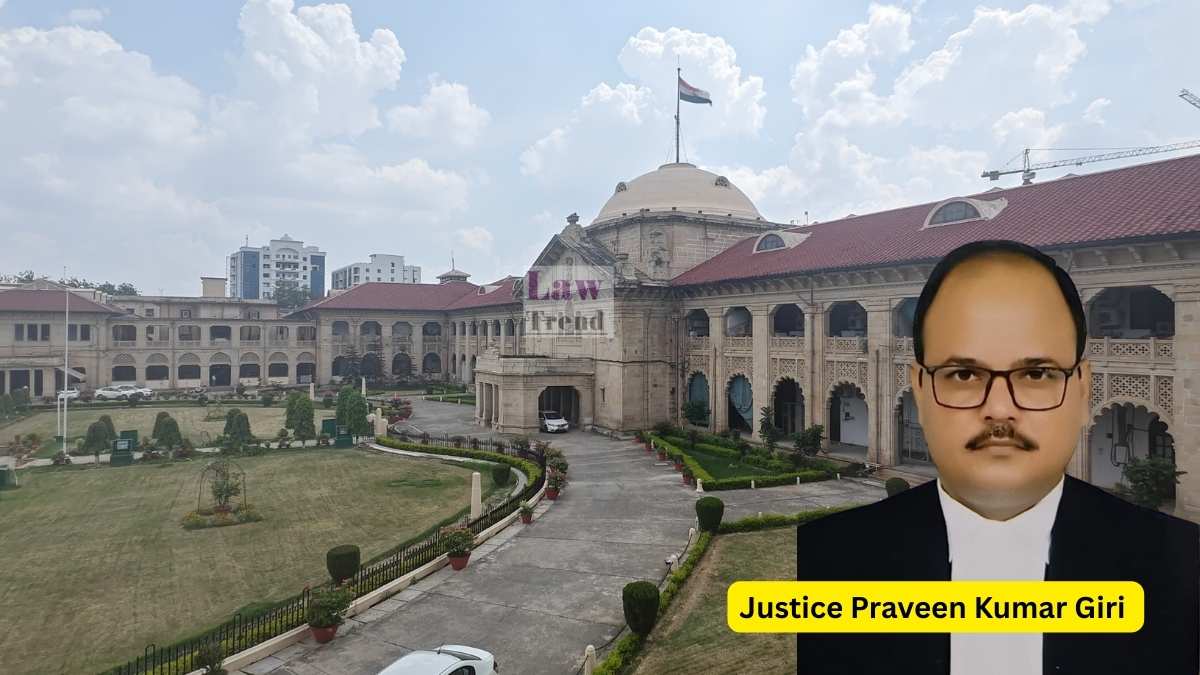
The High Court of Judicature at Allahabad has issued a comprehensive set of guidelines and timelines for the conduct of criminal proceedings, particularly focusing on the “Trial in Absentia” of proclaimed offenders under the newly enacted Bharatiya Nagarik Suraksha Sanhita (BNSS), 2023. Justice Praveen Kumar Giri, while dealing with an application seeking to quash a non-bailable warrant (NBW), emphasized that the law now provides a robust mechanism to ensure that justice is not stalled by absconding accused persons.
The Court held that under Section 356 of the BNSS, if a proclaimed offender absconds to evade trial and there is no immediate prospect of arrest, it shall be deemed as a waiver of their right to be present, allowing the trial to proceed and judgment to be pronounced in their absence.
Background of the Case
The applicant, Ravi alias Ravindra Singh, had approached the High Court under Section 528 of the BNSS (corresponding to Section 482 Cr.P.C.) seeking the quashing of a Non-Bailable Warrant issued on October 18, 2024, by the Additional Sessions Judge, Agra.
The case originated from an F.I.R. lodged on November 24, 2020, under Sections 307 and 504 of the IPC. Although the applicant had been granted bail by the High Court in December 2021 and charges were framed in his presence in February 2024, he subsequently failed to appear before the trial court on several dates. Consequently, the trial court issued an NBW, followed by proclamation orders under Section 82 Cr.P.C. and attachment orders under Section 83 Cr.P.C.
Arguments of the Parties
Counsel for the Applicant: The learned counsel argued that the trial court issued the NBW directly without first issuing a bailable warrant, which he claimed was contrary to law. He further contended that since the applicant was already on bail, the court should have followed the procedure under Section 89 Cr.P.C. (now Section 92 BNSS), involving the forfeiture of the bail bond and notice under Section 446 Cr.P.C. before initiating proclamation and attachment proceedings.
State Counsel (A.G.A.): The learned A.G.A. countered that the applicant was deliberately playing “hide and seek” with the trial court. He pointed out that the applicant was well aware of the proceedings, had charges framed in his presence, and had even successfully moved to recall a previous warrant once before, only to abscond again. He argued that the applicant was intentionally delaying the trial, causing hardship to other co-accused persons.
Court’s Analysis and Observations
The Court observed that the applicant had been absent for approximately 29 dates since October 2024. Analyzing the provisions of the BNSS, Justice Giri noted that Sections 228 and 355 of the BNSS mandate the personal attendance of the accused unless specifically exempted.
The Court highlighted the significance of Section 356 of the BNSS, describing it as a “landmark provision.” The Court noted:
“Section 356 of the Bharatiya Nagarik Suraksha Sanhita (BNSS), 2023… allows a court to proceed with the inquiry, trial, or judgment of an accused person who has been declared a proclaimed offender and is deliberately evading arrest.”
The Court delineated four stages where an accused might abscond and provided specific procedural pathways for each to ensure a speedy trial. It emphasized that for a trial in absentia to commence:
- Two consecutive warrants of arrest must be issued at a 30-day interval.
- A notice must be published in a national or local daily newspaper.
- Relatives or friends must be informed.
- Information must be affixed at the last known residence and displayed at the local police station.
- The trial cannot commence until 90 days have lapsed from the date of framing of charges.
The Court also discussed the “Exclusion” in Section 215(1)(a) of the BNSS regarding Section 209 BNS (non-appearance in response to proclamation), noting that unlike other contempt-related offences, prosecution for non-appearance can proceed through standard police procedures without requiring a formal written complaint from a public servant.
The Decision and Directions
The High Court disposed of the application by keeping the impugned NBW in abeyance for two months to allow the applicant to cooperate with the trial. However, the Court issued a slew of mandatory directions to ensure the effective implementation of the BNSS:
- To Trial Courts: Presiding officers must not grant unnecessary adjournments. Any officer causing delay through negligence or “unavoidable circumstances” may face departmental action.
- To Police: All G.D. entries regarding service of summons and execution of warrants must be uploaded to the official portal (NSTEP/CIS). Failure by police officials to follow these procedures will attract penalties under Section 199 BNS and the Police Act.
- To Prosecutors: Public Prosecutors must assist the court within prescribed timelines. The Directorate of Prosecution is held accountable for monitoring cases carrying sentences of seven years or more.
- To the State Government: The DGP and Director of Prosecution must circulate this order to all concerned authorities within 60 days.
- Time Limits (Luxman Rekha): The Court reiterated the strict timelines under BNSS, such as completing sexual offence trials within 2 months of the chargesheet and pronouncing judgments within 30-45 days of final arguments.
The Court concluded that the new provisions are intended to establish a “Luxman Rekha” for every stage of criminal proceedings to guarantee speedy justice for both the accused and the victim.
Case Details
- Case Title: Ravi Alias Ravindra Singh v. State of U.P. and another
- Case No.: APPLICATION U/S 528 BNSS No. 7980 of 2026
- Bench: Justice Praveen Kumar Giri
- Date: May 5, 2026